Truck parts are the physical sections that allow a truck to move, carry load, steer, stop, and remain stable on the road. Together, these parts connect in a clear mechanical order that supports power transfer, braking control, steering response, visibility, and cargo use. The cab and body form the main outer structure, while the frame supports the load below. At the same time, the engine and drivetrain create movement, and the brake and steering parts guide control.
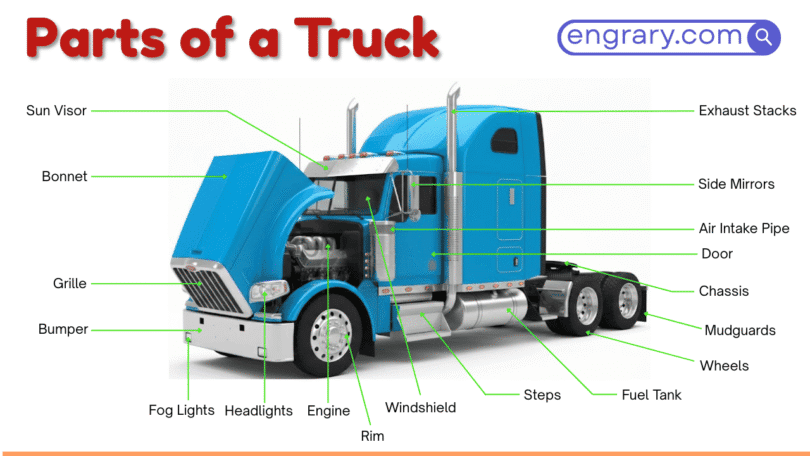
In addition, a labeled diagram shows how these named parts align across the cab, chassis, engine bay, wheel areas, and rear cargo or towing section. As power moves from the engine through the drivetrain, the wheels create forward motion. Meanwhile, the steering, braking, lighting, and towing parts support controlled handling, safe visibility, and stable transport across standard truck designs.
Parts of a Truck With Labeled Diagram
Parts of a truck with labeled diagram refer to the truck’s main sections and named parts shown clearly in one view. Together, this labeled layout helps identify where each part sits from the front body and engine area to the frame, wheels, and rear towing section.
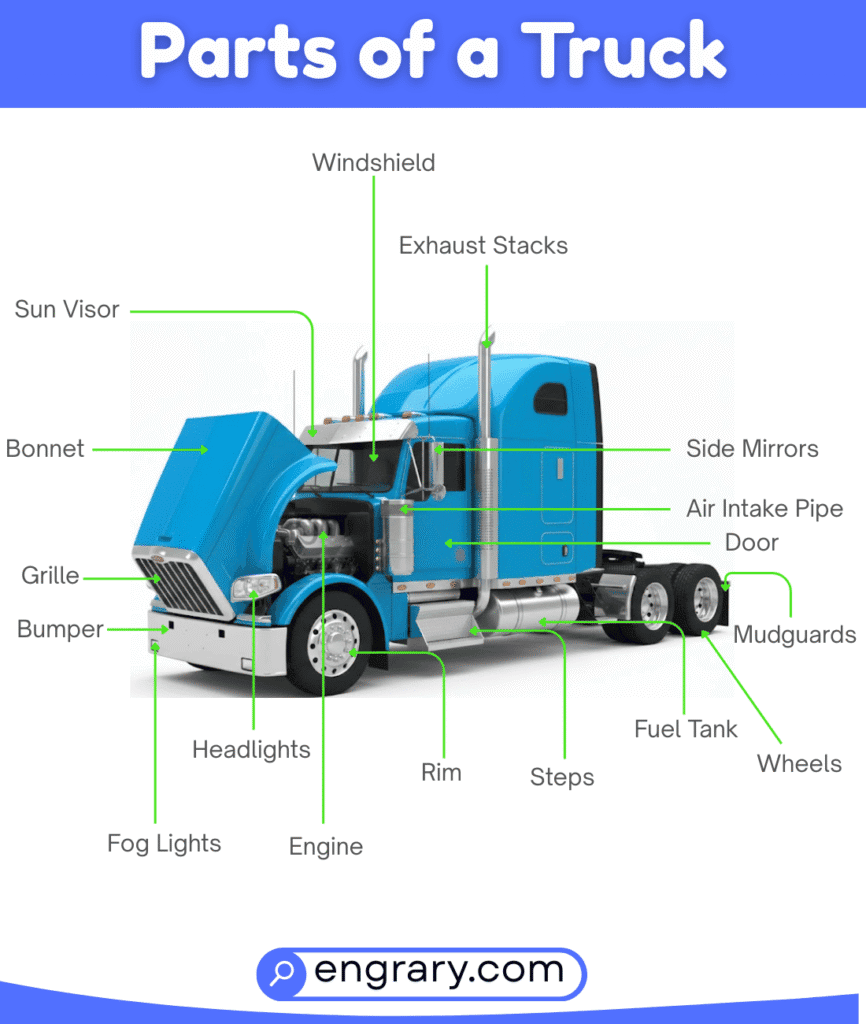
Cab and Body Parts
Cab and body parts form the main outer shell of the truck. Together, these parts protect the driver area, support access, and shape the truck’s visible front and side structure.
Cab
The cab is the main driver compartment of the truck. It holds the seat, controls, and interior space for driving.
Hood
The hood is the front cover that opens over the engine area. It protects the engine bay and allows access when lifted.
Grille
The grille is the front opening or front panel area that allows airflow toward the radiator area. It also forms a main front-face feature.
Bumper
The bumper is the protective front or rear bar or panel. It helps reduce minor impact to the outer body.
Fender
The fender is the outer body panel around the wheel opening. It helps block mud and road spray from the tire area.
Mud Flap
The mud flap is the flexible guard mounted behind a wheel. It reduces spray and debris thrown backward by the tire.
Door
The door is the side panel that opens for entry and exit. It provides controlled access to the cab.
Cab Door Handle
The cab door handle is the grip part used to open the door. It supports pulling or releasing the door latch.
Windshield
The windshield is the front glass panel that supports forward visibility. It protects the cab from wind, dust, and rain.
Wiper / Wiper Blade
The wiper is the moving blade fitted on the windshield. It clears water and debris to maintain visibility.
Mirror
The mirror is the reflective part mounted on the cab. It helps the driver see behind and along the sides.
Step / Running Board
The step or running board is the foothold below the door. It supports easier entry and exit.
Roof
The roof is the top covering of the cab. It protects the interior space and forms the upper outer surface.
Sleeper Cab
The sleeper cab is the extended rear cab space on many long-haul trucks. It provides resting space behind the driver area.
Chassis and Frame Parts
Chassis and frame parts form the main load-carrying base of the truck. Together, these parts support the body and drivetrain, while also holding major systems in alignment during movement.
Chassis
The chassis is the lower structural base of the truck. It supports the body, engine, suspension, and other major parts.
Frame Rails
The frame rails are the long main beams that run along the length of the truck. They carry load and form the main frame structure.
Frame Horn
The frame horn is the front extension of the frame rails. It supports mounting points near the front section.
Crossmembers
Crossmembers are the horizontal support bars that connect the frame rails. They add stiffness and help keep the frame stable.
Mounting Bracket
The mounting bracket is the support piece used to attach parts to the frame. It holds components in position under load.
Subframe
The subframe is a secondary support frame used on some trucks. It helps carry specific mounted systems or body sections.
Engine and Cooling Parts
Engine and cooling parts create power and control operating temperature. Together, these parts support combustion flow, cooling circulation, and stable engine performance.
Engine
The engine is the main power-producing part of the truck. It creates the force that moves the vehicle.
Oil Pan
The oil pan is the lower container attached under the engine. It holds engine oil during operation.
Oil Filter
The oil filter cleans the engine oil as it circulates. It helps reduce dirt and particles in the oil flow.
Air Intake
The air intake is the path that brings air into the engine system. It supports the airflow needed for combustion.
Air Filter
The air filter cleans incoming air before it enters the engine. It helps reduce dust and debris in the airflow.
Turbocharger
The turbocharger forces more air into the engine. It increases power by boosting air intake pressure.
Intercooler
The intercooler cools compressed air from the turbocharger. It helps improve air density before the air enters the engine.
Radiator
The radiator releases heat from the cooling system. It helps control engine temperature during use.
Cooling Fan
The cooling fan pulls or pushes air through the radiator. It supports cooling airflow when the truck moves slowly or idles.
Fan Shroud
The fan shroud guides airflow through the radiator area. It helps the fan pull air more effectively.
Water Pump
The water pump moves coolant through the engine and radiator. It supports cooling circulation.
Thermostat
The thermostat controls coolant flow based on temperature. It helps the engine reach and maintain proper operating heat level.
Serpentine Belt / Drive Belt
The drive belt transfers rotation to engine accessories. It helps run parts such as the fan or water pump on many setups.
Fuel and Exhaust Parts
Fuel and exhaust parts supply fuel to the engine and release exhaust gases. Together, these parts support fuel flow, combustion support, emissions control, and exhaust exit.
Fuel Tank
The fuel tank stores fuel for the truck. It supports continued operation by holding the fuel supply.
Fuel Pump
The fuel pump moves fuel from the tank toward the engine. It supports steady fuel delivery during operation.
Fuel Filter
The fuel filter removes dirt and particles from fuel. It helps protect the fuel system and engine feed path.
Fuel Line
The fuel line carries fuel from the tank to the engine system. It supports fuel movement through the vehicle.
Fuel Injector
The fuel injector sprays fuel into the engine for combustion. It supports controlled fuel delivery in modern systems.
Fuel Rail
The fuel rail is the fuel supply tube that feeds multiple injectors. It distributes fuel to the injectors evenly.
DEF Tank
The DEF tank stores diesel exhaust fluid on many diesel trucks. It supports emissions control by supplying fluid to the exhaust treatment system.
Exhaust Manifold
The exhaust manifold collects exhaust gases from the engine. It directs the gases into the exhaust path.
Exhaust Pipe
The exhaust pipe carries exhaust gases away from the engine. It routes the gases toward the rear exit.
Catalytic Converter
The catalytic converter is the exhaust treatment part that reduces harmful gases. It supports cleaner exhaust output on many systems.
DPF
The diesel particulate filter traps soot in diesel exhaust systems. It helps reduce particulate emissions in diesel trucks.
EGR Valve
The EGR valve controls exhaust gas recirculation in many engines. It helps manage emissions by redirecting some exhaust back into the intake path.
SCR / DEF System
The SCR system uses diesel exhaust fluid to reduce emissions. It supports nitrogen oxide reduction in many diesel exhaust setups.
Muffler
The muffler reduces exhaust noise. It helps quiet the exhaust flow as gases exit.
Tailpipe
The tailpipe is the final outlet section of the exhaust system. It releases exhaust gases out of the truck.
Drivetrain and Power Transfer Parts
Drivetrain parts transfer engine power to the wheels. Together, these parts carry rotation through gears and shafts to create forward movement.
Transmission
The transmission controls gear range and transfers engine power. It supports speed and torque changes during driving.
Clutch
The clutch connects or disconnects engine power from the transmission in manual trucks. It supports smooth starts and gear changes.
Torque Converter
The torque converter transfers engine power in automatic transmissions. It supports smooth power delivery without a manual clutch.
Transfer Case
The transfer case splits power to front and rear axles on many 4×4 trucks. It supports four-wheel drive operation.
Driveshaft / Propeller Shaft
The driveshaft is the rotating shaft that carries power from the transmission to the axle system. It supports power transfer toward the drive wheels.
U-Joint
The U-joint is the flexible joint on the driveshaft. It allows rotation through angle changes as suspension moves.
Differential
The differential helps deliver power to the wheels while allowing different wheel speeds in turns. It supports smoother turning under drive power.
Axle Shaft
The axle shaft transfers power from the differential to the wheel hub area. It supports wheel rotation under load.
CV Joint
The CV joint is the flexible joint used on some axle setups. It supports smooth rotation through steering and suspension movement.
PTO
The PTO is the power take-off connection used on some work trucks. It transfers engine power to external equipment systems.
Axles, Wheels, and Suspension Parts
Axles, wheels, and suspension parts support road contact and load balance. Together, these parts carry truck weight, absorb road impact, and keep wheel motion controlled during driving.
Steering Axle
The steering axle is the front axle that supports turning control. It helps guide the truck’s direction.
Drive Axle
The drive axle is the axle that receives power to move the truck. It supports driven wheel rotation under load.
Tag Axle
The tag axle is an extra supporting axle on some trucks. It helps carry added load and improve stability.
Leaf Spring
The leaf spring is a layered spring used on many trucks. It supports heavy load and absorbs road impact.
Air Suspension
Air suspension uses air bags to support load and smooth ride movement. It helps manage ride height and shock control on many heavy trucks.
Air Bag
The air bag is the flexible air-filled support used in air suspension systems. It carries load and absorbs vibration.
Shock Absorber
The shock absorber controls bounce and rebound from the suspension. It helps keep the truck stable after bumps.
Sway Bar / Stabilizer Bar
The sway bar helps reduce side-to-side body roll. It supports steadier handling during turns.
Torque Rod / Radius Rod
The torque rod helps control axle movement under load. It supports axle alignment during acceleration and braking.
Wheel
The wheel is the rotating circular part that supports movement. It carries the tire and supports rolling motion.
Tire
The tire is the rubber covering fitted on the wheel. It provides traction and road grip.
Rim
The rim is the hard outer ring that holds the tire in place. It forms the main outer wheel structure.
Hub
The hub is the central wheel part that connects to the axle. It supports wheel rotation around the axle.
Wheel Bearing
The wheel bearing supports smooth wheel rotation at the hub. It reduces friction and helps the wheel spin freely.
Control Arm
The control arm is a suspension link used on some trucks, especially front setups. It helps guide wheel movement and alignment.
Brake System Parts
Brake system parts reduce speed and support controlled stopping. Together, these parts apply friction, transmit force, and help the truck stop safely under load.
Brake Pedal
The brake pedal is the foot control used to activate braking. It sends braking force into the brake system.
Master Cylinder
The master cylinder creates hydraulic pressure in hydraulic brake systems. It sends braking pressure through brake lines.
Brake Booster
The brake booster increases braking force from the pedal input. It helps reduce driver effort during braking.
Brake Line
The brake line carries hydraulic fluid pressure to the brakes. It supports force transfer in hydraulic systems.
Air Compressor
The air compressor builds air pressure for air brake systems. It supplies compressed air to the brake system.
Air Tank / Reservoir
The air tank stores compressed air for air brakes. It supports steady braking pressure supply.
Air Line
The air line carries compressed air to brake components. It supports air pressure transfer in air brake systems.
Brake Chamber
The brake chamber converts air pressure into mechanical brake force. It helps apply braking on air brake systems.
Brake Drum
The brake drum is the round braking surface used in drum brakes. It works with brake shoes to reduce wheel rotation.
Brake Disc
The brake disc is the rotating braking surface used in disc brakes. It works with pads and a caliper to slow the wheel.
Brake Rotor
The brake rotor is another common name for the brake disc. It refers to the same rotating braking surface.
Brake Shoe
The brake shoe is the friction part used inside a brake drum. It presses outward to slow the drum.
Brake Pad
The brake pad is the friction part that presses against a brake disc. It reduces wheel speed through controlled friction.
Brake Caliper
The brake caliper is the braking part that clamps the brake pads onto the disc. It creates friction for stopping.
Brake Caliper Bracket
The caliper bracket supports caliper alignment and mounting. It helps hold the caliper in the correct position.
ABS Sensor
The ABS sensor detects wheel speed for the anti-lock brake system. It helps prevent wheel lock during hard braking.
Parking Brake
The parking brake holds the truck in place when parked. It helps prevent rolling when stopped.
Steering and Control Parts
Steering and control parts guide direction and support stable handling. Together, these parts transfer steering input through linkages so the front wheels can turn in a controlled way.
Steering Wheel
The steering wheel is the main driver control used to turn the truck. It directs steering input during driving.
Steering Column
The steering column connects the steering wheel to the steering system below. It supports control transfer from the driver.
Steering Gearbox
The steering gearbox converts steering wheel rotation into steering movement. It sends motion into steering linkages.
Power Steering Pump
The power steering pump supplies hydraulic assist for steering. It helps reduce steering effort during turns.
Pitman Arm
The pitman arm connects the steering gearbox to the steering linkage. It moves the linkage as the driver turns the wheel.
Drag Link
The drag link transfers motion from the pitman arm to the steering system. It helps move the wheels left or right.
Tie Rod
The tie rod connects steering linkages across the axle. It helps keep both front wheels aligned during steering.
Tie Rod End
The tie rod end is the joint at the end of a tie rod. It allows movement while maintaining steering connection.
Idler Arm
The idler arm supports the steering linkage on some setups. It helps keep the linkage stable during steering movement.
Steering Knuckle
The steering knuckle is the part that connects the wheel hub area to the steering system. It supports wheel turning at the front end.
Ball Joint
The ball joint is the pivot joint that supports steering and suspension movement. It helps allow controlled turning and vertical motion.
Electrical and Lighting Parts
Electrical and lighting parts supply power and support visibility. Together, these parts start the truck, run electrical systems, and provide road lighting and signals.
Battery
The battery supplies stored electrical power. It supports starting and electrical operation.
Alternator
The alternator generates electrical power while the engine runs. It helps charge the battery and supply power.
Starter Motor
The starter motor turns the engine during starting. It helps begin engine operation.
Wiring Harness
The wiring harness is the grouped set of electrical wires in the truck. It connects electrical systems through organized wiring paths.
Fuse Box
The fuse box holds fuses that protect electrical circuits. It supports circuit safety and power control.
Relay
The relay is the electrical switch that controls higher power circuits. It helps manage controlled electrical flow.
ECU / Engine Control Module
The ECU is the control unit that manages engine and system signals. It supports electronic control of engine operation.
Headlight
The headlight is the front light used to illuminate the road. It supports forward visibility in low light.
Headlight Bulb
The headlight bulb is the light source inside the headlight unit. It produces the light output for the headlamp.
Taillight
The taillight is the rear light that makes the truck visible from behind. It supports rear visibility.
Tail Light Lens
The tail light lens is the outer cover of the rear light unit. It protects the light and shapes light output.
Indicator / Turn Signal
The indicator is the signal light used to show turning direction. It alerts other road users during turning.
Brake Light
The brake light is the rear light that turns on during braking. It signals that the truck is slowing down or stopping.
Marker Light
The marker light is the small outer light used to show vehicle edges on many trucks. It supports visibility along the truck outline.
Cargo, Bed, and Towing Parts
Cargo, bed, and towing parts support load carrying and connection to trailers. Together, these parts help the truck transport items, secure cargo space, and connect towing equipment.
Bed / Cargo Body
The bed or cargo body is the rear load area of the truck. It holds cargo and supports transport use.
Tailgate
The tailgate is the rear panel that opens on many pickup trucks. It supports access to the bed and helps contain cargo.
Toolbox
The toolbox is the storage box fitted in the bed or on the body of many work trucks. It holds tools and work equipment.
Tow Hitch
The tow hitch is the rear towing connection used to pull trailers. It supports towing attachment behind the truck.
Trailer Coupler
The trailer coupler is the connecting socket on a trailer. It fits onto the hitch ball to connect the trailer to the truck.
Safety Chain
The safety chain is the backup chain connection used in towing. It helps keep the trailer connected if the main coupling fails.
Fifth Wheel
The fifth wheel is the heavy-duty coupling plate used on semi trucks. It connects the tractor to the trailer through the kingpin.
Kingpin
The kingpin is the main trailer pin that locks into the fifth wheel. It forms the core connection point between tractor and trailer.
Trailer Connector
The trailer connector is the electrical plug connection between truck and trailer. It supports trailer lights and signal power.
Air Lines
Air lines are the hose connections used on many semis. They supply air for trailer brakes and related systems.
Truck Parts Names Key Takeaways
Truck parts names are grouped into cab, frame, engine, fuel and exhaust, drivetrain, axles, brakes, steering, electrical, and cargo sections. Together, these groups form the main working build of a standard truck. The cab and frame support structure and access, while engine and drivetrain parts create movement. At the same time, axle, suspension, steering, and brake parts guide handling and stopping control. In addition, electrical parts support power and visibility, and cargo and towing parts support load carrying and trailer connection. As these sections work together, the truck carries weight, moves steadily, and remains controlled on the road.
FAQs
The main parts of a truck include the cab, frame, engine, transmission, axles, suspension, brakes, steering parts, lights, and cargo or towing parts. Together, these parts support transport and control.
The engine makes a truck move by creating power. That power then passes through the transmission and drivetrain to the drive axle and wheels.
Truck steering uses the steering wheel, steering gearbox, pitman arm, drag link, tie rod, and steering knuckle. Together, these parts turn the front wheels in a controlled way.
Truck brake parts include the brake pedal, hydraulic or air system parts, brake lines, drums or discs, pads or shoes, calipers, and parking brake. These parts reduce speed and support stopping.
A semi truck connects to a trailer using the fifth wheel and kingpin. Air lines and trailer connectors also link braking and electrical systems between the truck and trailer.
You May Also Like