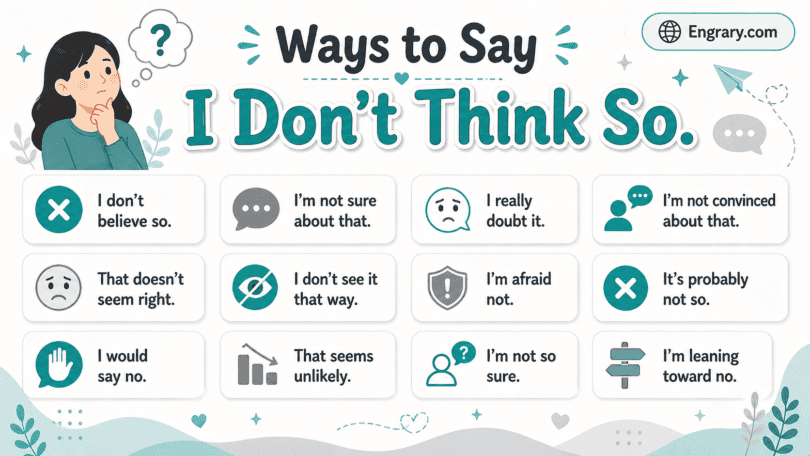
I don’t think so is a common English phrase, but it can mean different things depending on the situation. Sometimes it shows mild doubt, sometimes polite disagreement, and sometimes a soft or firm no. Because of that, using the right alternative can help you sound more natural, more respectful, or more direct.
This guide shares different ways to say I don’t think so in English, along with simple meanings and examples. You will also see which phrases work best in casual conversations, friendly situations, workplace communication, and texts or chats.
Common Alternatives to I Don’t Think So
These are some of the most common and useful alternatives to I don’t think so. They work well in many everyday situations.
- I don’t think so: the standard phrase for doubt, disagreement, or a soft no.
Example: Do you think they’ll finish today? I don’t think so. - I doubt it: useful when something seems unlikely.
Example: Will he change his mind? I doubt it. - Probably not: a natural way to give a likely no.
Example: Are they coming with us? Probably not. - I’m not sure about that: softer and less direct.
Example: Is that really the best idea? I’m not sure about that. - I don’t believe so: a slightly more polished alternative.
Example: Is this the final version? I don’t believe so. - I don’t see it that way: useful when you have a different opinion.
Example: I don’t see it that way. - I’m not convinced: good when you still have doubts.
Example: I’m not convinced that will work. - That doesn’t seem right: useful when something sounds incorrect.
Example: That doesn’t seem right to me. - I’m afraid not: polite and common in careful responses.
Example: Is there another seat available? I’m afraid not. - I don’t think that’s right: clear when you think something is mistaken.
Example: I don’t think that’s right.

Polite and Formal Ways to Say I Don’t Think So
These phrases work best when you want to sound respectful, careful, or more formal.
- I’m afraid not: one of the safest polite alternatives.
Example: Is that still available? I’m afraid not. - I don’t believe so: formal and measured.
Example: Has the issue been resolved? I don’t believe so. - I’m not sure that’s correct: useful when questioning something politely.
Example: I’m not sure that’s correct. - I would disagree with that: formal and direct without sounding too harsh.
Example: I would disagree with that conclusion. - That does not appear to be the case: polished and professional.
Example: That does not appear to be the case. - I’m not convinced that’s right: careful and respectful.
Example: I’m not convinced that’s right. - I don’t think that would be accurate: useful in thoughtful or formal disagreement.
Example: I don’t think that would be accurate. - I would have to say no: firm but polite.
Example: I would have to say no. - I respectfully disagree: one of the best formal disagreement phrases.
Example: I respectfully disagree with that assessment. - That’s not my understanding: useful when the disagreement is about facts or interpretation.
Example: That’s not my understanding.
Casual and Everyday Ways to Say I Don’t Think So
These phrases sound relaxed and natural in daily conversation.
- I don’t think so: still one of the most common casual choices.
Example: I don’t think so. - Probably not: simple and natural.
Example: Is she coming? Probably not. - Not really: short and common in speech.
Example: Do you like it? Not really. - I doubt it: casual but clear.
Example: Will they agree? I doubt it. - Nah: very casual and best with friends.
Example: Nah, I don’t think so. - Nope: short and informal.
Example: Nope. - I’m not sure about that: softer and conversational.
Example: I’m not sure about that. - I don’t buy that: informal and a little stronger.
Example: I don’t buy that excuse. - I don’t see it: useful when you are not convinced.
Example: I don’t see it. - That’s not it: casual and dismissive, but common in speech.
Example: That’s not it.
Friendly or Softer Ways to Say I Don’t Think So
These phrases help you disagree or say no without sounding too sharp.
- I’m not so sure: gentle and thoughtful.
Example: I’m not so sure about that. - I’m not sure about that: soft and easy to use.
Example: I’m not sure about that. - I don’t think that’s the case: calm and polite.
Example: I don’t think that’s the case. - I see it a little differently: useful when you want to focus on perspective.
Example: I see it a little differently. - I’m not fully convinced: polite and measured.
Example: I’m not fully convinced. - That’s one way to look at it: gentle and indirect.
Example: That’s one way to look at it. - I’m not sure I’d say yes: soft and careful.
Example: I’m not sure I’d say yes. - I don’t quite agree: friendly and not too strong.
Example: I don’t quite agree. - I’m leaning no: useful when you want to sound cautious.
Example: I’m leaning no on that idea. - I’m not sure that’s right: soft but still clear.
Example: I’m not sure that’s right.
Professional Alternatives to I Don’t Think So at Work
These phrases work especially well with coworkers, managers, clients, or in meetings.
- I’m not sure that aligns with the goal: useful in strategic discussions.
Example: I’m not sure that aligns with the goal. - I don’t believe that’s the best option: professional and clear.
Example: I don’t believe that’s the best option. - I would take a different view: formal and thoughtful.
Example: I would take a different view on that. - I’m not convinced that approach will work: constructive and professional.
Example: I’m not convinced that approach will work. - That does not appear to be the case: polished and measured.
Example: That does not appear to be the case. - I’d suggest another direction: useful when offering a better option.
Example: I’d suggest another direction. - I see your point, but I would not recommend that: respectful and practical.
Example: I see your point, but I would not recommend that. - I’m not sure that would be appropriate: good for careful workplace disagreement.
Example: I’m not sure that would be appropriate. - I would question that conclusion: suitable for meetings and reviews.
Example: I would question that conclusion. - I think there may be a better option: constructive and collaborative.
Example: I think there may be a better option.
Ways to Say I Don’t Think So in Texts and Chats
These phrases are short, natural, and easy to use in messages.
- I don’t think so: still very common in chat.
Example: I don’t think so. - Probably not: quick and natural.
Example: Probably not. - Nah: very casual and common in messages.
Example: Nah. - Nope: short and informal.
Example: Nope. - Not really: common for a soft no.
Example: Not really. - Don’t think so: a shorter text-style version.
Example: Don’t think so. - I doubt it: useful for skepticism.
Example: I doubt it. - Not likely: simple and clear.
Example: Not likely. - Not convinced: useful when you still have doubts.
Example: Not convinced. - Doesn’t seem like it: natural and conversational.
Example: Doesn’t seem like it.
Strong or Direct Ways to Say I Don’t Think So
Sometimes you want your response to sound firm and unmistakable.
- Absolutely not: very strong and direct.
Example: Absolutely not. - No way: strong and emotional.
Example: No way. - I strongly disagree: direct and forceful.
Example: I strongly disagree. - That’s simply not true: strong when rejecting a claim.
Example: That’s simply not true. - I reject that: firm and direct.
Example: I reject that idea. - I don’t agree at all: strong and clear.
Example: I don’t agree at all. - That’s definitely not right: firm and emphatic.
Example: That’s definitely not right. - I firmly disagree: formal but forceful.
Example: I firmly disagree. - Not a chance: strong and casual.
Example: Not a chance. - I couldn’t disagree more: one of the strongest natural phrases.
Example: I couldn’t disagree more.
How to Choose the Right I Don’t Think So Phrase
Choose the phrase based on how strong your doubt or disagreement is. If you want to sound soft and careful, phrases like I’m not so sure or I’m not sure about that work well. For everyday casual disagreement, probably not, I doubt it, or not really are natural choices. In formal or professional situations, I’m afraid not, I respectfully disagree, or that does not appear to be the case sound more polished. When you need to be firm, absolutely not or I strongly disagree may fit better.
It also helps to think about whether you mean mild doubt, soft refusal, skepticism, or direct rejection.
What to Say Instead of I Don’t Think So in Different Situations
Sometimes the best phrase depends on the exact situation.
- I doubt it: best for mild doubt.
- Probably not: best for a likely no.
- I’m afraid not: best for polite refusal.
- I’m not sure about that: best for soft disagreement.
- I don’t believe so: best for careful or formal disagreement.
- I see it differently: best for a different perspective.
- I’m not convinced: best when you still have doubts.
- That does not appear to be the case: best for professional use.
- Absolutely not: best for strong rejection.
- I think there may be a better option: best for constructive workplace pushback.
Summary
There are many ways to say I don’t think so in English. Some sound casual, some formal, some professional, and some much stronger.
The best phrase depends on whether you want to show mild doubt, soft no, skepticism, professional disagreement, or strong rejection. Once you understand the tone behind each option, it becomes much easier to choose the right one naturally.
FAQs
Another way to say I don’t think so is I doubt it, probably not, or I’m not sure about that. The best choice depends on whether you want to sound casual, polite, or stronger.
Polite alternatives include I’m afraid not, I don’t believe so, and I respectfully disagree. These work best when you want to sound careful and respectful.
Friendly ways to say I don’t think so include I’m not so sure, I don’t quite agree, and I see it a little differently. These sound softer and less harsh.
At work, you can say I’m not sure that aligns with the goal, I don’t believe that’s the best option, or I think there may be a better option. These sound clearer and more professional than a blunt reply.
Strong ways to say I don’t think so include absolutely not, no way, and I strongly disagree. These are best when you want to sound firm and direct.
You May Also Like