“I’m not sure” is used to express uncertainty, low confidence, incomplete information, hesitation, or careful doubt. It is honest and natural, but the best alternative depends on tone, situation, confidence level, and whether you need to check facts, make a decision, or disagree softly.
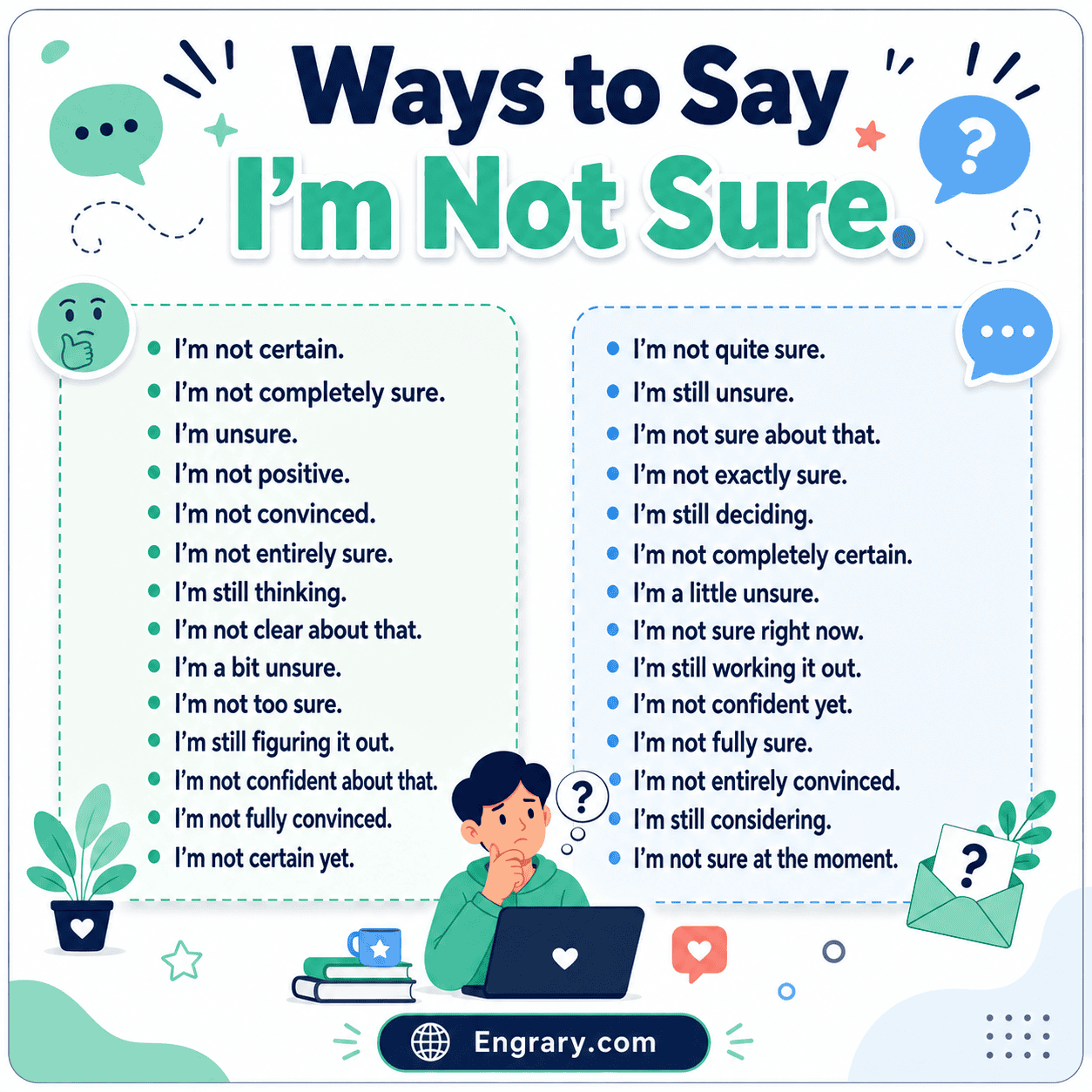
Below, you’ll find 90 natural ways to say “I’m not sure” for work, texts, emails, polite conversations, casual chats, decisions, fact-checking, and soft disagreement. Each phrase includes a short meaning and a simple example.
Best I’m Not Sure Phrase by Situation
| Situation | Better Phrase |
|---|---|
| Simple uncertainty | I can’t say for sure. |
| Polite reply | I’m not entirely sure. |
| Work email | Let me confirm that first. |
| Client message | I’ll verify and get back to you. |
| Casual text | Not sure yet. |
| Need to check facts | I’ll double-check and let you know. |
| Soft disagreement | I’m not convinced yet. |
| Decision hesitation | I’m still thinking it over. |
| Avoiding a guess | I don’t want to guess. |
| Low confidence | I’m not 100% sure. |
I’m Not Sure vs I Don’t Know vs I’ll Check
| Phrase | Tone | Best Use |
|---|---|---|
| I’m not sure | Polite, cautious, and uncertain. | When you have partial knowledge or low confidence. |
| I don’t know | Direct and clear. | When you have no answer or information. |
| I’ll check | Helpful and action-focused. | When you can verify the answer later. |
| I can’t say for sure | Careful and honest. | When you do not want to overstate confidence. |
Is “I’m Not Sure” Polite and Professional?
“I’m not sure” is polite and natural in most conversations. It sounds honest when you do not want to give a wrong answer or pretend you know something.
In professional settings, it is better to pair uncertainty with action. For example, Let me confirm that first, I’ll verify and get back to you, or I’ll double-check and let you know sounds more responsible than simply saying I’m not sure.
Simple Alternatives to I’m Not Sure
Use these phrases for everyday uncertainty.
I’m uncertain
A simple phrase for saying you do not feel fully sure.
Example: I’m uncertain about the answer.
I’m not certain
A clear phrase for mild doubt or low confidence.
Example: I’m not certain that’s correct.
I can’t say for sure
A careful phrase when you do not want to give a definite answer.
Example: I can’t say for sure.
I’m not entirely sure
A polite phrase for partial uncertainty.
Example: I’m not entirely sure about that.
That’s hard to say
A natural phrase when the answer is difficult or unclear.
Example: That’s hard to say without more details.
I don’t know for sure
A simple phrase for honest uncertainty.
Example: I don’t know for sure.
I’m not positive
A natural phrase when you have some doubt.
Example: I’m not positive that this is the right file.
I’m unsure
A short and clear phrase for uncertainty.
Example: I’m unsure about the next step.
I’m not clear on that
A useful phrase when you do not fully understand or know something.
Example: I’m not clear on that yet.
I can’t give a definite answer
A clear phrase when you cannot answer with certainty.
Example: I can’t give a definite answer right now.
Polite Ways to Say I’m Not Sure
Use this section when you want to sound respectful and careful.
I’m not 100% sure
A polite phrase for low confidence.
Example: I’m not 100% sure.
I’m afraid I’m not sure
A gentle phrase for polite uncertainty.
Example: I’m afraid I’m not sure.
I don’t have a definite answer
A clear phrase when you cannot answer with certainty.
Example: I don’t have a definite answer yet.
I can’t say for certain
A careful phrase for avoiding overconfidence.
Example: I can’t say for certain.
I’d need to check first
A polite phrase when you need to verify information.
Example: I’d need to check first.
I’m not quite sure
A softer phrase for uncertainty.
Example: I’m not quite sure what happened.
I may be wrong, but…
A careful phrase before sharing an uncertain thought.
Example: I may be wrong, but I think the meeting starts at 2.
I’m not fully confident about that
A clear phrase for limited confidence.
Example: I’m not fully confident about that answer.
I could be mistaken
A polite phrase before giving an uncertain idea.
Example: I could be mistaken, but I think she already replied.
I’m not completely sure yet
A careful phrase when your answer may change later.
Example: I’m not completely sure yet.
Professional Phrases for Work and Emails
Use these phrases for coworkers, clients, managers, meetings, reports, and email replies.
I’ll need to double-check that
A professional phrase for verifying information.
Example: I’ll need to double-check that.
Let me confirm that first
A polished phrase before giving an answer.
Example: Let me confirm that first.
I’ll verify and get back to you
A responsible phrase for client or work communication.
Example: I’ll verify and get back to you.
I don’t have the full information yet
A professional phrase when details are incomplete.
Example: I don’t have the full information yet.
I’ll follow up once I confirm
A useful phrase when you need to check and respond later.
Example: I’ll follow up once I confirm.
I’ll look into it and let you know
A helpful work-safe phrase.
Example: I’ll look into it and let you know.
I need to review the details first
A professional phrase before giving a careful answer.
Example: I need to review the details first.
I can provide a better answer after checking
A clear phrase that promises accuracy.
Example: I can provide a better answer after checking.
I’ll confirm the details and follow up
A polished phrase for emails and meetings.
Example: I’ll confirm the details and follow up.
I want to make sure I answer accurately
A professional phrase that shows care and responsibility.
Example: I want to make sure I answer accurately.
Casual Ways to Say I’m Not Sure
Use these phrases for friends, family, classmates, and everyday chats.
Not sure
A short casual phrase for uncertainty.
Example: Not sure.
I’m not positive
A relaxed phrase when you are unsure.
Example: I’m not positive.
Maybe, but I’m not sure
A casual phrase for uncertain possibility.
Example: Maybe, but I’m not sure.
Could be
A short casual phrase when something is possible.
Example: Could be.
Hard to say
A relaxed phrase when the answer is unclear.
Example: Hard to say.
I’m not sure yet
A phrase for uncertainty that may change later.
Example: I’m not sure yet.
I don’t really know
A casual phrase for not having an answer.
Example: I don’t really know.
I’m still figuring it out
A casual phrase when you are still thinking or learning.
Example: I’m still figuring it out.
I’m not totally sure
A natural casual phrase for partial uncertainty.
Example: I’m not totally sure.
Maybe, I need to check
A casual phrase when something is possible but needs confirmation.
Example: Maybe, I need to check.
Short Text Replies and Quick Uncertainty Phrases
Use these short phrases for messages, chats, comments, and quick replies.
Not sure.
Use this for a short uncertain reply.
Maybe.
Use this when something is possible but not definite.
Could be.
Use this when you think something might be true.
I’ll check.
Use this when you can verify the answer.
Not sure yet.
Use this when you may know later.
Hard to say.
Use this when the answer is unclear.
I need to check.
Use this when you do not want to guess.
No clue yet.
Use this casually with friends.
Maybe not.
Use this when you think something may be false.
I’ll ask.
Use this when someone else may know the answer.
Ways to Say You Need to Check First
Use this section when you do not want to guess or give the wrong answer.
Let me check first
A simple phrase for verifying information.
Example: Let me check first.
I need to verify that
A clear phrase for checking accuracy.
Example: I need to verify that.
I’ll double-check and let you know
A helpful phrase that promises a follow-up.
Example: I’ll double-check and let you know.
Let me confirm before I answer
A careful phrase for responsible communication.
Example: Let me confirm before I answer.
I don’t want to guess
A direct phrase for avoiding a wrong answer.
Example: I don’t want to guess.
I should check the details first
A practical phrase when more information is needed.
Example: I should check the details first.
Let me look into that
A professional and natural phrase for checking.
Example: Let me look into that.
I’ll confirm the details first
A careful phrase for accuracy.
Example: I’ll confirm the details first.
I need to check the source first
A useful phrase when accuracy matters.
Example: I need to check the source first.
Let me verify before I say yes
A careful phrase before confirming something.
Example: Let me verify before I say yes.
Ways to Show Doubt or Soft Disagreement
Use this section when you are not fully convinced but want to sound respectful.
I’m not convinced yet
A polite phrase for careful doubt.
Example: I’m not convinced yet.
I have some doubts
A clear phrase for expressing concern or uncertainty.
Example: I have some doubts about this plan.
I’m not sure that’s right
A soft way to question something.
Example: I’m not sure that’s right.
I’m not completely sold on that
A natural phrase for mild disagreement.
Example: I’m not completely sold on that idea.
I’d like to look into that more
A careful phrase before agreeing or disagreeing.
Example: I’d like to look into that more.
I’m not fully convinced
A polite phrase for uncertainty about a claim or idea.
Example: I’m not fully convinced.
I’d need more evidence before agreeing
A clear phrase for careful disagreement.
Example: I’d need more evidence before agreeing.
I’m not ready to agree yet
A direct but respectful phrase for hesitation.
Example: I’m not ready to agree yet.
I see your point, but I’m unsure
A polite phrase for partial disagreement.
Example: I see your point, but I’m unsure.
I’m not sure I agree
A simple phrase for soft disagreement.
Example: I’m not sure I agree with that approach.
Decision and Opinion Uncertainty Phrases
Use this section when you are unsure about a choice, plan, or opinion.
I’m still thinking it over
A natural phrase for decision hesitation.
Example: I’m still thinking it over.
I haven’t decided yet
A clear phrase when you have not made a choice.
Example: I haven’t decided yet.
I’m on the fence
A casual phrase when you are between two choices.
Example: I’m on the fence about it.
I need more time to decide
A clear phrase for delaying a decision.
Example: I need more time to decide.
I’m not ready to choose yet
A direct phrase for decision uncertainty.
Example: I’m not ready to choose yet.
I’m still weighing my options
A thoughtful phrase for comparing choices.
Example: I’m still weighing my options.
I haven’t made up my mind
A natural phrase for not deciding yet.
Example: I haven’t made up my mind.
I’m leaning one way, but I’m not sure
A careful phrase when you have a possible choice.
Example: I’m leaning one way, but I’m not sure.
I’m still considering it
A polite phrase when you need more time.
Example: I’m still considering it.
I need to think about it more
A natural phrase for decision uncertainty.
Example: I need to think about it more.
Low-Confidence and Careful Opinion Phrases
Use these phrases when you want to share a thought without sounding too certain.
My guess is…
A clear phrase for an uncertain answer.
Example: My guess is that it will be ready tomorrow.
I think so, but I’m not certain
A careful phrase when you partly agree.
Example: I think so, but I’m not certain.
That seems possible
A cautious phrase when something may be true.
Example: That seems possible.
I could be wrong
A simple phrase for softening an uncertain opinion.
Example: I could be wrong, but it looks finished.
From what I know, maybe
A careful phrase based on limited information.
Example: From what I know, maybe.
I’m not confident enough to say yes
A clear phrase when you cannot confirm.
Example: I’m not confident enough to say yes.
It might be true
A simple phrase for possibility.
Example: It might be true.
I’d rather not say without checking
A responsible phrase when accuracy matters.
Example: I’d rather not say without checking.
There’s a chance, but I’m unsure
A careful phrase for uncertain possibility.
Example: There’s a chance, but I’m unsure.
I don’t want to overstate it
A thoughtful phrase when you want to be accurate.
Example: I don’t want to overstate it.
Phrases to Use Carefully
Some alternatives can sound careless, rude, vague, or unprofessional depending on the situation.
| Phrase | Why to Use Carefully | Better Use |
|---|---|---|
| No idea. | It can sound too casual or careless. | Use with friends, not formal messages. |
| I’m clueless. | This can make you sound unprepared. | Use jokingly with close people only. |
| Who knows? | The phrase can sound dismissive. | Use only in casual conversations. |
| Beats me. | It sounds very informal. | Avoid it in professional settings. |
| I don’t care. | This does not mean uncertainty and can sound rude. | Use only if you truly mean lack of concern. |
What to Say Instead of I’m Not Sure in Different Situations
| Situation | Better Phrase |
|---|---|
| Simple uncertainty | I can’t say for sure. |
| Polite reply | I’m not entirely sure. |
| Work email | Let me confirm that first. |
| Client message | I’ll verify and get back to you. |
| Casual text | Not sure yet. |
| Need to check facts | I’ll double-check and let you know. |
| Soft disagreement | I’m not convinced yet. |
| Decision hesitation | I’m still thinking it over. |
| Avoiding a guess | I don’t want to guess. |
| Low confidence | I’m not 100% sure. |
How to Choose the Right Uncertainty Phrase
Choose the phrase based on whether you are unsure about a fact, decision, opinion, or answer. For simple uncertainty, I can’t say for sure, I’m not entirely sure, or That’s hard to say sounds natural. In professional situations, pair your uncertainty with a next step, such as Let me confirm that first or I’ll verify and get back to you.
For casual texts, short phrases like Not sure, Could be, or I’ll check work well. When you want to show polite doubt, use I’m not convinced yet or I’d like to look into that more. If you are unsure about a decision, phrases like I’m still thinking it over or I haven’t decided yet fit better.
Summary
There are many ways to say “I’m not sure,” and the best phrase depends on whether you are uncertain, checking facts, making a decision, or expressing polite doubt. I can’t say for sure, I’m not entirely sure, and Let me confirm that first work well in different situations.
Professional, casual, polite, text-ready, fact-checking, decision-related, and low-confidence phrases all fit different needs. The best phrase should match your tone, confidence level, and reason for being unsure.
FAQs
Another way to say “I’m not sure” is I can’t say for sure. You can also say I’m uncertain, I’m not certain, I’m not entirely sure, That’s hard to say, or I don’t know for sure.
Professionally, you can say Let me confirm that first, I’ll verify and get back to you, I’ll need to double-check that, I don’t have the full information yet, or I’ll follow up once I confirm.
A polite way to say “I’m not sure” is I’m not entirely sure. Other polite options include I’m not 100% sure, I can’t say for certain, I’d need to check first, and I’m not fully confident about that.
In an email, you can say Let me confirm that first, I’ll double-check and let you know, I’ll verify and get back to you, I need to review the details first, or I can provide a better answer after checking.
“I’m not sure” and “I don’t know” are similar, but they are not always the same. “I’m not sure” often means you have partial knowledge or low confidence, while “I don’t know” usually means you have no answer or information.
You May Also Like