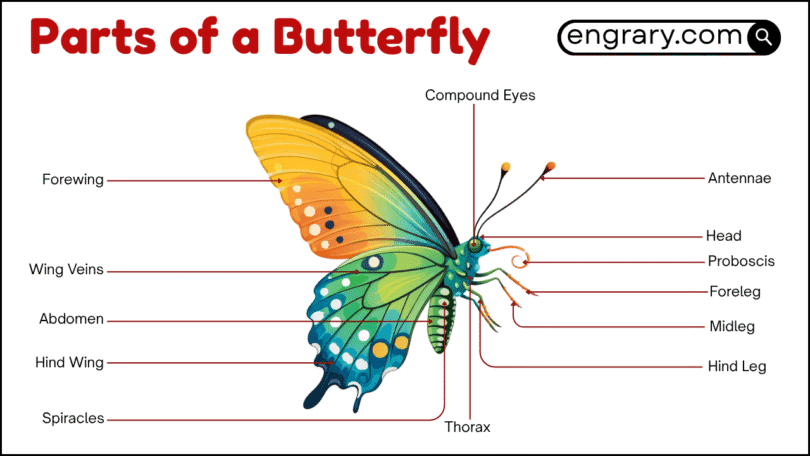
A butterfly has several visible body parts that support movement, feeding, breathing, sensing, and body balance. The main groups include the head, thorax, legs, wings, and abdomen, while smaller features such as the proboscis, wing veins, spiracles, and claws help each section perform a more specific role.
First, it helps to see the butterfly as one connected body rather than a list of separate names. You’ll learn how each butterfly part looks, what it is used for, and how to tell one from another, while also seeing how the head handles sensing and feeding, the thorax supports the wings and legs, and the abdomen helps with breathing and body function.
Butterfly Parts Labeled Diagram
The diagram below shows the main visible parts of a butterfly and how they are arranged across the head, thorax, wings, legs, and abdomen. It highlights key areas such as the antennae, proboscis, wings, legs, and spiracles so readers can recognize each labeled part more easily.
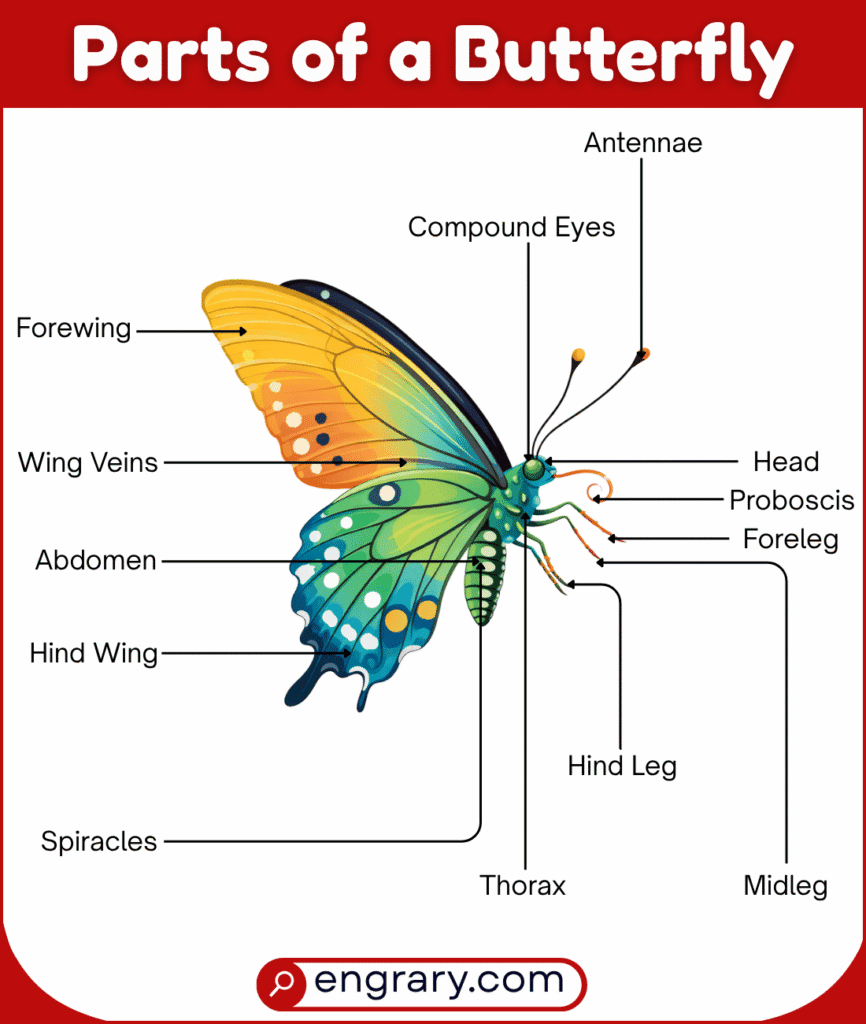
Head Parts Of a Butterfly
Head
The head is the front body section that holds the butterfly’s main sensing and feeding parts. It supports the eyes, antennae, and mouth structures.
Antenna
The antenna helps the butterfly detect smells, movement, and changes in the air. It also supports balance and orientation during flight.
Compound Eye
The compound eye is the large eye on each side of the head. It helps the butterfly detect light, motion, and its surroundings.
Ocelli
Ocelli are the small simple eyes found near the top of the head in some butterflies. They help detect light intensity and support basic visual awareness.
Proboscis
The proboscis is the long coiled feeding tube used to drink nectar and other liquids. It uncoils when the butterfly feeds and curls back up when not in use.
Labial Palps
The labial palps are the small paired parts near the mouth area. They help protect and support the feeding structures at the front of the head.
Thorax And Wing Parts
Thorax
The thorax is the middle body section of the butterfly. It supports the wings and legs and plays a major role in movement.
Forewing
The forewing is the front wing on each side of the body. It helps the butterfly stay lifted and controlled during flight.
Hindwing
The hindwing is the rear wing on each side of the body. It works with the forewing to support balance and flight movement.
Wing Base
The wing base is the part where the wing attaches to the thorax. It supports wing connection and movement.
Wing Margin
The wing margin is the outer edge of the wing. It helps define the shape and outline of the butterfly’s wing.
Wing Veins
Wing veins are the fine structural lines that run through the wings. They help support the wings and carry body fluids through the wing surface.
Wing Scales
Wing scales are the tiny overlapping structures that cover the wings. They give the butterfly its color and pattern.
Wing Apex
The wing apex is the outer tip area of the wing. It helps form the wing’s final shape and is often easy to notice in side view.
Eyespot
An eyespot is a round marking on the wing that looks like an eye. It helps form the butterfly’s wing pattern and may also help with protection.
Leg Parts Of a Butterfly
Foreleg
The foreleg is the front leg attached to the thorax. It helps the butterfly stand, grip surfaces, and support body position.
Midleg
The midleg is the middle leg attached to the thorax. It supports balance and contact with surfaces.
Hindleg
The hindleg is the rear leg attached to the thorax. It helps support the body during resting and landing.
Coxa
The coxa is the upper leg segment where the leg joins the thorax. It helps connect the leg to the body.
Femur
The femur is one of the stronger leg sections between the upper and middle leg parts. It helps support leg movement.
Tibia
The tibia is the leg section below the femur. It helps extend the leg and support movement or grip.
Tarsus
The tarsus is the lower part of the leg near the foot area. It helps the butterfly hold onto flowers, leaves, and other surfaces.
Claw
The claw is the small hooked tip at the end of the leg. It helps the butterfly grip surfaces more securely.
Abdomen And Lower Body Parts
Abdomen
The abdomen is the rear body section behind the thorax. It contains important internal organs and helps support body function.
Segments
Segments are the visible sections that divide the abdomen into smaller parts. They help form the flexible structure of the lower body.
Spiracles
Spiracles are the tiny breathing openings along the sides of the body. They help the butterfly take in air.
Anal Area
The anal area is the rear end section of the abdomen. It forms the final lower body area at the back of the butterfly.
Key Takeaways
A butterfly’s body works through connected regions that each support a different job. The head handles sensing and feeding, while the thorax supports the wings and legs for movement and balance. Meanwhile, the wings help with flight and display, and the abdomen supports breathing and internal body functions. Together, these parts make the butterfly easier to understand as one complete body.
FAQs
The main parts of a butterfly include the head, thorax, abdomen, wings, legs, antennae, eyes, and proboscis. Each part helps with movement, feeding, sensing, or breathing.
A butterfly uses its proboscis to drink nectar. This long tube uncoils during feeding and curls back up afterward.
The thorax is the middle body section. It supports the wings and legs and plays a major role in movement.
Butterfly wings are covered with tiny scales. These scales create the wing colors and patterns.
Spiracles are small openings used for breathing. They allow air to enter the butterfly’s body.
The antennae help detect smells and movement in the air, while the eyes help the butterfly detect light, motion, and surroundings.
You May Also Like