A fish has many body parts that help it live, move, breathe, and respond to the water around it. The main groups include the head, outer body covering, fins, tail region, gill area, and internal organs. Each part has a clear role, whether it helps with feeding, sensing, balance, protection, or body support.
These parts also work together in a connected flow. First, the head and mouth help the fish find and take in food, while the gills handle breathing. Next, the fins, tail region, muscles, and spine control balance and movement. Inside the body, organs such as the heart, liver, kidneys, and digestive parts keep the fish alive, while the swim bladder helps many fish stay at the right depth.
Parts of a Fish Labeled Diagram
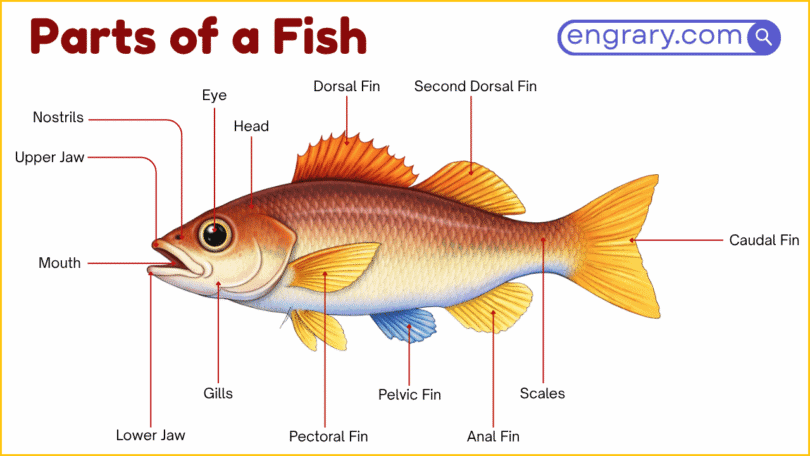
The diagram below shows the main visible parts of a fish and how they are arranged across the head, body, fins, tail, and gill area. It highlights key features such as the mouth, eye, operculum, scales, lateral line, fins, and tail so readers can identify each labeled part more easily.
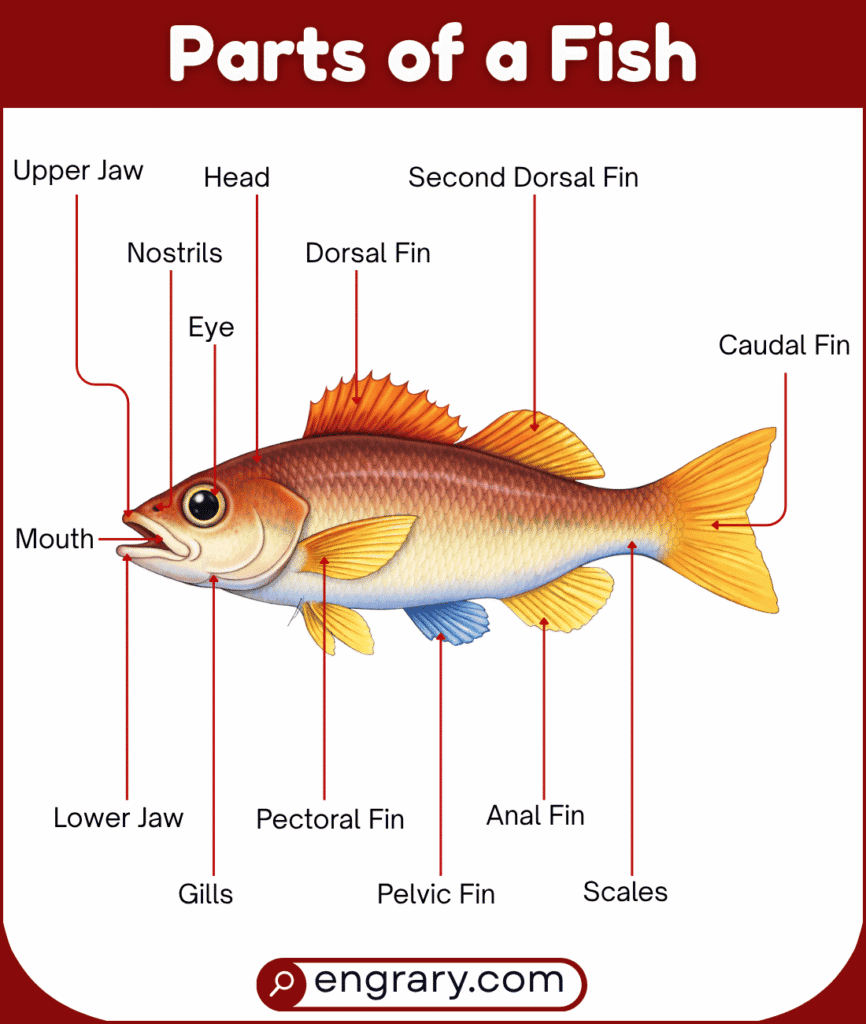
External Parts of a Fish
Head
The head is the front part of the fish and contains important structures such as the eyes, mouth, nostrils, and gill area. It plays a central role in feeding, sensing, and breathing.
Snout
The snout is the front section of the head between the eyes and the mouth area. It shapes the face of the fish and supports the openings used for feeding and smell.
Eye
The eye helps a fish detect light, motion, and nearby objects in the water. Eye position also helps the fish watch for food, obstacles, and danger around it.
Mouth
The mouth takes in food and helps the fish capture what it eats. In some fish, it also helps move water during breathing.
Jaw
The jaw supports the mouth and helps the fish catch, grip, and bite food. Jaw shape often matches the way a fish feeds in its environment.
Teeth
Teeth help some fish grip, tear, crush, or hold food. Their shape can vary widely depending on what the fish eats.
Nostril (Nares)
The nostrils, also called nares, are small openings that help a fish detect smells in the water. Unlike human nostrils, they are not used for breathing.
Operculum (Gill Cover)
The operculum is the hard flap that covers and protects the gills on each side of the head. It also helps move water across the gills during breathing.
Gills
Gills take oxygen from water and release carbon dioxide. They are one of the most important parts of a fish because they make underwater breathing possible.
Gill Rakers
Gill rakers are comb-like structures attached to the gill arches inside the gill area. They help protect the gills and can also help trap food particles in some fish.
Skin
Skin forms the outer covering of the fish and protects the body from the surrounding water. It also supports a mucus layer that helps reduce friction and adds protection.
Mucus Layer
The mucus layer is a slimy coating on the skin surface. It helps protect the body, reduce drag in water, and lower the chance of irritation or infection.
Scales
Scales are small overlapping plates that cover much of the fish’s body. They protect the skin while still allowing the body to bend and move freely.
Lateral Line
The lateral line is a sensory line that runs along the side of the body. It helps the fish detect vibrations and movement in nearby water.
Body (Trunk)
The body, or trunk, is the main middle section between the head and tail. It holds many internal organs and provides space for the strong muscles used in swimming.
Tail
The tail is the rear body section of the fish. It connects the main body to the tail fin and supports the back-end movement that helps power swimming.
Caudal Peduncle
The caudal peduncle is the narrow part of the body just before the caudal fin. It helps transfer muscle force from the body to the tail fin during swimming.
Fins and Movement Parts of a Fish
Dorsal Fin
The dorsal fin sits on the back of the fish. It helps keep the body stable and prevents the fish from rolling from side to side.
Pectoral Fin
Pectoral fins are found on the sides of the body near the head. They help with steering, turning, slowing down, and balance.
Pelvic Fin
Pelvic fins are usually located on the lower part of the body. They help the fish stay balanced and control its position in the water.
Anal Fin
The anal fin is on the underside of the body near the tail. It works with other fins to keep the fish steady while swimming.
Caudal Fin
The caudal fin is the tail fin at the very back of the fish. It produces most of the forward thrust and plays a major role in speed and direction.
Adipose Fin
The adipose fin is a small soft fin found on the back of some fish between the dorsal fin and the caudal fin. It does not appear in all fish, but when present, it is part of the external fin structure.
Fin Rays
Fin rays are thin support structures inside the fins. They help the fins keep their shape while still allowing smooth bending and controlled movement in water.
Fin Spines
Fin spines are stiff, pointed supports found in the fins of some fish. They add structure and, in some species, also help with defense.
Internal Parts of a Fish
Swim Bladder
The swim bladder is a gas-filled sac inside many fish. It helps control buoyancy, so the fish can rise, sink, or remain at a certain depth.
Spine (Vertebral Column)
The spine, or vertebral column, supports the body and helps it keep its shape. It also protects the spinal cord and works with muscles during movement.
Muscles
Muscles provide the force needed for swimming and body movement. As they contract, they move the body and tail in a way that pushes the fish through water.
Brain
The brain controls body functions, movement, and responses to the environment. It works with the senses to help the fish react to food, danger, and changes around it.
Heart
The heart pumps blood through the fish’s body and toward the gills. This circulation helps move oxygen and nutrients to different parts of the body.
Esophagus
The esophagus is the tube that carries food from the mouth to the stomach. It forms an early part of the digestive pathway.
Stomach
The stomach helps break down food after the fish eats. It is an important early part of the digestive process.
Pyloric Caeca
Pyloric caeca are small finger-like sacs near the stomach in many fish. They help increase surface area and support digestion.
Liver
The liver helps process nutrients and supports digestion. It also plays an important role in storing and managing substances the body needs.
Gall Bladder
The gall bladder stores bile linked to digestion. This fluid helps the body process fats from food.
Pancreas
The pancreas helps the fish break down food by producing digestive substances. It also supports other internal body functions.
Intestine
The intestine continues digestion and absorbs nutrients from food. It also helps move waste through the body.
Kidneys
The kidneys filter waste from the blood and help control salt and fluid balance inside the body. This keeps the fish’s internal condition stable.
Spleen
The spleen helps with blood-related functions in the body. It supports internal balance and plays a role in the fish’s internal system.
Reproductive Organs
Reproductive organs produce the cells needed for breeding. Their structure can differ between male and female fish.
Anus (Vent)
The anus, also called the vent, is the opening through which waste leaves the body. In many fish, it is located on the underside near the rear of the trunk.
Parts of a Fish Key Takeaways
The parts of a fish can be grouped into external parts, fins and movement parts, and internal organs. The head, mouth, teeth, gills, operculum, skin, scales, mucus layer, and lateral line help with feeding, breathing, protection, and sensing. The fins, caudal peduncle, muscles, and spine guide balance and movement, while the caudal fin provides strong forward thrust. Inside the body, the swim bladder manages buoyancy, and organs such as the heart, liver, pancreas, intestine, kidneys, spleen, and reproductive organs support life processes.
FAQs
The main parts of a fish include the head, body, tail, fins, gills, scales, and internal organs. Many fish also have added parts such as teeth, gill rakers, a swim bladder, and digestive organs.
The gills help a fish breathe. Water passes over them, and they take oxygen from that water while releasing carbon dioxide.
No. The tail is the rear body section, while the caudal fin is the tail fin attached at the back that provides most of the forward push.
No. The adipose fin appears only in some fish species. Many fish do not have this fin at all.
The lateral line helps a fish sense vibrations and movement in the surrounding water. Because of this, the fish can detect nearby objects, prey, or danger more easily.
Summary
A fish has external parts, movement parts, and internal organs that work together in one connected system. The head and outer body support sensing, feeding, breathing, and protection. The fins, caudal peduncle, spine, and muscles control balance and swimming. Inside the body, the swim bladder, heart, digestive organs, kidneys, spleen, and reproductive organs support buoyancy, circulation, digestion, waste control, and reproduction.
You May Also Like