A flower has several outer and reproductive parts that help with pollination, seed formation, and the growth of new plants. The main groups include the petals, sepals, support parts, male parts, and female parts, and each one helps with protection, attraction, support, or reproduction.
Together, these parts work in a clear sequence. First, the outer parts protect the developing flower and attract pollinators. Then, the male parts produce and release pollen, while the female parts receive it and guide reproduction inside the ovary. At the same time, support parts such as the peduncle, pedicel, receptacle, and nectary hold the flower in place and support its overall structure and function.
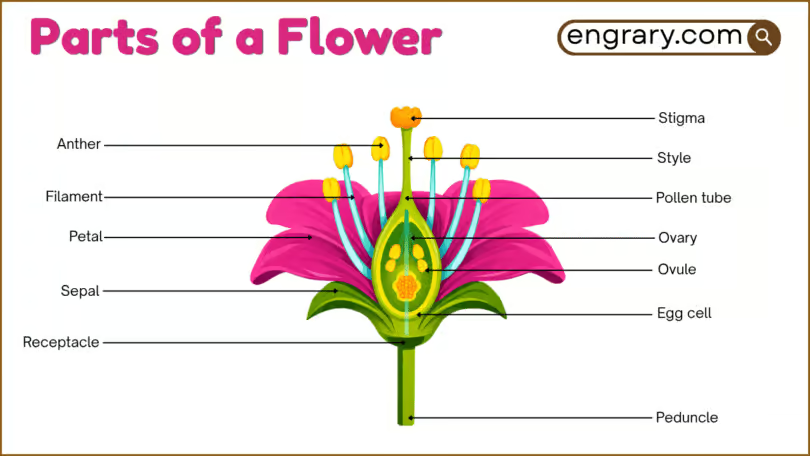
Parts of a Flower Labeled Diagram
The diagram below shows the main parts of a flower and how they are arranged across the outer structure and reproductive sections. It highlights key parts such as the petals, sepals, stamen, pistil, ovary, ovule, and receptacle so readers can identify each labeled part more easily.
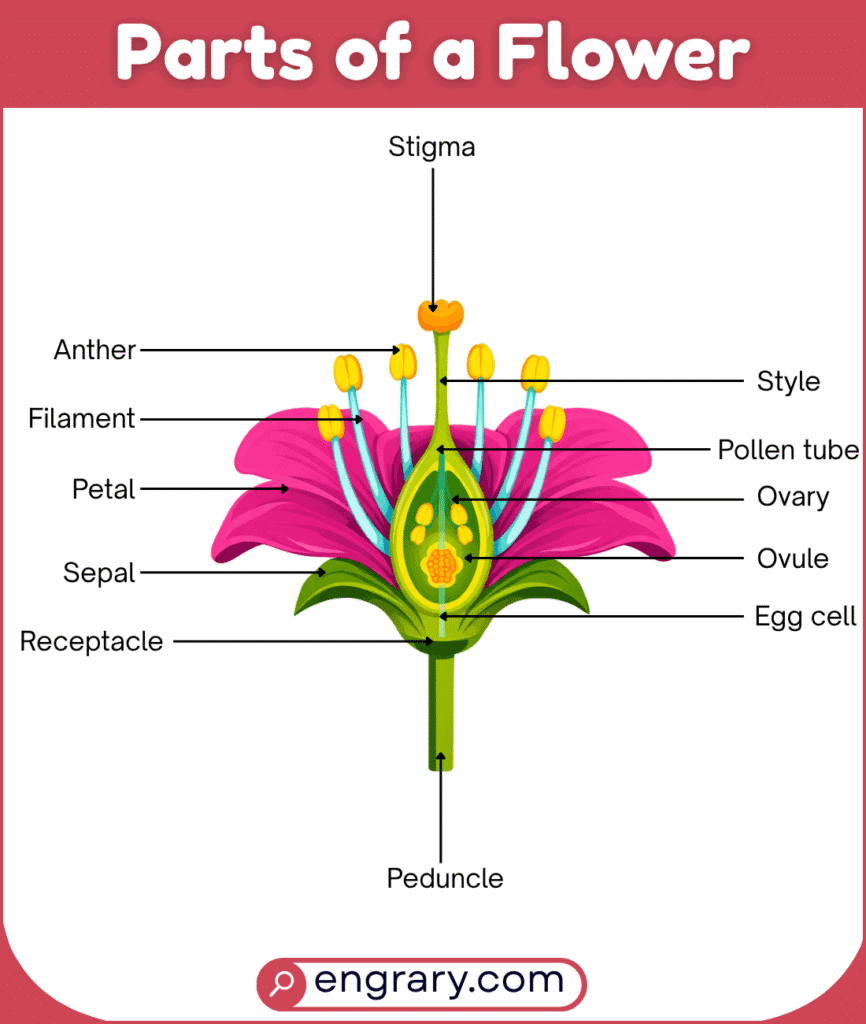
Main Parts of a Flower
Petal (Corolla)
Petals are the colorful or noticeable parts that often attract insects, birds, and other pollinators to the flower. Collectively, the petals are called the corolla, and they help make the flower easy to spot.
Sepal (Calyx)
Sepals are the leaf-like outer parts that protect the flower before it opens. Together, they form the calyx, which supports and covers the developing bud.
Peduncle
The peduncle is the main flower stalk that supports the flower or flower cluster. It connects the flower structure to the rest of the plant.
Pedicel
The pedicel is the smaller stalk that attaches an individual flower to the main stem or flowering branch. It helps hold the flower in position.
Receptacle
The receptacle is the thickened base where the main parts of the flower attach. Petals, sepals, stamens, and carpels all connect around this area.
Nectary
The nectary is the part that produces nectar inside the flower. This sweet liquid attracts pollinators and helps support the pollination process.
Male Parts of a Flower
Stamen
The stamen is the male reproductive part of a flower. It usually consists of the anther and filament and forms the male structure that produces pollen.
Anther
The anther is the top part of the stamen where pollen is produced. Once mature, it releases pollen so it can reach the female part of the flower.
Filament
The filament is the thin stalk that holds up the anther. By lifting the anther into position, it helps pollen become easier to spread.
Pollen
Pollen contains the male reproductive cells of the flower. It must reach the female part for fertilization to begin.
Female Parts of a Flower
Pistil (Carpel)
The pistil, also called the carpel, is the female reproductive part of a flower. It includes the stigma, style, and ovary and receives pollen during reproduction.
Stigma
The stigma is the top part of the pistil that receives pollen. Its surface is often sticky or shaped to catch pollen effectively.
Style
The style is the slender tube-like part below the stigma. It connects the stigma to the ovary and provides the path pollen follows after landing.
Ovary
The ovary is the lower part of the pistil that contains the ovules. After fertilization, it develops into the fruit in many flowering plants.
Ovule
The ovule is the structure inside the ovary that contains the female reproductive cell. After fertilization, the ovule develops into a seed.
Key Takeaways
The parts of a flower can be grouped into outer parts, support parts, and reproductive parts. Petals and sepals help attract pollinators and protect the flower, while the peduncle, pedicel, receptacle, and nectary support its structure and function. The stamen produces pollen, and the pistil receives it through the stigma and style. Inside the ovary, the ovule develops after fertilization, so all of these parts work together in a clear reproductive sequence.
FAQs
The main parts of a flower include petals, sepals, stamens, and pistils. Support parts such as the peduncle, pedicel, receptacle, and nectary are also important.
The male part of a flower is the stamen. It includes the anther and filament and produces pollen.
The female part of a flower is the pistil, also called the carpel. It includes the stigma, style, ovary, and ovule.
The ovary holds the ovules inside the flower. After fertilization, it often develops into the fruit.
Petals help attract pollinators by adding color, shape, and visibility. This makes pollination more likely.
You May Also Like