A plant has several visible parts that support growth, food production, support, and reproduction. The main groups include the root system, stem, leaves, flowers, fruits, and seeds, while smaller structures such as the root cap, bud, lamina, ovary, and cotyledon help each section perform a more specific role.
First, it helps to see the plant as one connected structure rather than a list of separate names. You’ll learn how each plant part looks, what it is used for, and how to tell one from another, while also seeing how the roots absorb water, the stem carries materials upward, the leaves make food, and the flower, fruit, and seed work together to form, protect, and continue the next stage of plant growth.
Plant Parts Labeled Diagram
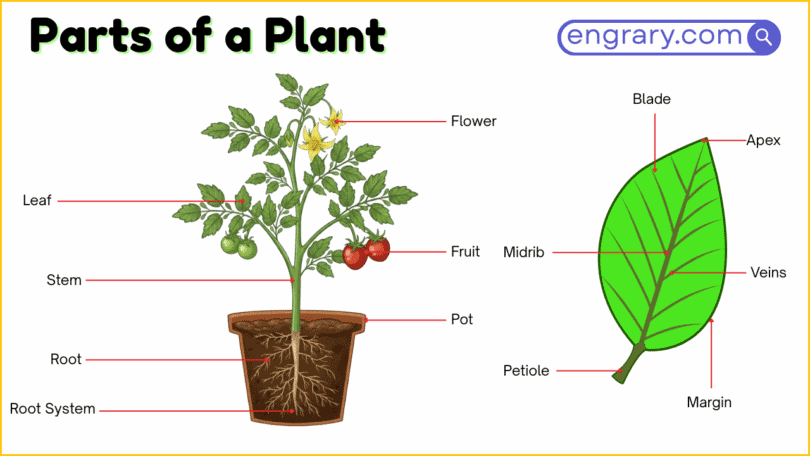
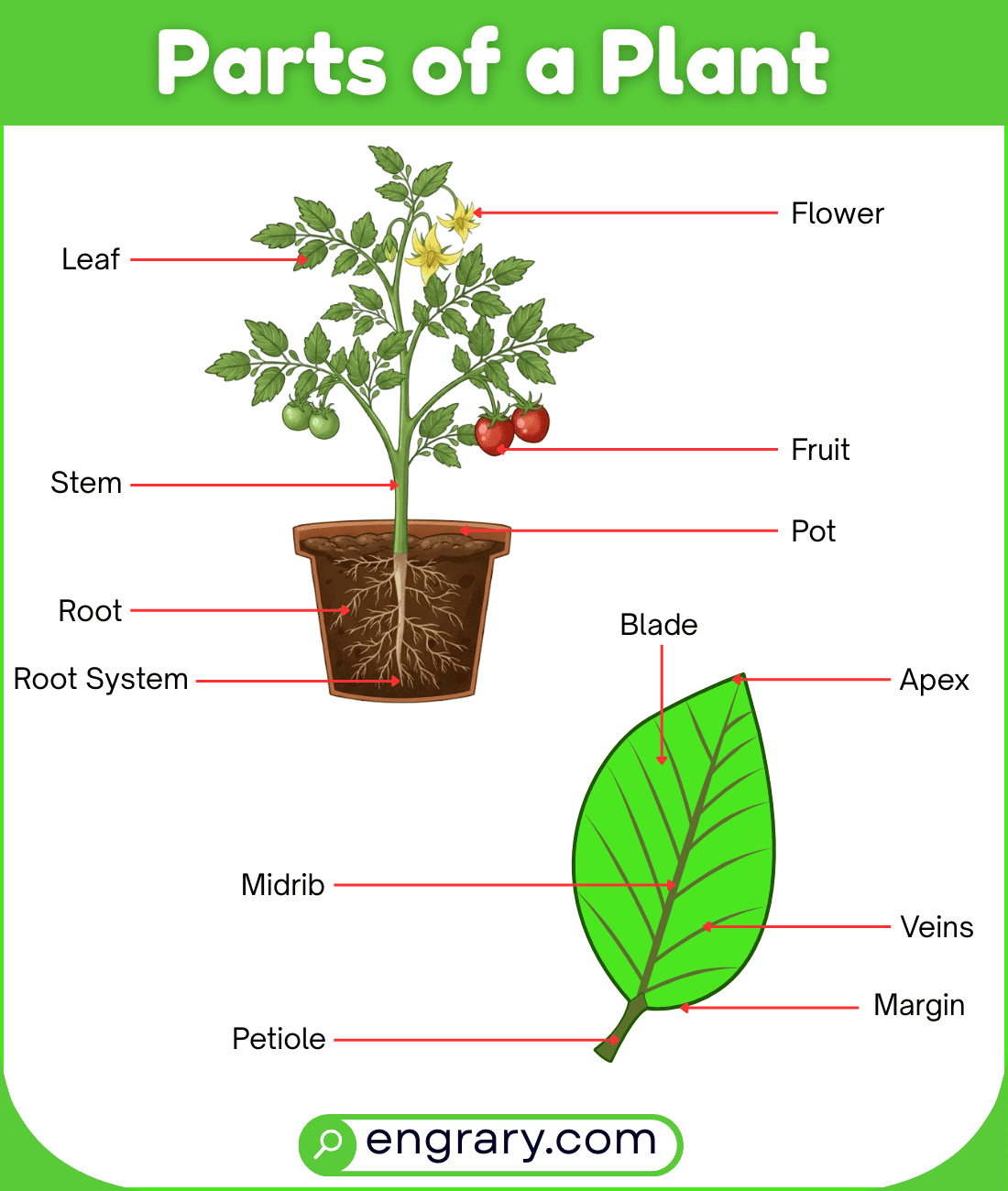
The diagram below shows the main parts of a plant and how they are arranged from the roots to the flower and seed-forming sections. It highlights key areas such as the root system, stem, leaves, flower, fruit, and seed so readers can recognize each labeled part more easily.
Root And Underground Parts
Root System
The root system includes all the parts of the plant that grow below the ground. It anchors the plant in the soil and absorbs water and minerals needed for growth.
Root
The root is the main underground part that holds the plant in place. It also takes in water and minerals from the soil.
Primary Root
The primary root is the first main root that grows downward from the seed. It forms the central base of the root system.
Tap Root
The tap root is a thick main root that grows straight down into the soil. It helps the plant reach deeper water and gives strong support.
Lateral Root
Lateral roots branch out from the main root. They spread through the soil to absorb water and nutrients from a wider area.
Fibrous Root
A fibrous root system has many thin roots that spread out near the surface of the soil. These roots help absorb water quickly from a wide area.
Root Hair
Root hairs are tiny hair-like growths on young roots. They increase the root’s surface area and help the plant absorb water more efficiently.
Root Cap
The root cap is the small protective structure at the tip of the root. It helps shield the growing root as it pushes through the soil.
Root Tip
The root tip is the growing end of the root below the root cap area. It helps the root extend deeper into the soil.
Stem And Support Parts
Shoot System
The shoot system includes the above-ground parts of the plant, such as the stem, leaves, flowers, fruits, and seeds. It supports growth, food production, and reproduction.
Stem
The stem holds the plant upright and connects the roots to the leaves, buds, flowers, and fruits. It also carries water and food between the lower and upper parts.
Node
A node is the point on the stem where leaves, buds, or branches grow. It acts as an attachment point for many plant structures.
Internode
The internode is the stem section between two nodes. Its length affects how spread out the leaves and branches appear on the plant.
Bud
A bud is a small growth point that can develop into a leaf, branch, or flower. It helps the plant continue growing from the stem.
Terminal Bud
The terminal bud is the bud found at the tip of the stem or branch. It supports upward growth and the extension of the shoot.
Axillary Bud
An axillary bud grows at the point where a leaf joins the stem. It can develop into a branch or flower.
Branch
A branch grows out from the main stem and supports leaves, buds, flowers, or fruits. It helps spread the upper parts of the plant outward.
Leaf And Food-Making Parts
Leaf
The leaf is the main food-making part of most plants. It uses sunlight, water, and air to produce food for growth.
Leaf Base
The leaf base is the lower part of the leaf where it attaches to the stem. It helps connect the leaf to the plant and supports its position.
Petiole
The petiole is the stalk that connects the leaf to the stem. It supports the leaf and helps hold it toward the light.
Leaf Blade
The leaf blade is the broad flat part of the leaf. It provides the main surface for capturing sunlight.
Lamina
The lamina is the broad flat surface of the leaf. It is the main area where food production takes place.
Leaf Vein
Leaf veins are the thin lines that run through the blade. They carry water and food while also helping support the leaf’s shape.
Midrib
The midrib is the main central vein that runs through the leaf blade. It supports the leaf and helps carry water and food through the leaf.
Veinlets
Veinlets are the smaller branches of the leaf veins. They spread through the leaf blade and help move materials through the leaf.
Margin
The margin is the outer edge of the leaf blade. It helps define the leaf’s shape.
Apex
The apex is the tip of the leaf. It marks the end point of the leaf blade.
Flower And Reproductive Parts
Flower Bud
A flower bud is the unopened stage of a flower before it blooms. It protects the developing flower parts until they open.
Flower
The flower is the part of the plant that produces seeds. It contains the main reproductive structures and often attracts pollinators.
Pedicel
The pedicel is the stalk that supports a single flower. It connects the flower to the stem or branch.
Receptacle
The receptacle is the base part of the flower where the floral parts attach. It supports the sepals, petals, stamens, and pistil.
Sepal
The sepal is the small leaf-like outer part at the base of the flower. It protects the flower bud before it opens.
Petal
Petals are the colorful or noticeable parts around the center of the flower. They help attract pollinators and surround the inner reproductive parts.
Stamen
The stamen is the male reproductive part of a flower. It produces pollen and usually stands around the center.
Anther
The anther is the top part of the stamen. It makes and releases pollen needed for reproduction.
Filament
The filament is the thin stalk that holds up the anther. It helps position the anther for pollen release.
Pistil
The pistil is the female reproductive part in the center of the flower. It receives pollen and contains the structures that help form seeds.
Stigma
The stigma is the top part of the pistil. It receives pollen during pollination.
Style
The style is the narrow section below the stigma. It connects the stigma to the ovary.
Ovary
The ovary is the lower part of the pistil that holds the ovules. After fertilization, it often develops into the fruit.
Ovule
The ovule is the structure inside the ovary that develops into a seed after fertilization. It plays a direct role in reproduction.
Fruit And Seed Parts
Fruit
The fruit is the mature structure that develops from the ovary after fertilization. It helps protect the seeds and may also help spread them.
Seed
The seed contains the young plant and stored food for early growth. It can grow into a new plant when conditions are right.
Seed Coat
The seed coat is the outer covering of the seed. It protects the inner parts from damage and drying.
Embryo
The embryo is the tiny young plant inside the seed. It develops into the root, stem, and first leaves during germination.
Plumule
The plumule is the young shoot inside the seed embryo. It develops into the upper part of the new plant.
Radicle
The radicle is the young root inside the seed embryo. It is the first part to grow downward during germination.
Cotyledon
The cotyledon is the seed leaf inside the seed. It stores or supplies food to the young plant during early growth.
Endosperm
The endosperm is the food-storage tissue inside some seeds. It helps nourish the developing embryo.
Key Takeaways
A plant grows and functions through connected parts that each support a specific job. The root system anchors the plant and absorbs water, while the shoot system holds the stem, leaves, flowers, fruits, and seeds above the ground. Meanwhile, the leaves make food using sunlight, and the flower contains the reproductive parts that help form seeds. Finally, the fruit and seed protect the next stage of growth, so the whole plant becomes easier to understand when each part is viewed in order from root to seed.
FAQs
The main parts of a plant include the root system, stem, leaves, flower, fruit, and seed. Each part helps the plant grow, make food, reproduce, or stay supported.
The root anchors the plant in the soil and absorbs water and minerals. It also helps support the plant from below the ground.
The stem holds the plant upright and connects the roots to the leaves, buds, flowers, and fruits. It also carries water and food through the plant.
Leaves are important because they make food for the plant. They use sunlight, water, and air to support growth.
The flower makes seeds through reproduction. Its inner parts help with pollination, fertilization, and seed formation.
The fruit is the mature structure that protects the seeds, while the seed contains the young plant inside. The seed can grow into a new plant under the right conditions.
You May Also Like