A seed has several outer and inner parts that protect the young plant, store food, and support early development. The main groups include the outer covering, food-storage tissues, and embryo parts, and each one helps with protection, nourishment, or growth.
Together, these parts work in a connected sequence. First, the seed coat protects the seed from damage and drying. Inside, the cotyledon and endosperm store or transfer food to the young plant. Then, the embryo axis, plumule, radicle, hypocotyl, and epicotyl guide the growth of the future shoot and root, while monocot structures such as the scutellum, coleoptile, and coleorhiza support early development in certain seeds.
Parts of a Seed Labeled Diagram
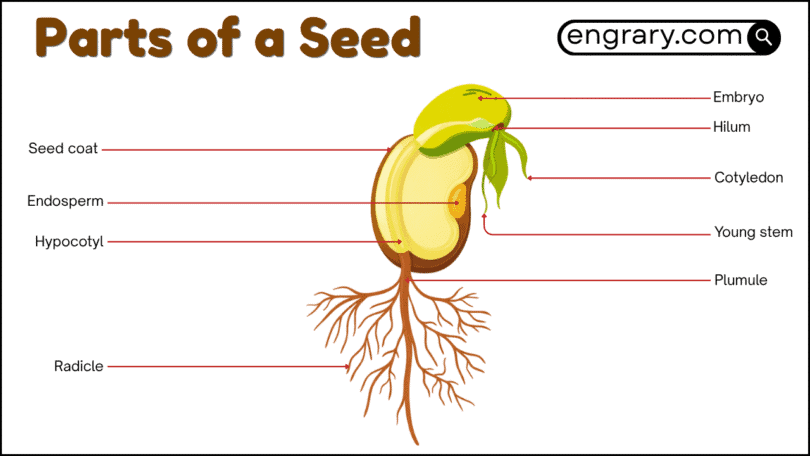
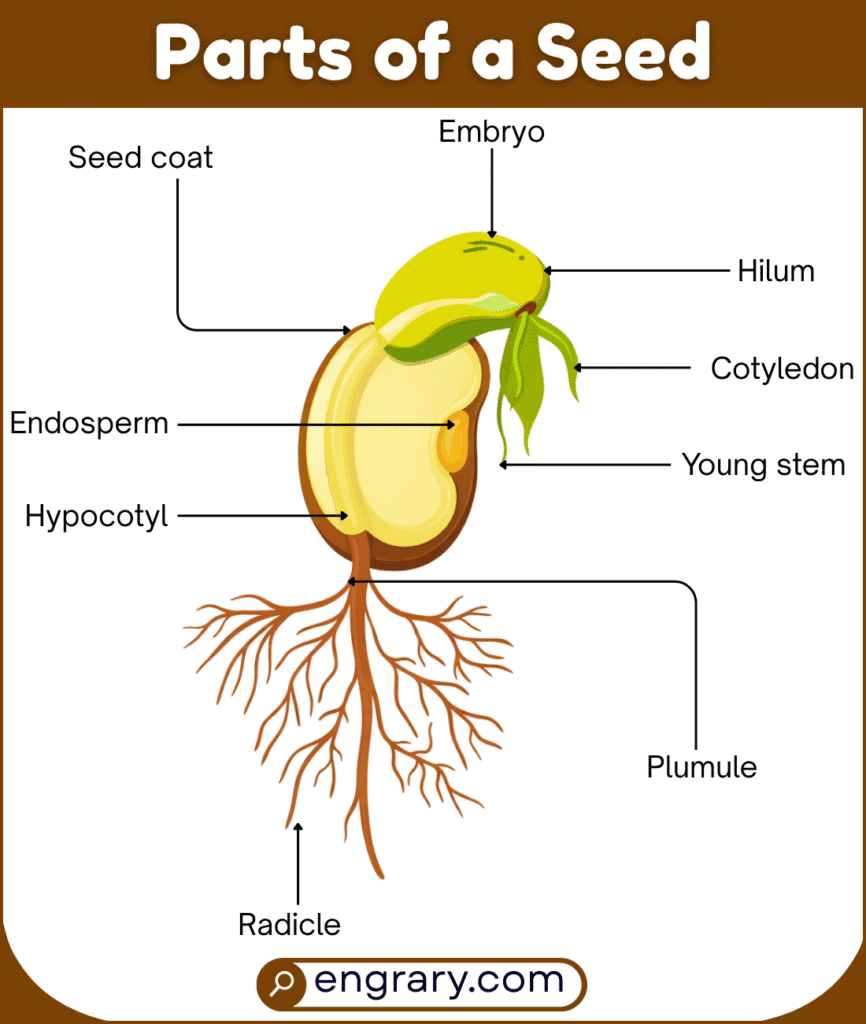
The diagram below shows the main outer and inner parts of a seed and how they are arranged around the protective covering, food-storage tissues, and embryo structures. It highlights key parts such as the seed coat, hilum, micropyle, cotyledon, endosperm, embryo axis, plumule, and radicle so readers can identify each labeled part more easily.
Outer Parts of a Seed
Seed Coat
The seed coat is the outer covering of the seed. It protects the inner parts from injury, drying, and harmful outside conditions.
Testa
The testa is the outer layer of the seed coat. It is usually the tougher layer and forms the main protective surface of the seed.
Tegmen
The tegmen is the inner layer of the seed coat. It lies below the testa and adds another layer of protection around the seed.
Hilum
The hilum is the scar on the seed where it was attached to the parent plant. It marks the point where the seed was connected before it separated.
Micropyle
The micropyle is a tiny opening in the seed coat. It allows water to enter the seed during germination.
Food Storage Parts of a Seed
Cotyledon
The cotyledon is the seed leaf inside the seed. It is part of the embryo and often stores or absorbs food for the young plant during early growth.
Endosperm
The endosperm is the food-storage tissue that nourishes the developing embryo. In many seeds, it provides the main food supply before the young plant can make its own food.
Scutellum
The scutellum is the single cotyledon found in many monocot seeds. It helps absorb stored food from the endosperm and pass it to the embryo.
Embryo Parts of a Seed
Embryo
The embryo is the young undeveloped plant inside the seed. It contains the main structures that will grow into the root and shoot.
Embryo Axis
The embryo axis is the central part of the embryo that connects the plumule and radicle. It forms the main line from which the young shoot and root develop.
Plumule
The plumule is the embryonic shoot. It grows upward and develops into the stem and leaves of the new plant.
Radicle
The radicle is the embryonic root. It is usually the first part to emerge during germination and grows downward into the soil.
Hypocotyl
The hypocotyl is the part of the embryo axis between the cotyledon and the radicle. It connects the seed leaf region to the young root region during early growth.
Epicotyl
The epicotyl is the part of the embryo axis above the cotyledon. It develops into the upper shoot region of the young plant.
Coleoptile
The coleoptile is a protective sheath around the plumule in many monocot seeds. It helps protect the young shoot as it grows upward.
Coleorhiza
The coleorhiza is the protective sheath around the radicle in many monocot seeds. It covers the young root before it emerges during germination.
Parts of a Seed Key Takeaways
The parts of a seed can be grouped into outer covering parts, food-storage parts, and embryo parts. The seed coat, testa, tegmen, hilum, and micropyle protect the seed and help control water entry. The cotyledon, endosperm, and in some seeds the scutellum provide or transfer stored food. Inside the seed, the embryo and embryo axis contain the plumule, radicle, hypocotyl, and epicotyl, while the coleoptile and coleorhiza protect early shoot and root growth in many monocot seeds.
FAQs
The main parts of a seed include the seed coat, food-storage tissues, and embryo. Together, these parts protect the seed, provide nourishment, and support early plant growth.
The seed coat protects the seed from damage, drying, and harmful outside conditions. It acts as the outer protective covering.
The radicle becomes the first root of the young plant. It is usually the first part to emerge during germination.
The plumule develops into the shoot, while the radicle develops into the root. Both are important embryo parts inside the seed.
The micropyle is a small opening in the seed coat. It allows water to enter the seed when germination begins.
You May Also Like