A snake may look simple from the outside, but its body is made up of many specialized parts that work together for movement, feeding, protection, breathing, and reproduction. Some parts are easy to see, such as the head, scales, and tail. Others are found inside the body, where they support digestion, circulation, and other vital functions.
These parts can be grouped into outer parts, head parts, body parts, internal parts, and specialized parts found in certain species. Each group plays a different role. The outer body protects the snake and helps it move. The head contains important sensory and feeding structures. Inside the body, organs support breathing, digestion, waste removal, and reproduction. In addition, some snakes have unique features such as venom glands, heat-sensing pits, and rattles that give them extra survival advantages.
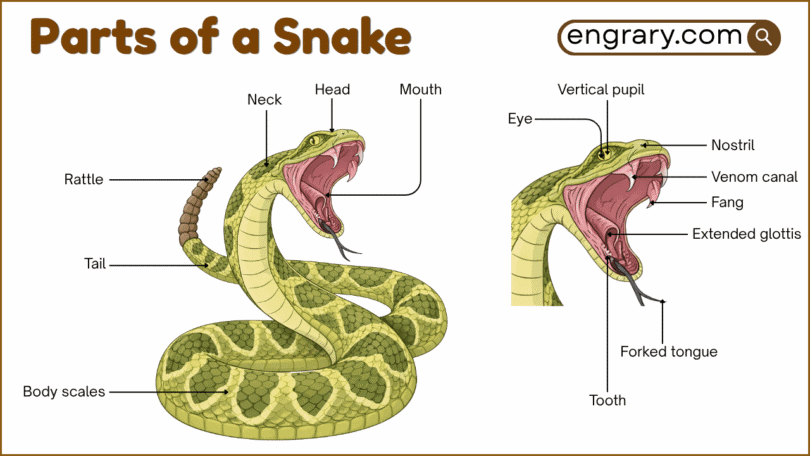
Parts of a Snake Labeled Diagram
A labeled diagram of a snake usually shows both the visible outer parts and the main internal organs. On the outside, it may identify the head, eyes, nostrils, tongue, fangs, scales, vent, and tail. Inside the body, it often labels structures such as the trachea, esophagus, heart, lung, liver, stomach, intestines, and kidneys. Seeing these parts in one diagram makes it much easier to understand how the snake’s body is arranged from head to tail.
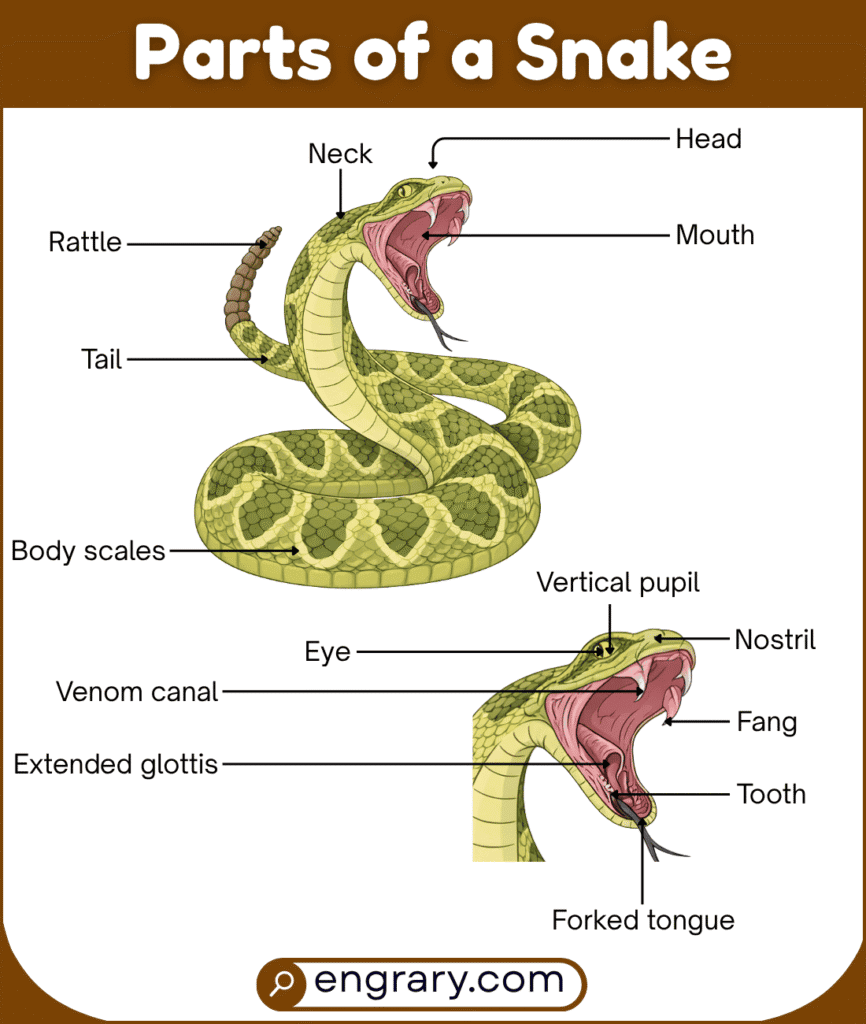
Outer Parts of a Snake
The outer parts of a snake are the features visible on the outside of the body. These parts protect the animal, help it move, and allow it to interact with its surroundings.
Head
The head is the front part of the snake’s body. It contains the mouth, eyes, nostrils, and several important sensory structures. As a result, it plays a central role in feeding and awareness.
Body
The body is the long middle region of the snake. It holds most of the muscles, ribs, vertebrae, and internal organs. Because the body is long and flexible, it allows the snake to bend, coil, and move through narrow spaces.
Tail
The tail is the part of the snake behind the vent. It is usually narrower than the main body. In some species, the tail also helps with defense, balance, gripping, or signaling.
Scales
Scales cover the outer surface of the snake. They protect the skin from injury, reduce water loss, and help the snake move smoothly across the ground, rocks, trees, or sand.
Ventral Scales
Ventral scales are the broad scales along the underside of the snake. These scales help the snake grip surfaces and push its body forward. For this reason, they are especially important for slithering and climbing.
Cloaca or Vent
The cloaca, also called the vent, is the opening near the rear of the body. It serves as the exit for waste and also plays a role in reproduction.
Head Parts of a Snake
The head contains many of the snake’s most important sensory and feeding parts. Although head shape varies among species, several structures are found in most snakes.
Eyes
The eyes help the snake detect light and movement. Vision differs from one species to another, but the eyes still play an important role in how many snakes respond to their environment.
Spectacle
The spectacle is the clear protective scale that covers the eye. Unlike animals with movable eyelids, snakes rely on this transparent covering to protect the eye at all times.
Nostrils
The nostrils are the openings used for breathing and odor detection. They allow air to enter the body and also help the snake sense chemical cues in its surroundings.
Tongue
The tongue is long and forked. It flicks in and out to collect tiny particles from the air or ground. The snake then brings those particles into the mouth for further detection.
Jacobson’s Organ
Jacobson’s organ, also called the vomeronasal organ, helps the snake detect scents and chemical signals. It works closely with the tongue and allows the snake to track prey, recognize mates, and sense danger.
Teeth and Fangs
Teeth help the snake grip and hold prey. In some species, specialized fangs are used to inject venom. Therefore, these mouthparts are important for both feeding and defense.
Heat Pits
Heat pits are special sensory openings found in some snakes, such as pit vipers. They detect body heat from warm-blooded animals and help the snake locate prey even in darkness or low light.
Body Parts of a Snake
The body of a snake contains the structures that support movement, strength, and flexibility. Since snakes do not have limbs, these parts are especially important.
Neck Region
The neck region is the area just behind the head. It is not always sharply separated from the rest of the body, but it gives the head a high degree of controlled movement.
Dorsal Scales
Dorsal scales are the scales on the upper side of the snake’s body. They protect the back and sides and often contribute to camouflage through their colors and patterns.
Ventral Scales
Ventral scales run along the belly and help the snake move by gripping the surface below. Their broad shape makes them especially useful in locomotion.
Subcaudal Scales
Subcaudal scales are found on the underside of the tail. They cover the tail region beyond the vent and form part of the snake’s outer body covering.
Vertebrae
Vertebrae are the bones of the spine. Snakes have many vertebrae, which gives the body remarkable flexibility and allows it to bend, twist, coil, and strike with precision.
Ribs
Ribs are attached to much of the vertebral column. They support the body, help protect internal organs, and work closely with the muscles during movement.
Muscles
Muscles run throughout the snake’s body and attach to the skeleton. They power slithering, climbing, constricting, striking, and many other movements.
Internal Parts of a Snake
Inside the snake’s body are many organs that support breathing, digestion, circulation, waste removal, and reproduction. Even though the body is long and narrow, these organs are arranged in a way that fits the snake’s unique shape.
Glottis
The glottis is the opening that leads into the airway. It can extend forward when the snake is swallowing large prey, which allows the animal to keep breathing during feeding.
Trachea
The trachea is the windpipe that carries air toward the lungs. It is a key part of the respiratory system.
Esophagus
The esophagus is the tube that carries food from the mouth to the stomach. Because snakes often swallow prey whole, this tube must be able to stretch widely.
Heart
The heart pumps blood through the body. It supports circulation and helps deliver oxygen and nutrients to tissues and organs.
Lung
The lung helps the snake breathe. In many snakes, the right lung is more developed, while the left lung is reduced or absent.
Liver
The liver helps process nutrients and supports many internal chemical functions. It is an essential organ in metabolism.
Stomach
The stomach helps break down food after it is swallowed. Since snakes may eat large prey, the stomach is adapted for slow and efficient digestion.
Pancreas
The pancreas produces substances that help with digestion and also supports other important internal functions.
Gallbladder
The gallbladder stores bile, which helps break down fats during digestion.
Intestines
The intestines absorb nutrients from digested food and move waste through the digestive tract.
Kidneys
The kidneys help remove waste from the blood and regulate water balance inside the body.
Reproductive Organs
Reproductive organs help the snake produce offspring. Depending on the species, snakes may lay eggs or give birth to live young.
Specialized Parts Found in Some Snakes
Some snakes have special structures that are not found in every species. These parts can improve hunting, defense, or reproduction.
Venom Glands
Venom glands produce venom in venomous snakes. This venom helps subdue prey and may also be used for defense.
Hollow Fangs
Hollow fangs are specialized teeth that deliver venom into prey. They are an important adaptation in many venomous snakes.
Heat-Sensing Pits
Heat-sensing pits are special organs that detect infrared heat. As a result, certain snakes can locate warm prey even when visibility is poor.
Rattle
The rattle is found at the end of the tail in rattlesnakes. When shaken, it produces a warning sound that helps deter threats.
Pelvic Spurs
Pelvic spurs are small external structures found in some primitive snakes, such as boas and pythons. They are remnants of hind limbs from distant ancestors.
Functions of Each Part of a Snake
Each part of a snake has a specific job. The scales protect the body, while the ventral scales help with movement. The tongue and Jacobson’s organ work together to detect chemical signals in the environment. The eyes, nostrils, and in some snakes heat pits help the animal sense prey and danger. Meanwhile, the teeth and fangs help capture prey, and in venomous species, fangs also deliver venom.
Inside the body, the glottis, trachea, and lung support breathing. The esophagus, stomach, intestines, liver, pancreas, and gallbladder all help with digestion. At the same time, the heart circulates blood, while the kidneys remove waste and maintain internal balance. Together, these parts allow the snake to move, hunt, breathe, digest food, and reproduce successfully.
Key Takeaways
The parts of a snake can be divided into outer parts, head parts, body parts, internal parts, and specialized parts. The outer body includes the head, body, tail, scales, ventral scales, and cloaca or vent. The head contains important sensory and feeding structures such as the eyes, spectacle, nostrils, tongue, Jacobson’s organ, teeth and fangs, and heat pits in some species. The body is supported by vertebrae, ribs, and muscles, while the inside contains organs such as the heart, lung, liver, stomach, intestines, and kidneys. In some snakes, special parts such as venom glands, hollow fangs, rattle, and pelvic spurs provide extra adaptations.
FAQs
The main parts of a snake include the outer parts, head parts, body parts, internal organs, and specialized structures found in some species. Together, these parts help the snake move, feed, sense its surroundings, and survive.
Snake scales protect the body from injury and water loss. In addition, the ventral scales on the underside help the snake grip surfaces and move more effectively.
A snake uses its tongue and Jacobson’s organ to detect scents. First, the tongue collects chemical particles, and then Jacobson’s organ processes them.
No, not all snakes have venom-injecting fangs. Some snakes only have regular teeth for gripping prey, while venomous snakes may have specialized fangs.
A snake has several internal organs, including the glottis, trachea, esophagus, heart, lung, liver, stomach, pancreas, gallbladder, intestines, kidneys, and reproductive organs.
You May Also Like