A tree has several outer and inner parts that help it stay upright, absorb water, move nutrients, make food, and reproduce. These parts can be grouped into root parts, trunk parts, crown parts, leaf parts, reproductive parts, and transport parts. Each group supports the tree in a different way, but together they keep the whole structure alive and growing.
Below the ground, the roots anchor the tree and take in water and minerals. Above the ground, the trunk supports the body and carries materials between the roots and the crown. Farther up, the branches, leaves, buds, flowers, fruit, or cones help with growth and reproduction. At the same time, tissues such as xylem, phloem, and cambium connect these groups by moving water, sugars, and growth cells through the tree.
Parts of a Tree With Labeled Diagram
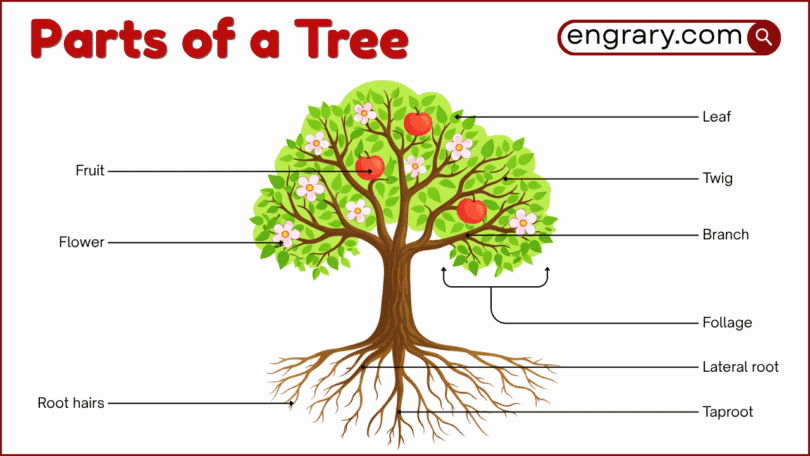
The labeled diagram below shows the main outer and inner parts of a tree and how they are arranged from the roots to the crown. It highlights major structures such as the root system, trunk, bark, cambium, sapwood, heartwood, branches, leaves, flowers, fruit, and cones so readers can identify each part more easily. It also helps show how the underground roots connect with the trunk and how the upper parts spread outward through the crown.
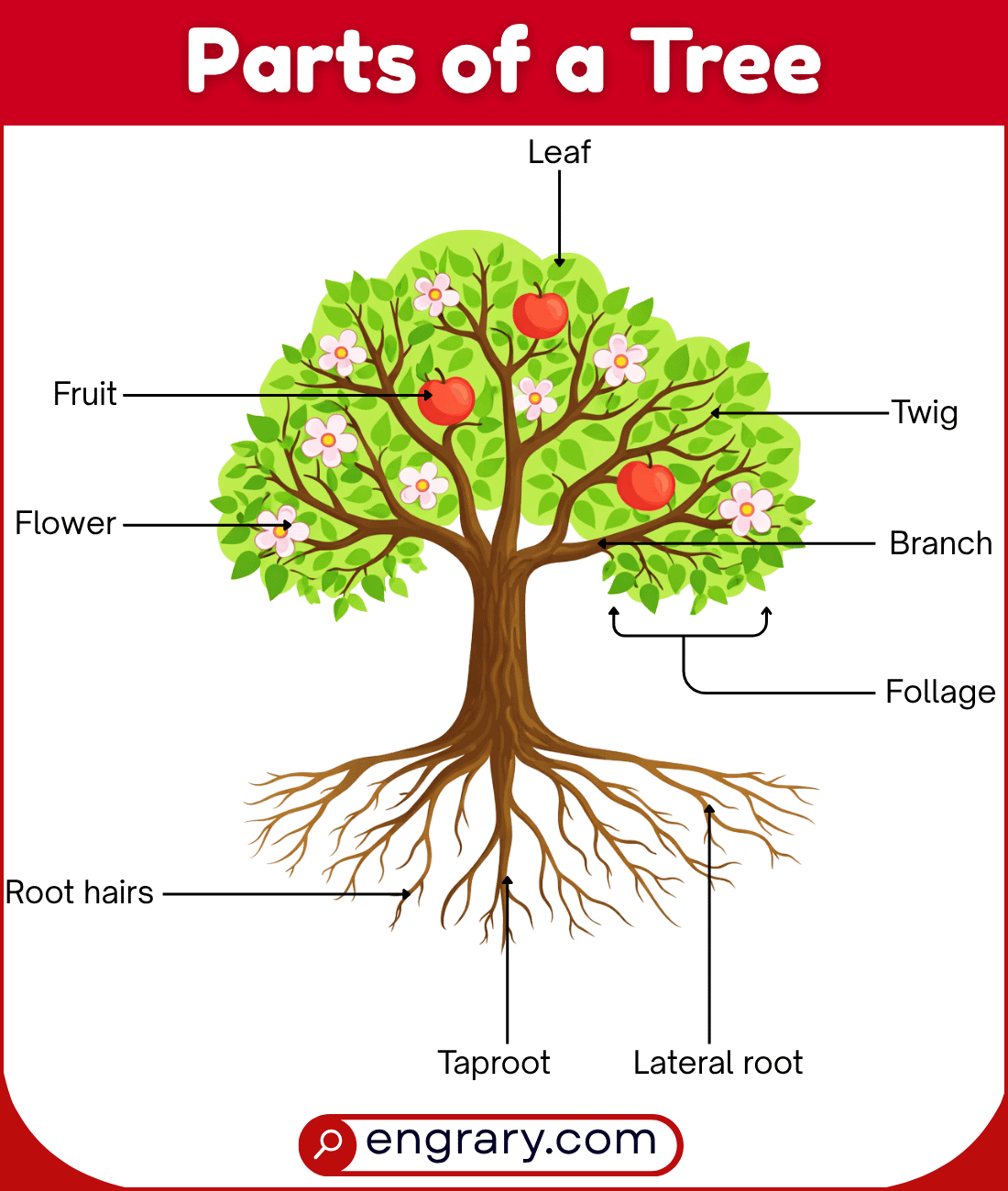
Main Parts of a Tree
The main parts of a tree can be grouped into below-ground parts, supportive woody parts, upper growing parts, food-making parts, reproductive parts, and transport tissues. Each group has a specific job, but all of them work together to keep the tree alive.
Root System
The root system is the underground part of the tree. It anchors the tree in the soil and absorbs water and minerals needed for growth.
Trunk
The trunk is the main woody stem of the tree. It supports the crown and connects the roots with the upper parts of the tree.
Crown
The crown is the upper part of the tree made up of branches, twigs, leaves, and buds. It spreads outward to capture sunlight and support new growth.
Leaves
Leaves are the main food-making parts of the tree. They use sunlight, water, and carbon dioxide to produce food through photosynthesis.
Reproductive Parts
The reproductive parts include structures such as flowers, fruit, seeds, or cones. These parts help the tree produce offspring and continue its life cycle.
Transport Parts
Transport parts move materials through the tree. Xylem carries water and minerals upward, phloem carries sugars to other parts, and cambium helps produce new living tissues.
Root Parts of a Tree
The root parts of a tree lie mostly below the ground, where they anchor the tree and absorb the water and minerals needed for growth. Although they are often hidden from view, these parts are essential because they support the tree, connect it to the soil, and help it survive in changing conditions.
Root System
The root system is the full network of roots below the tree. It spreads through the soil to hold the tree in place and take in the water and minerals the tree needs to live.
Taproot
A taproot is the main central root that grows downward in some trees. It helps anchor the tree deeply and may reach lower layers of soil where water is available.
Lateral Roots
Lateral roots grow outward from the main root system. They spread through the soil to support the tree and increase the area where water and minerals can be absorbed.
Feeder Roots
Feeder roots are small, active roots that absorb most of the water and minerals entering the tree. They are usually found closer to the soil surface, where nutrients and moisture are easier to reach.
Fine Roots
Fine roots are the thin, delicate parts of the root system. They help increase the absorbing surface of the tree and play a major role in taking in water from the soil.
Root Hairs
Root hairs are tiny hair-like extensions on young roots. They greatly increase the surface area for absorption, allowing the tree to gather more water and dissolved minerals.
Root Flare
The root flare is the widened area at the base of the trunk where the trunk begins to spread into the main roots. It forms the transition between the above-ground trunk and the underground root system.
Trunk Parts of a Tree
The trunk parts of a tree form the strong central support of the whole structure. In addition to holding up the crown, these parts protect the inside of the tree, move materials through the stem, and add new layers of growth over time.
Trunk
The trunk is the main upright woody stem of the tree. It supports the crown above and provides the central pathway that links the roots with the upper parts of the tree.
Bole
The bole is another name for the main trunk of a tree, especially the long central section below the branches. It is the solid woody column that gives the tree much of its height and support.
Bark
Bark is the outer covering of the trunk and branches. It protects the inner tissues from injury, drying, insects, and harsh environmental conditions.
Outer Bark
Outer bark is the outermost protective layer of the trunk. It forms a tough surface that shields the tree from outside damage and helps reduce water loss.
Inner Bark
Inner bark is the layer just inside the outer bark. It carries food made in the leaves to other parts of the tree and helps keep the living tissues supplied with energy.
Cambium
Cambium is a thin layer of living cells between the inner bark and the wood. It produces new bark on the outside and new wood on the inside, so it is responsible for the tree’s increase in thickness.
Sapwood
Sapwood is the younger, lighter-colored wood just inside the cambium. It carries water and minerals upward from the roots to the leaves and other growing parts.
Heartwood
Heartwood is the older, darker wood near the center of the trunk. It no longer carries water, but it gives the tree strong internal support.
Tree Rings
Tree rings are the circular layers of growth visible inside the trunk. Each ring marks a period of growth, and together they show how the tree has added new wood over time.
Crown Parts of a Tree
The crown is the upper part of the tree made up of branches, twigs, leaves, and buds. It spreads outward and upward to capture sunlight, support new growth, and hold many of the parts involved in food production and reproduction.
Crown
The crown is the top part of the tree above the trunk. It includes the branches, twigs, leaves, and buds that form the tree’s broad upper shape.
Branches
Branches grow outward from the trunk and support smaller shoots, leaves, flowers, fruit, or cones. They help spread the crown so the tree can reach more sunlight.
Twigs
Twigs are the smaller woody stems found at the ends of branches. They hold leaves, buds, and young growth, making them important for the tree’s continued development.
Shoots
Shoots are young growing stems that develop from buds. They extend the length of branches and carry new leaves, flowers, or other growing parts.
Buds
Buds are small growth points found on twigs and branches. They contain undeveloped leaves, shoots, or flowers that will open as the tree continues to grow.
Growing Points
Growing points are the active areas where new cells are produced for length growth. These points help the crown expand by forming new shoots, leaves, and branch tips.
Leaf Parts of a Tree
The leaf parts of a tree help the plant make food, exchange gases, and manage water loss. Although leaves may vary in shape and size, their main parts work together to support photosynthesis and healthy growth.
Leaves
Leaves are the green food-making parts of the tree. They capture sunlight and use it to produce food from water and carbon dioxide.
Leaf Blade
The leaf blade is the broad, flat part of the leaf. It provides a wide surface for capturing sunlight and carrying out photosynthesis.
Petiole
The petiole is the stalk that attaches the leaf blade to the twig or stem. It holds the leaf in position and connects it to the tree’s transport system.
Veins
Veins are the thin lines that run through the leaf blade. They carry water and nutrients into the leaf and move food away from it.
Stomata
Stomata are tiny openings, usually found on the surface of leaves. They allow gases to move in and out of the leaf and help regulate water loss.
Reproductive Parts of a Tree
The reproductive parts of a tree help it produce seeds and continue its life cycle. In many trees, these parts develop in the crown, where flowers, fruit, or cones form and later release or protect the seeds for new growth.
Flowers
Flowers are the reproductive structures of many trees. They help the tree produce seeds by forming the parts needed for pollination and fertilization.
Fruit
Fruit develops from the flower in many trees after fertilization. It protects the seeds and often helps spread them by attracting animals or falling to the ground.
Seeds
Seeds contain the young plant and stored food needed for early growth. Once they land in a suitable place, they can begin developing into a new tree.
Cones
Cones are the reproductive structures of many conifer trees, such as pines and firs. They hold and protect the seeds until the seeds are ready to be released.
Transport Parts of a Tree
The transport parts of a tree move water, minerals, and food through the trunk, branches, and roots. Because a tree depends on steady internal movement, these tissues connect the lower and upper parts into one working system.
Xylem
Xylem is the tissue that carries water and dissolved minerals upward from the roots to the trunk, branches, and leaves. It forms an important part of the tree’s inner wood and supports both transport and structure.
Phloem
Phloem is the tissue that carries sugars made in the leaves to other parts of the tree. In this way, it helps distribute food to growing, living tissues throughout the plant.
Cambium
Cambium is the thin living layer between the bark and the wood. It produces new xylem on the inside and new phloem on the outside, so it plays a key role in both transport and growth.
Functions of Tree Parts
Each part of a tree has a specific role, but all of them work together to keep the tree alive. The root system, including the taproot, lateral roots, feeder roots, fine roots, and root hairs, anchors the tree and absorbs water and minerals from the soil. Above that, the trunk, bole, bark, outer bark, inner bark, cambium, sapwood, heartwood, and tree rings support the tree, protect its inner tissues, and add new layers of growth over time. In the crown, the branches, twigs, shoots, buds, and growing points hold the upper structure and allow the tree to spread, grow, and produce new parts. The leaves, including the leaf blade, petiole, veins, and stomata, make food and manage gas exchange. Meanwhile, the flowers, fruit, seeds, and cones support reproduction, while xylem, phloem, and cambium connect the whole system by moving water, minerals, sugars, and new growth through the tree.
Key Takeaways
The parts of a tree work together as one connected system, with the roots anchoring the tree and absorbing water, the trunk and its layers supporting the body and moving materials, the crown holding branches and growth points, the leaves making food, and the reproductive parts producing seeds for new life. As water and minerals rise through the xylem and sugars move through the phloem, each group supports the next, allowing the tree to grow, stay strong, and continue its life cycle.
FAQs
The main parts of a tree include the root system, trunk, crown, leaves, reproductive parts, and transport tissues. Together, these parts help the tree absorb water, make food, grow, and reproduce.
The bark protects the tree’s inner tissues from injury, drying, insects, and harsh weather. It forms the outer covering of the trunk and branches.
Xylem carries water and minerals upward from the roots, while phloem carries sugars made in the leaves to other parts of the tree. Both are important transport tissues.
The roots anchor the tree in the soil and absorb water and minerals. Smaller parts such as feeder roots, fine roots, and root hairs increase the tree’s ability to take in what it needs.
The crown is the upper part of the tree made up of branches, twigs, leaves, and buds. It helps the tree capture sunlight, grow outward, and support reproduction.
You May Also Like