A root has several outer and inner parts that help a plant absorb water, take in minerals, anchor itself in the soil, and move materials upward. The main groups include the main root, branching roots, growth regions near the tip, root hairs, and internal tissues such as the cortex, endodermis, xylem, and phloem.
These parts also work in a connected sequence. First, the root cap protects the tip as the root pushes through soil. Just behind it, the apical meristem and zone of cell division produce new cells, the zone of elongation lengthens the root, and the zone of maturation develops root hairs for absorption. Farther inside, the epidermis, cortex, endodermis, pericycle, stele, xylem, and phloem help regulate movement, support branching, and transport water and dissolved nutrients.
Parts of a Root Labeled Diagram
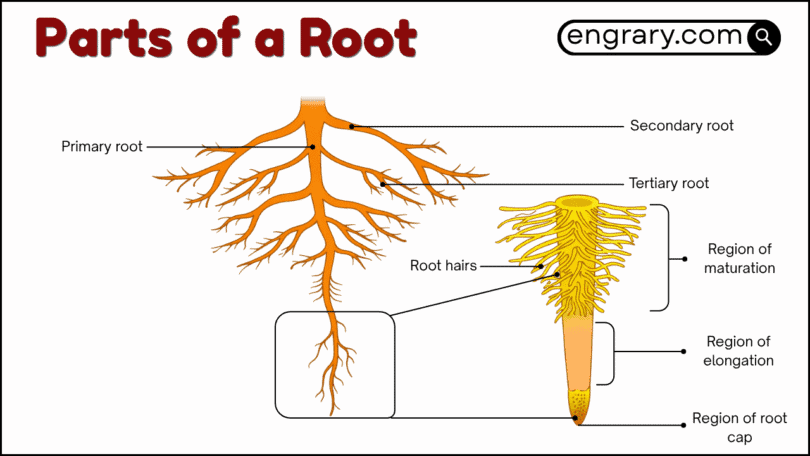
The diagram below shows the main external and internal parts of a root and how they are arranged from the tip to the central transport tissues. It highlights key parts such as the root cap, apical meristem, root hairs, cortex, endodermis, stele, xylem, and phloem so readers can identify each labeled part more easily.

Main External Parts and Regions of a Root
Primary Root
The primary root is the main central root that grows downward from the seedling. It forms the main axis of the root system and supports anchorage and absorption.
Lateral Root
Lateral roots branch out from the primary root and spread through the soil. They increase the total absorbing area and help the plant hold more firmly in place.
Root Tip
The root tip is the growing end of the root. It contains the youngest regions of growth and leads the root forward into the soil.
Root Cap
The root cap is the protective structure that covers the root tip. It shields the delicate growing tissue as the root moves through soil and is continuously worn away and replaced.
Apical Meristem
The apical meristem is the active growth tissue just behind the root cap. Cells here divide rapidly and produce the new cells needed for root growth.
Zone of Cell Division
The zone of cell division is the region closest to the root tip where new cells are formed. It is made up of actively dividing meristematic cells and begins the root’s growth sequence.
Zone of Elongation
In the zone of elongation, newly formed cells increase in size. This lengthening pushes the root farther through the soil.
Zone of Maturation
The zone of maturation is the region where cells become fully specialized. Root hairs form here, which makes this area especially important for water and mineral absorption.
Root Hair
Root hairs are fine extensions of epidermal cells in the maturation zone. They greatly increase the surface area of the root and help absorb water and dissolved minerals from the soil.
Internal Parts of a Root
Epidermis
The epidermis is the outermost cell layer of the root. It protects the root surface and gives rise to root hairs in the absorbing region.
Cortex
The cortex is the broad region inside the epidermis. It stores materials and helps move water inward from the outer root tissues toward the center.
Endodermis
The endodermis is the inner boundary of the cortex. It forms a controlled barrier around the inner vascular tissues and helps regulate what enters the center of the root.
Casparian Strip
The Casparian strip is a waxy band in the endodermis. It blocks easy flow between cells and forces water and dissolved substances to pass through endodermal cell membranes before entering the stele.
Pericycle
The pericycle is the outermost layer of the vascular tissue just inside the endodermis. It is important because lateral roots can arise from this region.
Vascular Cylinder (Stele)
The vascular cylinder, also called the stele, is the central transport region of the root. It contains the main conducting tissues, including xylem and phloem.
Xylem
Xylem carries water and dissolved minerals upward from the root to the rest of the plant. It is one of the two main transport tissues in the stele.
Phloem
Phloem carries food made in other parts of the plant to areas that need it, including the root. It works with xylem as part of the root’s transport system.
Pith
The pith is a central tissue region found clearly in some roots. It can store materials, but it is less emphasized in basic root-part diagrams than the cortex, endodermis, stele, xylem, and phloem.
Cambium
Cambium is a growth tissue linked to thicker, more developed plant organs. In a general root-parts article, it is more advanced than the core tissues, but it can be included in a comprehensive version because it contributes to secondary growth in suitable roots.
Key Takeaways
The parts of a root can be grouped into outer regions of growth and inner transport tissues. The root cap, apical meristem, zone of cell division, zone of elongation, zone of maturation, and root hairs guide protection, growth, and absorption. Inside the root, the epidermis, cortex, endodermis, Casparian strip, pericycle, and stele regulate movement and branching. Finally, the xylem and phloem transport water, minerals, and food through the plant in a continuous flow.
FAQs
The main parts of a root include the primary root, lateral roots, root tip, root cap, growth zones, root hairs, epidermis, cortex, endodermis, pericycle, stele, xylem, and phloem.
The root cap protects the growing tip of the root as it pushes through soil. It is worn down by contact with soil and replaced continuously.
Root hairs develop in the zone of maturation, also called the differentiation region. They are extensions of epidermal cells and increase the absorbing surface of the root.
The Casparian strip helps control what enters the stele by blocking easy movement between endodermal cells. This forces water and dissolved substances to pass through cell membranes instead.
The stele is the central vascular cylinder of the root. It contains the transport tissues, especially xylem and phloem.
You May Also Like