A leaf has several visible and internal parts that help the plant make food, exchange gases, move water, and stay attached to the stem. The main groups include the blade, edges, veins, base, surface layers, and inner tissues, and each one supports photosynthesis, transport, protection, or gas exchange.
Together, these parts work in a connected flow. First, the blade spreads out to capture sunlight, while the surface layers protect the leaf and help control gas exchange. Then, the veins, xylem, and phloem move water, minerals, and food through the leaf. At the same time, the mesophyll tissues support photosynthesis, while the petiole and leaf base hold the leaf in position on the plant.
Parts of a Leaf Labeled Diagram
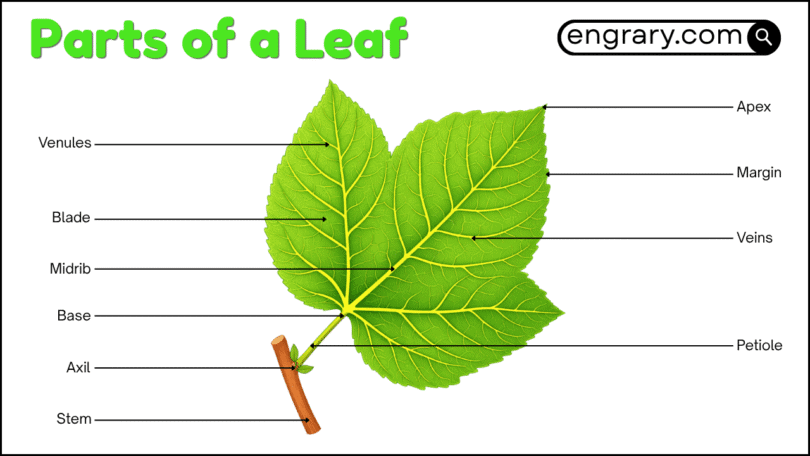
The diagram below shows the main visible and internal parts of a leaf and how they are arranged across the blade, edges, veins, surface layers, and inner tissues. It highlights key parts such as the lamina, apex, margin, midrib, stomata, guard cells, mesophyll, xylem, and phloem so readers can identify each labeled part more easily.
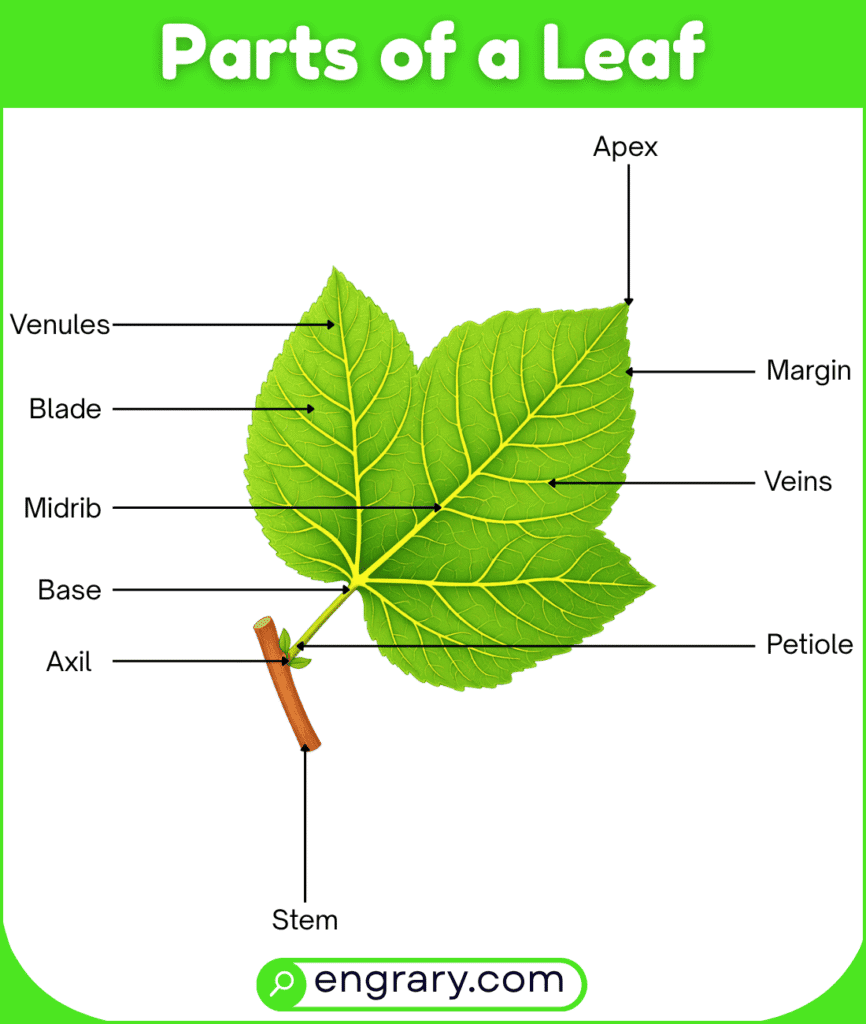
Main Parts of a Leaf
Leaf Blade (Lamina)
The leaf blade, also called the lamina, is the broad flat part of the leaf. It provides the main surface area for capturing sunlight and carrying out photosynthesis.
Tip (Apex)
The tip, or apex, is the end part of the leaf blade. It marks the outermost point of the leaf and helps define the overall leaf shape.
Margin
The margin is the outer edge of the leaf blade. It forms the boundary of the leaf and may be smooth, toothed, wavy, or lobed.
Midrib
The midrib is the main central vein that runs through the leaf blade. It supports the leaf and connects the smaller veins across the surface.
Veins
Veins branch out from the midrib through the leaf blade. They help carry water, minerals, and food while also supporting the leaf structure.
Veinlets
Veinlets are the smaller branches that spread from the main veins. They form a fine network that helps reach more parts of the leaf blade.
Petiole
The petiole is the stalk that attaches the leaf blade to the stem. It supports the leaf and helps hold it in a position where it can receive light.
Leaf Base
The leaf base is the lower part of the leaf where it joins the petiole or stem. It helps attach the leaf securely to the plant.
Stipule
Stipules are small leaf-like structures found at the base of some leaves. In certain plants, they help protect the young developing leaf.
Outer Surface and Support Parts of a Leaf
Cuticle
The cuticle is a thin waxy layer that covers the leaf surface. It helps reduce water loss and protects the leaf from outside damage.
Upper Epidermis
The upper epidermis is the outer cell layer on the top side of the leaf. It protects the inner tissues beneath it and lies just under the cuticle.
Lower Epidermis
The lower epidermis is the outer cell layer on the underside of the leaf. It protects the lower surface and often contains many stomata.
Stomata
Stomata are tiny openings in the leaf surface. They allow gases to move in and out and also help regulate water loss.
Guard Cells
Guard cells are the paired cells around each stoma. They control when the stomata open and close.
Internal Parts of a Leaf
Mesophyll
The mesophyll is the inner tissue between the upper and lower epidermis. It contains the main cells involved in photosynthesis.
Palisade Mesophyll
Palisade mesophyll is the tightly packed upper layer of the mesophyll. It contains many chloroplasts and plays a major role in capturing light for photosynthesis.
Spongy Mesophyll
Spongy mesophyll is the looser lower layer of the mesophyll. Its air spaces help gases move through the leaf.
Vascular Bundle
The vascular bundle is the transport tissue found inside the veins of the leaf. It contains the xylem and phloem.
Bundle Sheath
The bundle sheath is the layer of cells that surrounds the vascular bundle. It protects and supports the transport tissue inside the leaf.
Xylem
Xylem carries water and minerals from the roots to the leaf. It is one of the main transport tissues in the vascular bundle.
Phloem
Phloem carries food made by the leaf to other parts of the plant. It works with the xylem as part of the transport system.
Key Takeaways
The parts of a leaf can be grouped into visible parts, surface layers, and internal tissues. The blade, tip, margin, midrib, veins, petiole, and base shape the leaf and help hold it in place. The cuticle, epidermis, stomata, and guard cells protect the leaf and control gas exchange. Inside the leaf, the mesophyll supports photosynthesis, while the vascular bundle, xylem, and phloem move water, minerals, and food through the plant in a connected flow.
FAQs
The main parts of a leaf include the blade, tip, margin, midrib, veins, petiole, base, and internal tissues. Surface layers and transport tissues also help the leaf work properly.
The lamina is the broad flat part of the leaf, also called the leaf blade. It is the main area where photosynthesis takes place.
Stomata are tiny openings that allow gases to move in and out of the leaf. They also help control water loss.
The midrib supports the leaf blade and connects the main network of veins. It helps with both strength and transport.
Veins carry water, minerals, and food through the leaf. They also help support the leaf structure.
Summary
A leaf has visible parts, surface layers, and internal tissues that work together in one connected system. The blade and outer parts help capture light and shape the leaf, the surface layers protect it and manage gas exchange, and the internal tissues support photosynthesis and transport. When these parts work together, the leaf can help the plant make food and stay healthy.
You May Also Like