The mouth includes several connected parts that help with eating, speaking, tasting, swallowing, and saliva control. The main groups usually include the lips, cheeks, teeth, gums, tongue, palate, salivary glands, and oral lining. Each part has its own role, so together they form a working space that manages food, sound, moisture, and movement.
At the same time, these parts work as one system rather than as separate pieces. The lips help close the opening, the teeth and tongue handle food, the palate supports the roof and back passage, and the salivary glands keep the mouth moist. Meanwhile, the oral lining protects the inner surfaces, while the back parts of the mouth help guide chewing into swallowing and speech.
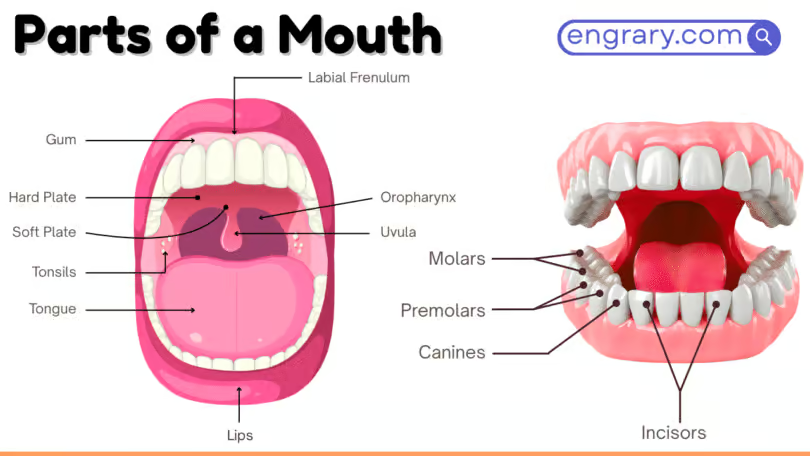
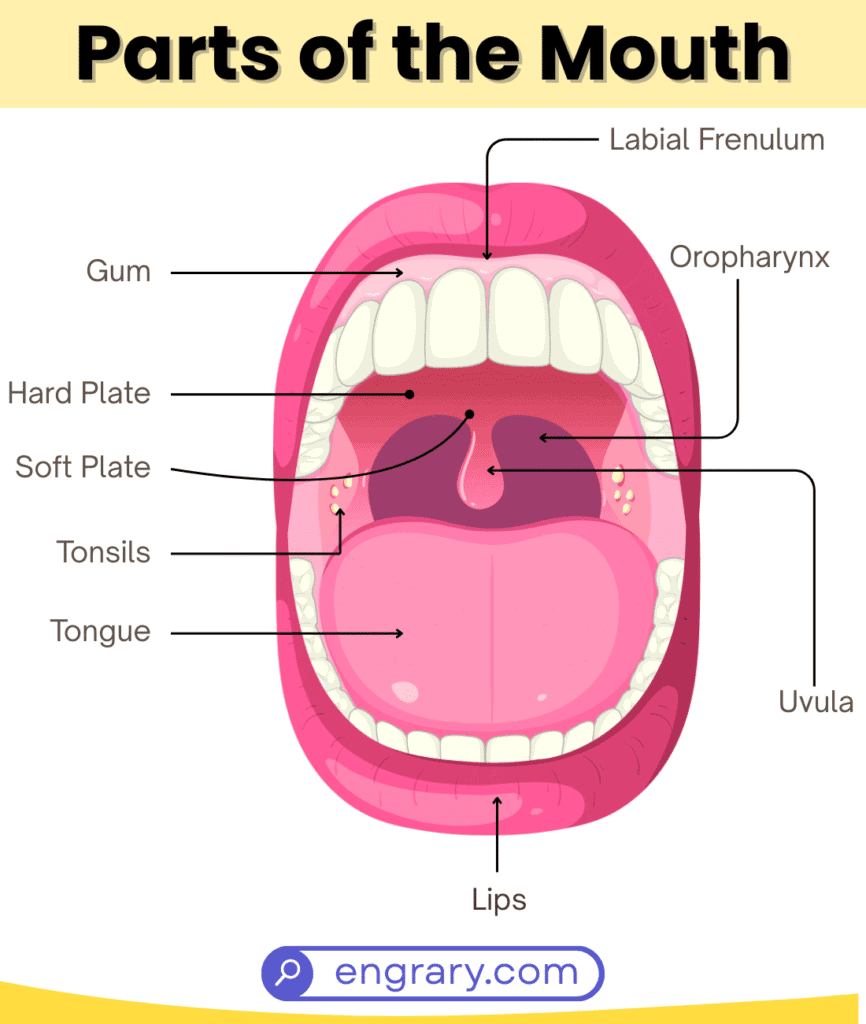
Parts of a Mouth With Labeled Diagram
A labeled diagram of the mouth usually points to the most visible and most teachable parts first. These names help readers identify the opening, inner lining, tongue area, teeth, gums, and roof of the mouth before moving into smaller anatomy details.
Lips
The lips form the soft outer opening of the mouth. They help close the mouth, support speech sounds, and control how food and drink enter.
Cheeks
The cheeks form the soft side walls of the mouth. They help keep food between the teeth during chewing and support the shape of the face and oral cavity.
Teeth
Teeth are the hard biting structures inside the mouth. They help cut, tear, and grind food into smaller pieces.
Gums
The gums, also called gingiva, surround and support the teeth. They cover the tooth-supporting area and help protect the base of the teeth.
Tongue
The tongue is a muscular part in the floor of the mouth. It helps with tasting, moving food, speaking, and starting swallowing.
Palate
The palate forms the roof of the mouth. It separates the oral cavity from the nasal space above and helps guide speech and swallowing.
Salivary Glands
Salivary glands produce saliva inside and around the mouth. Saliva keeps the mouth moist and helps begin food processing.
Oral Mucosa
The oral mucosa is the soft lining that covers the inside of the mouth. It protects the inner surfaces and helps create a moist environment.
Main Parts of a Mouth and Their Functions
The main parts of a mouth can be grouped by what they do. Some form the opening, some prepare food, some support taste and speech, and others protect the inside surfaces or produce saliva.
Lips
Lips create the movable border of the mouth opening. They help control eating, facial expression, and many speech sounds.
Cheeks
Cheeks support the side walls of the oral space. They keep food in place during chewing and work with the lips and tongue during mouth movement.
Teeth
Teeth perform the main mechanical work of biting and chewing. Different teeth shapes help handle different stages of food breakdown.
Gums
Gums surround the tooth bases and cover the supporting ridge area. They help protect the structures that hold the teeth in place.
Tongue
The tongue moves food around the mouth and helps form words. It also carries taste structures and supports the early stage of swallowing.
Palate
The palate forms the roof of the mouth and helps divide oral and nasal spaces. Its front and back sections support different functions during speech and swallowing.
Salivary Glands
These glands release saliva into the mouth. Saliva moistens food, supports taste, and helps keep the mouth from becoming dry.
Oral Mucosa
The oral mucosa covers the inner surfaces of the mouth. It protects these areas and supports the soft, moist environment needed for normal mouth function.
Outer and Opening Parts of the Mouth
The outer and opening parts of the mouth form the visible entrance to the oral cavity. These parts shape the opening, support facial movement, and help control how food, air, and speech pass through the mouth.
Upper Lip
The upper lip forms the top border of the mouth opening. It helps close the mouth, shape expressions, and guide speech and eating movements.
Lower Lip
The lower lip forms the bottom border of the mouth opening. It moves with the upper lip during speaking, chewing, and swallowing.
Corners of the Mouth
The corners of the mouth are the side points where the upper and lower lips meet. They help shape the mouth opening and change position during facial expression and speech.
Cheeks
The cheeks form the soft outer side walls around the mouth opening. They help keep food from slipping outward and support the sides of the oral space.
Oral Fissure
The oral fissure is the opening between the upper and lower lips. It is the main entrance into the mouth and changes shape as the lips move.
Labial Frenulum or Labial Frena
The labial frenulum is a small fold of tissue that connects the inner lip to the gum area. It helps link the lips to the mouth lining and is visible when the lip is lifted.
Inside Parts of the Mouth
The inside parts of the mouth include the main internal spaces and soft lining areas that support chewing, speech, taste, and moisture control. While some parts are easy to see, others are better understood as regions that organize the inside of the mouth.
Oral Vestibule
The oral vestibule is the space between the lips or cheeks and the teeth or gums. It forms the outer part of the mouth cavity just inside the opening.
Oral Cavity Proper
The oral cavity proper is the inner main space located inside the dental arches. It contains the tongue and leads back toward the throat area.
Oral Mucosa
The oral mucosa is the soft lining that covers the inner surfaces of the mouth. It protects the tissues and helps keep the mouth moist.
Buccal Mucosa
The buccal mucosa is the inner lining of the cheeks. It forms the soft inner cheek surface inside the mouth.
Labial Mucosa
The labial mucosa is the inner lining of the lips. It covers the inside surface of the upper and lower lips.
Floor of the Mouth
The floor of the mouth is the soft area beneath the tongue. It supports the tongue above and contains important openings and tissue folds below it.
Floor-of-Mouth Mucosa
This is the soft lining that covers the floor of the mouth. It helps protect the lower inner surface and supports the moist environment of the oral cavity.
Teeth and Gum Parts of the Mouth
The teeth and gums form the main biting and supporting section of the mouth. While the teeth do the visible cutting and grinding, the surrounding gum and bone-related parts help hold them in place and support the whole dental arch.
Teeth
Teeth are the hard structures used for biting and chewing food. Together, they form the main mechanical surface that breaks food into smaller pieces before swallowing.
Incisors
Incisors are the front teeth at the front of the mouth. They are mainly used to cut or bite into food first.
Canines
Canines are the pointed teeth next to the incisors. Their shape helps grip and tear food.
Premolars
Premolars sit behind the canines. They help crush and begin grinding food during chewing.
Molars
Molars are the larger back teeth. They provide the broad chewing surface that grinds food more thoroughly.
Gums or Gingiva
The gums, also called gingiva, are the soft tissues that surround the teeth. They cover the supporting area around the tooth bases and help protect those structures.
Alveolar Ridge or Alveolar Process
This ridge is the tooth-supporting part of the jaw area inside the mouth. It forms the raised border that holds the tooth sockets and supports the gums above it.
Alveolar Bone
Alveolar bone is the bone that supports and surrounds the tooth roots. It gives the teeth a firm base within the jaws.
Dental Arches
The dental arches are the curved arrangements of the upper and lower teeth. They shape the biting area and help organize the teeth around the oral cavity proper.
Tongue Parts of the Mouth
The tongue is a muscular structure that supports taste, speech, food movement, and the first stage of swallowing. It can be divided into the tip, body, and root, while other named parts help anchor it and support taste.
Tongue Tip
The tongue tip is the front end of the tongue. It helps with precise movement during speech, food handling, and touch sensation inside the mouth.
Body of the Tongue
The body is the main front and middle portion of the tongue. It performs much of the movement needed for chewing, shaping food, and forming speech sounds.
Root of the Tongue
The root is the back part of the tongue where it connects more firmly within the mouth and throat region. It supports the tongue’s deeper attachment and helps during swallowing.
Lingual Frenulum
The lingual frenulum is the fold of tissue under the tongue that connects it to the floor of the mouth. It helps anchor the tongue while still allowing movement.
Taste Papillae or Taste Buds
Papillae are small elevations on the tongue surface, and several types contain taste buds. These structures help the tongue detect taste while also contributing to the tongue’s surface texture.
Lingual Tonsil
The lingual tonsil is tissue located near the root of the tongue. It forms part of the back area of the mouth and tongue region.
Roof and Back Parts of the Mouth
The roof and back parts of the mouth help separate spaces, guide food, and support speech and swallowing. While the front roof gives structure, the softer back region helps control movement toward the throat.
Hard Palate
The hard palate forms the front bony part of the roof of the mouth. It separates the mouth from the nasal area above and provides a firm surface inside the oral cavity.
Soft Palate
The soft palate is the softer back part of the roof of the mouth. It helps guide food backward and plays an important role during swallowing and speech.
Uvula
The uvula is the small hanging structure at the back edge of the soft palate. It is visible when the mouth is open wide and sits at the center of the back mouth area.
Fauces
The fauces is the opening at the back of the mouth that leads toward the throat. It forms the passage between the oral cavity and the pharyngeal region.
Palatoglossal Arch
This arch is a fold of tissue that runs from the soft palate toward the side of the tongue. It helps mark the boundary near the back of the mouth.
Palatine Tonsil or Tonsillar Pillars
This area lies at the sides of the back mouth region. It forms part of the tissue zone near the fauces and helps define the side boundaries of the throat opening.
Saliva and Support Parts of the Mouth
Saliva and support parts help keep the mouth moist, support food movement, and aid basic oral function. These parts are important because the mouth needs moisture and controlled secretions to work smoothly during eating, speaking, and swallowing.
Parotid Gland
The parotid gland is a major salivary gland located near the side of the face. It helps produce saliva that enters the mouth through duct openings.
Submandibular Gland
The submandibular gland is a major salivary gland found beneath the lower jaw area. It contributes a significant part of the saliva used in the mouth.
Sublingual Gland
The sublingual gland lies beneath the tongue. It releases saliva into the floor-of-mouth area.
Salivary Duct Openings
These are the small openings where saliva enters the mouth from the glands. They allow saliva to reach the oral cavity where it can moisten food and tissue surfaces.
Sublingual Area
The sublingual area is the region under the tongue. It contains soft tissues and gland-related structures that support saliva flow and tongue movement.
Sublingual Papilla or Caruncle
This is a small raised structure in the floor-of-mouth region near the base of the tongue. It marks an important area where saliva enters the mouth.
Common Mouth Parts by Function
Mouth parts can also be grouped by what they help the body do. Although the same structure may support more than one task, this functional view makes it easier to understand how the mouth works during everyday actions.
Parts That Help With Chewing
The lips, cheeks, teeth, gums, tongue, and dental arches all help with chewing. Together, they keep food in place, bite it, tear it, and grind it into smaller pieces.
Parts That Help With Swallowing
The tongue, soft palate, fauces, and back mouth area help guide food from the oral cavity toward the throat. These parts support the change from chewing to swallowing.
Parts That Help With Speaking
The lips, tongue, teeth, hard palate, and soft palate all help shape sounds. Their movement and position affect how words and speech sounds are formed.
Parts That Help With Taste
The tongue, especially its papillae and taste buds, plays the main role in taste. Saliva also supports this function by helping dissolved food particles contact the tongue surface.
Mouth Key Takeaways
The mouth works as one connected system in which the lips and cheeks form the opening and side walls, the teeth and gums handle biting and support, the tongue moves food and helps with taste and speech, the palate and back mouth parts guide swallowing, and the salivary glands and oral lining keep the mouth moist and protected. As food enters, the lips close, the teeth break it down, the tongue moves it, saliva moistens it, and the back parts of the mouth guide it toward swallowing.
FAQs
The main parts of a mouth include the lips, cheeks, teeth, gums, tongue, palate, salivary glands, and oral mucosa.
The oral vestibule is the space between the lips or cheeks and the teeth or gums, while the oral cavity proper is the inner main space inside the dental arches.
The main chewing parts are the lips, cheeks, teeth, gums, tongue, and dental arches. Together, they hold, bite, tear, and grind food.
The roof of the mouth includes the hard palate at the front and the soft palate at the back. The uvula hangs from the back edge of the soft palate.
The main saliva-producing parts are the parotid gland, submandibular gland, and sublingual gland. Their duct openings release saliva into the mouth.
You May Also Like