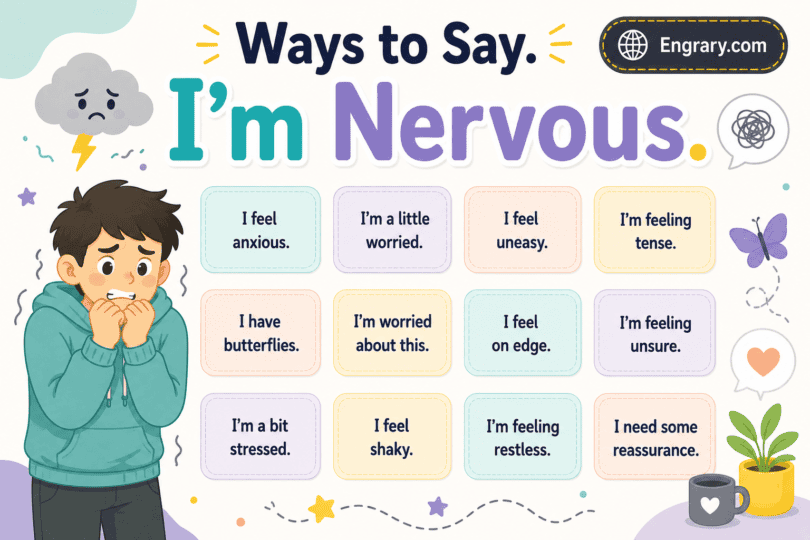
“I’m nervous” is a natural phrase in English, but sometimes you may want to sound calmer, more professional, more specific, or less dramatic. Nervousness can happen before an interview, exam, presentation, first meeting, performance, or any situation where the outcome feels uncertain.
For example, “I’m a little nervous” works well for mild nerves, while “I’m anxious” feels stronger. Meanwhile, “I’m feeling some pressure, but I’m prepared” sounds more professional. Therefore, this guide gives you 100 better ways to say “I’m nervous” in English with examples for interviews, exams, presentations, social situations, texts, body feelings, and everyday conversations.
Quick Guide: Best “I’m Nervous” Alternatives
| Situation | Best Phrase |
|---|---|
| Mild nerves | I’m a little nervous |
| Uneasy feeling | I feel uneasy |
| Worry | I’m worried |
| Strong nervousness | I’m anxious |
| Physical nerves | I have butterflies in my stomach |
| Interview nerves | I’m feeling some pre-interview nerves |
| Exam nerves | I’m nervous about the exam |
| Performance nerves | I have stage fright |
| Professional nerves | I’m feeling some pressure, but I’m prepared |
| Calm nervousness | I’m nervous, but I’m ready |
| Short text | I’m nervous |
| Need a moment | I need a moment to gather myself |
“Nervous,” “Anxious,” and “Worried”: What’s the Difference?
These words are similar, but they are not exactly the same. “Nervous” often describes feelings before an event, “anxious” can be stronger, and “worried” usually focuses on a possible bad result.
| Phrase | Meaning | Best Use |
|---|---|---|
| I’m nervous | Usually before an event, meeting, decision, or uncertain moment | Interviews, exams, speeches, first dates |
| I’m anxious | Stronger nervousness or worry; can also describe anxiety | Strong worry, uncertainty, pressure |
| I’m worried | Concern about a possible problem or bad outcome | Future problems, results, safety |
| I’m uneasy | Uncomfortable or unsure | Doubt, discomfort, hesitation |
| I’m apprehensive | Formal way to say nervous or hesitant | Professional or careful wording |
| I’m jittery | Physical nervous energy | Body reactions, restlessness |
| I’m tense | Physical or emotional tightness | Stress, pressure, discomfort |
| I’m on edge | Nervous, tense, and easily startled | Stressful situations |
Is “I’m Nervous” Natural in English?
Yes, “I’m nervous” is natural, polite, and easy to understand. You can use it in everyday conversations, texts, interviews, school situations, and personal moments.
However, in professional settings, it may sound stronger if you add confidence or preparation. Instead of only saying “I’m nervous,” you can say “I’m a little nervous, but I’m prepared,” or “I’m feeling some pressure, but I’m ready to begin.” This shows honesty without sounding overwhelmed.
When You Feel a Little Nervous
Use these phrases when your nervousness is mild, manageable, or connected to a small worry.
I’m a little nervous
A simple phrase for mild nervousness.
Example: I’m a little nervous about meeting them.
I’m slightly anxious
A gentle phrase for light anxiety.
Example: I’m slightly anxious about tomorrow.
I’m feeling a bit uneasy
A polite phrase for discomfort or uncertainty.
Example: I’m feeling a bit uneasy about the plan.
I have a few nerves
A natural phrase for mild nervous feelings.
Example: I have a few nerves before the event.
I’m a little tense
A phrase for light physical or emotional tension.
Example: I’m a little tense before the meeting.
I’m not fully relaxed
A soft phrase for feeling nervous but controlled.
Example: I’m not fully relaxed yet.
I’m a bit worried
A phrase for mild concern.
Example: I’m a bit worried about the result.
I’m feeling unsure
A phrase for uncertainty.
Example: I’m feeling unsure about what to say.
I’m mildly apprehensive
A formal phrase for slight nervousness.
Example: I’m mildly apprehensive about the decision.
I’m a little on edge
A phrase for light tension or nervousness.
Example: I’m a little on edge today.
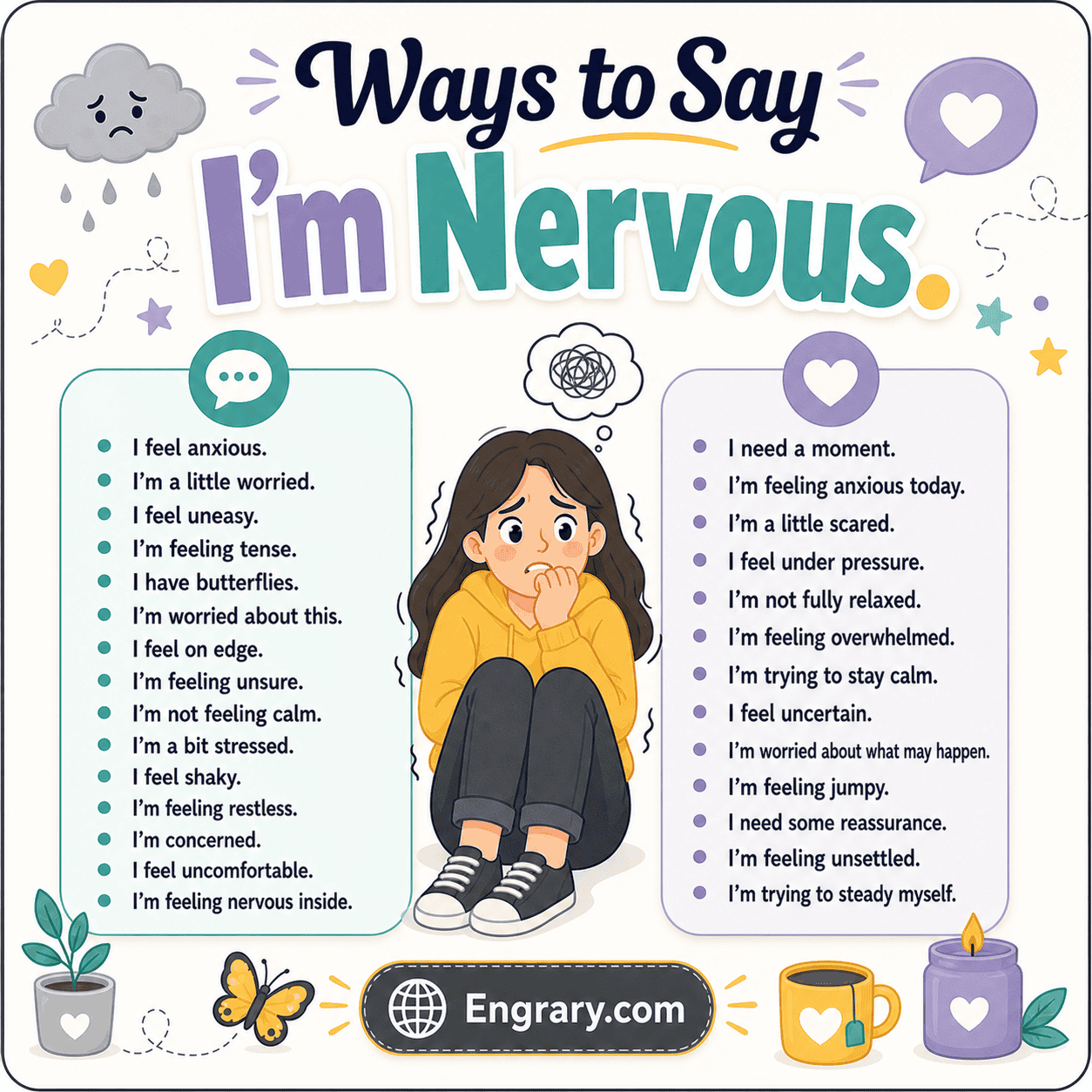
When Your Nervousness Feels Stronger
These phrases express stronger nerves, anxiety, pressure, or difficulty staying calm.
I’m really nervous
A clear phrase for strong nervousness.
Example: I’m really nervous about speaking today.
I’m extremely anxious
A strong phrase for intense worry or nervousness.
Example: I’m extremely anxious about the outcome.
My nerves are getting to me
A natural phrase when nerves start affecting you.
Example: My nerves are getting to me.
I’m overwhelmed by nerves
A strong phrase for intense nervousness.
Example: I’m overwhelmed by nerves right now.
I’m panicking a little
A phrase for nervousness close to panic.
Example: I’m panicking a little before the test.
I’m shaking from nerves
A phrase for physical nervousness.
Example: I’m shaking from nerves.
I’m struggling to stay calm
A phrase for strong nervousness.
Example: I’m struggling to stay calm.
I’m nervous out of my mind
A casual dramatic phrase for strong nervousness.
Example: I’m nervous out of my mind.
I’m on the edge of panic
A strong phrase for intense anxiety.
Example: I’m on the edge of panic.
I can barely think straight
A phrase for nervousness that affects focus.
Example: I can barely think straight right now.
Calm Phrases That Show You’re Still in Control
These phrases help you express nervousness while still sounding steady, confident, and prepared.
I’m nervous, but I’m ready
A balanced phrase that shows honesty and confidence.
Example: I’m nervous, but I’m ready.
I’m trying to stay calm
A phrase for managing nervousness.
Example: I’m trying to stay calm before I start.
I need a moment to gather myself
A calm phrase for taking a short pause.
Example: I need a moment to gather myself.
I’m feeling some nerves, but I’m prepared
A professional and confident phrase.
Example: I’m feeling some nerves, but I’m prepared.
I’m working through my nerves
A phrase for handling nervousness.
Example: I’m working through my nerves.
I’m a little nervous, but I can handle it
A phrase that shows resilience.
Example: I’m a little nervous, but I can handle it.
I’m feeling the pressure, but I’m focused
A strong phrase for serious situations.
Example: I’m feeling the pressure, but I’m focused.
I’m taking a moment to steady myself
A thoughtful phrase for calming down.
Example: I’m taking a moment to steady myself.
I’m nervous, but I’m going to try
A brave phrase for trying despite nerves.
Example: I’m nervous, but I’m going to try.
I’m staying calm as best I can
A phrase for controlling nerves.
Example: I’m staying calm as best I can.
Professional Phrases for Pressure or Uncertainty
These phrases sound controlled and appropriate in workplace, academic, or formal situations.
I’m feeling some pressure, but I’m prepared
A professional phrase for nervousness with confidence.
Example: I’m feeling some pressure, but I’m prepared.
I’m a little nervous, but ready to begin
A polished phrase before starting.
Example: I’m a little nervous, but ready to begin.
I’m focused on staying calm
A professional phrase for self-control.
Example: I’m focused on staying calm.
I’d like a moment to gather my thoughts
A respectful phrase for pausing.
Example: I’d like a moment to gather my thoughts.
I’m aware of the pressure, but I’m ready
A strong phrase for confident nervousness.
Example: I’m aware of the pressure, but I’m ready.
I’m feeling a bit apprehensive about this
A formal phrase for nervousness or hesitation.
Example: I’m feeling a bit apprehensive about this decision.
I’m working through some nerves
A calm phrase for managing nervousness.
Example: I’m working through some nerves.
I’m trying to approach this calmly
A professional phrase for control.
Example: I’m trying to approach this calmly.
I’m prepared, even though I feel some nerves
A balanced phrase for formal situations.
Example: I’m prepared, even though I feel some nerves.
I’m taking this seriously, so I feel a little nervous
A mature phrase that explains the feeling.
Example: I’m taking this seriously, so I feel a little nervous.
Before an Interview or Important Meeting
Use these phrases when you feel nervous before a job interview, meeting, call, or important conversation.
I have pre-interview nerves
A natural phrase for nervousness before an interview.
Example: I have pre-interview nerves.
I’m nervous about the interview
A direct phrase for interview anxiety.
Example: I’m nervous about the interview tomorrow.
I’m excited and a bit nervous
A positive phrase that balances nerves and enthusiasm.
Example: I’m excited and a bit nervous.
I’m feeling some interview pressure
A phrase for pressure before an interview.
Example: I’m feeling some interview pressure.
I want to make a good impression
A phrase that explains why you feel nervous.
Example: I want to make a good impression.
I’m nervous about speaking in front of everyone
A phrase for public speaking nerves.
Example: I’m nervous about speaking in front of everyone.
I have presentation nerves
A natural phrase before presenting.
Example: I have presentation nerves.
I’m feeling the pressure before presenting
A phrase for presentation stress.
Example: I’m feeling the pressure before presenting.
I’m a little nervous, but I know my material
A confident phrase for preparation.
Example: I’m a little nervous, but I know my material.
I need a moment before I start
A calm phrase for pausing before speaking.
Example: I need a moment before I start.
Before an Exam, Test, or Big Performance
These phrases are useful before exams, tests, competitions, auditions, performances, or important evaluations.
I’m nervous about the exam
A direct phrase for exam nerves.
Example: I’m nervous about the exam.
I have test anxiety
A phrase for anxiety connected to tests.
Example: I have test anxiety.
I’m worried I’ll forget everything
A phrase for exam or performance fear.
Example: I’m worried I’ll forget everything.
I’m feeling pressure to do well
A phrase for performance expectations.
Example: I’m feeling pressure to do well.
I have performance nerves
A phrase for nervousness before performing.
Example: I have performance nerves.
I have stage fright
A phrase for fear of performing in front of people.
Example: I have stage fright.
I’m nervous before going on stage
A direct phrase for performance nerves.
Example: I’m nervous before going on stage.
My nerves are kicking in
A phrase for nerves starting to feel stronger.
Example: My nerves are kicking in.
I’m worried I won’t do my best
A phrase for performance worry.
Example: I’m worried I won’t do my best.
I’m trying to stay focused
A calm phrase for managing nerves.
Example: I’m trying to stay focused.
When You Feel Nervous Around People
These phrases work well for social situations, first meetings, dates, group events, or speaking to new people.
I’m nervous about meeting new people
A direct phrase for social nervousness.
Example: I’m nervous about meeting new people.
I feel awkward at first
A natural phrase for social discomfort.
Example: I feel awkward at first.
I’m shy at the beginning
A simple phrase for early social nerves.
Example: I’m shy at the beginning.
I need time to warm up
A natural phrase for becoming comfortable slowly.
Example: I need time to warm up.
I’m nervous about the first impression
A phrase for social pressure.
Example: I’m nervous about the first impression.
I feel anxious in social settings
A phrase for social anxiety or discomfort.
Example: I feel anxious in social settings.
I’m not sure what to say
A phrase for social nervousness.
Example: I’m not sure what to say.
I’m worried about being judged
A phrase for social fear.
Example: I’m worried about being judged.
I feel tense around new people
A phrase for physical or emotional tension.
Example: I feel tense around new people.
I’m trying to be more confident
A positive phrase for working through social nerves.
Example: I’m trying to be more confident.
Body-Based Phrases for Nervous Feelings
Nervousness often shows up in the body. These phrases describe physical nervous feelings.
I have butterflies in my stomach
A common idiom for nervousness.
Example: I have butterflies in my stomach.
My hands are shaking
A phrase for visible nerves.
Example: My hands are shaking.
My heart is racing
A phrase for strong physical nervousness.
Example: My heart is racing before the speech.
I feel tense
A phrase for body tightness or stress.
Example: I feel tense.
I feel jittery
A phrase for nervous energy.
Example: I feel jittery after waiting so long.
I can’t sit still
A phrase for restless nerves.
Example: I can’t sit still right now.
My stomach is in knots
An idiom for strong nervousness.
Example: My stomach is in knots.
I’m feeling shaky
A phrase for physical nervousness.
Example: I’m feeling shaky.
My nerves are kicking in
A phrase for nerves becoming noticeable.
Example: My nerves are kicking in now.
I feel restless
A phrase for nervous energy or unease.
Example: I feel restless.
Short Text Messages for Nervous Moments
These short phrases work well in texts, chats, DMs, and quick messages.
I’m nervous
A short direct message.
Example: I’m nervous.
So nervous
A quick casual text.
Example: So nervous right now.
I’m anxious
A short phrase for stronger nerves.
Example: I’m anxious.
I’m worried
A short phrase for concern.
Example: I’m worried.
I’m tense
A short phrase for physical or emotional pressure.
Example: I’m tense.
I’m freaking out
A casual phrase for intense nerves.
Example: I’m freaking out.
I need a minute
A short phrase for needing time.
Example: I need a minute.
Wish me luck
A friendly phrase before doing something.
Example: Wish me luck.
My nerves are kicking in
A short phrase for growing nerves.
Example: My nerves are kicking in.
Trying to stay calm
A short calm phrase.
Example: Trying to stay calm.
Nervous Idioms and Expressions
These idioms make your English more expressive, but they are usually better for casual speech, storytelling, or informal writing.
I have butterflies in my stomach
An idiom for feeling nervous.
Example: I have butterflies in my stomach before every speech.
I’m on edge
A phrase for feeling tense and nervous.
Example: I’m on edge today.
I’m a bundle of nerves
An idiom for being very nervous.
Example: I’m a bundle of nerves before the interview.
My stomach is in knots
An idiom for strong nervousness.
Example: My stomach is in knots.
I got cold feet
An idiom for becoming nervous before doing something.
Example: I got cold feet before the performance.
I’m shaking like a leaf
An idiom for being visibly nervous or scared.
Example: I’m shaking like a leaf.
My heart is racing
A phrase for physical nervousness.
Example: My heart is racing.
I’m biting my nails
A phrase for nervous behavior.
Example: I’m biting my nails waiting for the result.
My nerves are getting the best of me
A phrase for nerves taking over.
Example: My nerves are getting the best of me.
I’m walking on eggshells
An idiom for feeling nervous about upsetting someone.
Example: I’m walking on eggshells around them.
Phrases That May Sound Too Dramatic
Some nervousness phrases can sound too intense, too informal, or too serious in the wrong situation.
| Phrase | Why to Use Carefully | Better Situation |
|---|---|---|
| I’m freaking out | Casual and intense | Informal situations |
| I’m panicking | Strong; use only when panic is real | Panic situations |
| I’m terrified | More fear than nervousness | Serious fear |
| I’m having a breakdown | Very serious and not casual | Use carefully |
| I’m paranoid | Can sound clinical or extreme | Use carefully |
| I’m dying inside | Dramatic and informal | Casual joking only |
| I’m scared to death | Too strong for normal nerves | Serious fear |
| I’m losing it | Sounds uncontrolled | Avoid professional settings |
| I’m anxious | Can be normal worry, but may also describe anxiety | Use with context |
| I’m a nervous wreck | Very dramatic | Casual or intense moments |
Mistakes to Avoid When Talking About Nerves
Many English learners use very strong phrases when they only mean mild nervousness. For example, “I’m terrified,” “I’m panicking,” and “I’m losing it” are much stronger than “I’m nervous” or “I’m a little tense.”
In professional situations, avoid sounding overwhelmed if you want to show confidence. Instead of “I’m freaking out,” say “I’m feeling some pressure, but I’m prepared” or “I’d like a moment to gather my thoughts.” Also, try to explain what you are nervous about, such as an interview, exam, meeting, presentation, or first impression.
Real-Life Example Sentences
Before an interview
A: How are you feeling?
B: I’m excited and a bit nervous.
Before an exam
A: Are you ready for the test?
B: I’m nervous about the exam, but I studied.
During a presentation
A: Do you need a minute?
B: Yes, I’d like a moment to gather my thoughts.
Social nerves
A: Why are you quiet?
B: I feel awkward at first, but I’ll warm up.
Physical nerves
A: Are you okay?
B: My nerves are kicking in.
Best Phrase Choices by Situation
| Situation | Better Phrase |
|---|---|
| Mild nerves | I’m a little nervous |
| Uneasy feeling | I feel uneasy |
| Worry | I’m worried |
| Strong nervousness | I’m anxious |
| Physical nerves | I have butterflies in my stomach |
| Interview nerves | I’m feeling some pre-interview nerves |
| Exam nerves | I’m nervous about the exam |
| Performance nerves | I have stage fright |
| Professional nerves | I’m feeling some pressure, but I’m prepared |
| Calm nervousness | I’m nervous, but I’m ready |
| Short text | I’m nervous |
| Need a moment | I need a moment to gather myself |
How to Sound Calm While Saying You’re Nervous
The best way to sound calm is to pair your nervousness with readiness, effort, or a clear request. Instead of saying only “I’m nervous,” try “I’m nervous, but I’m ready,” “I’m feeling some pressure, but I’m prepared,” or “I need a moment to gather myself.”
For interviews, exams, or presentations, confident phrases work best. Say “I’m excited and a bit nervous,” “I know my material,” or “I’m trying to stay focused.” These phrases show that you feel nervous, but you are still prepared and willing to continue.
Summary
“I’m nervous” is natural in English, but it is not the only way to describe nerves. You can sound mild, honest, professional, calm, or more specific depending on the situation.
For mild nerves, say “I’m a little nervous” or “I feel uneasy.” Before interviews or presentations, use “I’m excited and a bit nervous” or “I’m feeling some pressure, but I’m prepared.” For physical nerves, try “I have butterflies in my stomach” or “My heart is racing.” In short texts, use “So nervous,” “Wish me luck,” or “Trying to stay calm.”
FAQs
Another way to say “I’m nervous” is “I’m anxious.” You can also say “I’m worried,” “I feel uneasy,” “I’m tense,” “I’m jittery,” or “I have butterflies in my stomach.”
You can say “I’m a little nervous,” “I’m feeling some nerves, but I’m prepared,” “I’m trying to stay calm,” or “I need a moment to gather myself.”
A professional way to say “I’m nervous” is “I’m feeling some pressure, but I’m prepared.” You can also say “I’d like a moment to gather my thoughts” or “I’m aware of the pressure, but I’m ready.”
In a text, you can say “So nervous,” “I’m anxious,” “Wish me luck,” “My nerves are kicking in,” or “Trying to stay calm.”
“Nervous” usually means you feel tense before an event or uncertain moment. “Anxious” is often stronger and can involve ongoing worry. “Worried” means you are concerned about a possible problem or bad outcome.
You May Also Like