“I’m sorry to hear that” is a polite and caring phrase, but it can sometimes sound too general. When someone shares bad news, the best response depends on the situation, your relationship, and how serious the news is.
For example, “That must be disappointing” works well for mild bad news, while “My deepest condolences” fits grief or loss. Meanwhile, “I’m sorry to learn of this” sounds professional in emails or workplace messages. Therefore, this guide gives you 100 thoughtful ways to say “I’m sorry to hear that” with examples for illness, grief, stress, work setbacks, text messages, follow-ups, and emotional support.
Best “I’m Sorry to Hear That” Phrases by Situation
| Situation | Best Phrase |
|---|---|
| General bad news | I’m sorry you’re dealing with that |
| Mild disappointment | That must be disappointing |
| Stress or hardship | That sounds really overwhelming |
| Illness or health issue | I’m sorry you’re not feeling well |
| Loss or grief | My deepest condolences |
| Workplace setback | I’m sorry to hear about the setback |
| Emotional support | I’m here for you |
| Professional response | I’m sorry to learn of this |
| Practical support | I can help with anything practical |
| Close friend or family | You don’t have to face this alone |
| Follow-up message | I’ve been thinking about you |
| Serious hardship | My heart goes out to you |
| Text message | I’m so sorry |
| Sensitive situation | I wish I had the right words |
“I’m Sorry to Hear That” vs “I’m Sorry for Your Loss” vs “I’m Here for You”
These phrases all show sympathy, but they do not fit the same situations. Some are general, some are for grief, and others offer personal support.
| Phrase | Meaning | Best Use |
|---|---|---|
| I’m sorry to hear that | General sympathy for bad news | Illness, stress, disappointment, setbacks |
| I’m sorry for your loss | Sympathy for death or deep grief | Bereavement, loss, condolences |
| I’m here for you | Personal support | Friends, family, emotional support |
| That must be difficult | Validates hardship | Stress, disappointment, personal struggles |
| My heart goes out to you | Warm and emotional | Serious hardship, grief, painful news |
| I’m sorry to learn of this | Formal or professional | Work emails, client messages |
| Please accept my condolences | Formal grief phrase | Death, bereavement, formal sympathy |
| Let me know how I can support | Offers help politely | Work, friends, difficult situations |
Is “I’m Sorry to Hear That” Polite and Sincere?
Yes, “I’m sorry to hear that” is polite and natural. You can use it when someone shares bad news, a problem, a disappointment, or a difficult situation.
However, the phrase can sound generic if the news is very personal or painful. In serious moments, choose wording that fits the situation more closely. For example, use “I’m sorry you’re going through this” for hardship, “I’m wishing you a smooth recovery” for illness, and “My deepest condolences” for grief or loss.
Simple Empathy Phrases for Bad News
These phrases work well for general bad news when you want to sound kind, natural, and respectful.
I’m sorry to hear that
A polite phrase for responding to bad news.
Example: I’m sorry to hear that. I hope things get easier soon.
I’m sorry you’re dealing with that
A natural phrase for showing sympathy.
Example: I’m sorry you’re dealing with that.
That’s really hard to hear
A thoughtful phrase when the news feels painful or disappointing.
Example: That’s really hard to hear.
That must be difficult
A validating phrase for a hard situation.
Example: That must be difficult for you.
I’m sorry that happened
A simple phrase for showing care after something bad occurs.
Example: I’m sorry that happened.
That sounds really tough
A natural phrase for acknowledging difficulty.
Example: That sounds really tough.
I hate that you’re going through this
A warm phrase for showing emotional support.
Example: I hate that you’re going through this.
I’m sorry you have to deal with this
A kind phrase for sympathy and understanding.
Example: I’m sorry you have to deal with this.
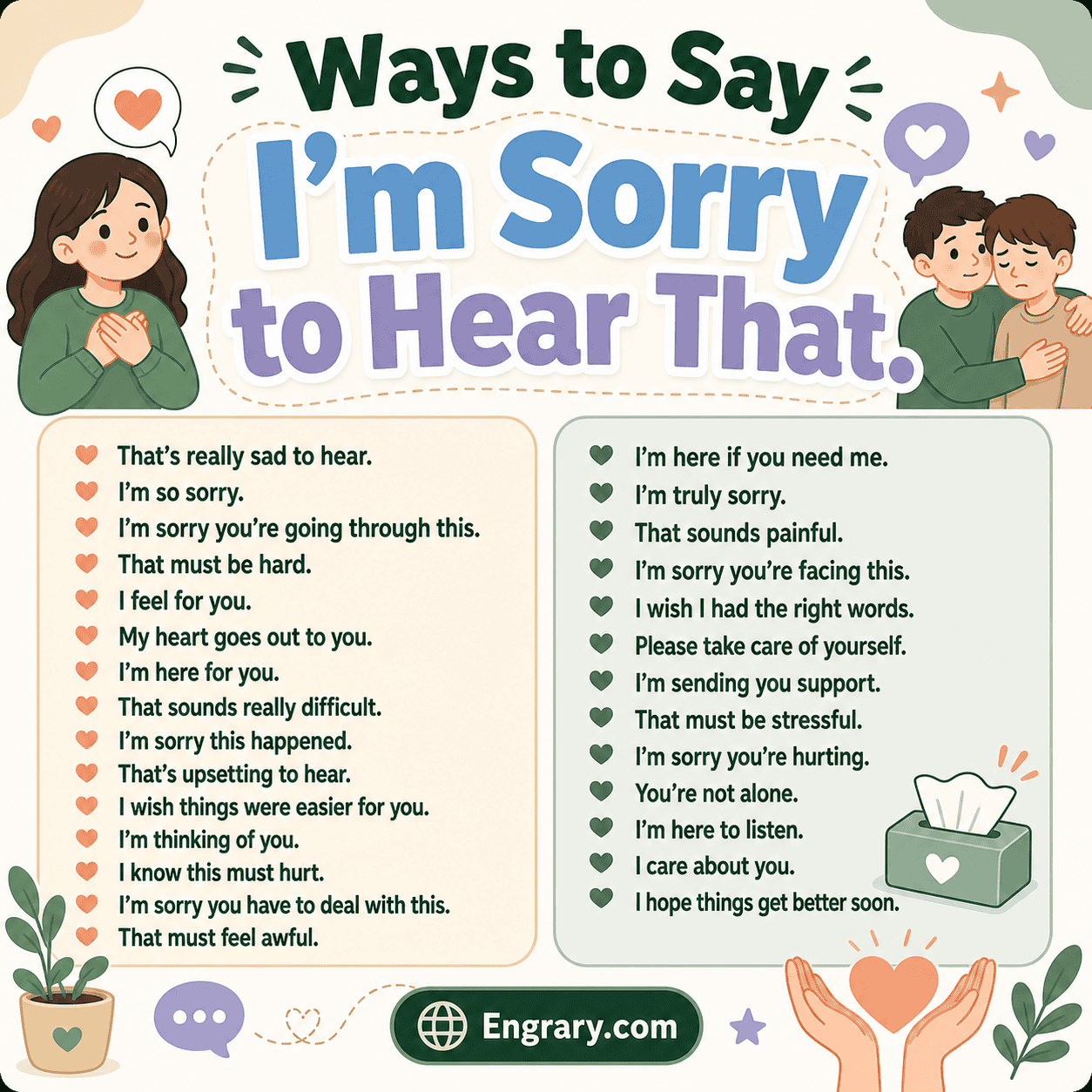
Warm Responses That Feel More Personal
Use these phrases when you want your response to feel warmer than a simple “sorry to hear that.”
I’m really sorry you’re going through this
A warm phrase for personal support.
Example: I’m really sorry you’re going through this.
My heart goes out to you
A caring phrase for serious or emotional news.
Example: My heart goes out to you.
I’m thinking of you
A simple phrase that shows care.
Example: I’m thinking of you during this hard time.
I care about you, and I’m here
A personal phrase for someone close.
Example: I care about you, and I’m here.
I wish I could make this easier
A heartfelt phrase for painful situations.
Example: I wish I could make this easier for you.
You don’t deserve this
A warm phrase for unfair or painful situations.
Example: You don’t deserve this.
I’m here with you
A supportive phrase for emotional moments.
Example: I’m here with you.
I can’t imagine how hard this feels
A careful phrase that avoids assuming too much.
Example: I can’t imagine how hard this feels.
Professional Responses to Bad News
These phrases work well in workplace emails, client messages, formal replies, and professional conversations.
I’m sorry to learn of this
A formal phrase for responding to bad news.
Example: I’m sorry to learn of this.
I’m sorry to hear about the issue
A professional phrase for problems or complaints.
Example: I’m sorry to hear about the issue.
I understand this must be difficult
A polished phrase for showing empathy.
Example: I understand this must be difficult.
I appreciate you letting me know
A respectful phrase for acknowledging shared information.
Example: I appreciate you letting me know.
I’m sorry this has caused difficulty
A professional phrase for inconvenience or trouble.
Example: I’m sorry this has caused difficulty.
I understand your concern
A useful phrase for professional empathy.
Example: I understand your concern.
Thank you for sharing this with me
A polite phrase for receiving serious information.
Example: Thank you for sharing this with me.
Please let me know how I can support
A professional phrase for offering help.
Example: Please let me know how I can support.
Supportive Phrases for Stressful Times
These phrases work well when someone is dealing with pressure, stress, burnout, or a difficult personal situation.
That sounds overwhelming
A validating phrase for stress.
Example: That sounds overwhelming.
I’m sorry you’re under so much pressure
A thoughtful phrase for stressful situations.
Example: I’m sorry you’re under so much pressure.
That must feel exhausting
A caring phrase for emotional or physical stress.
Example: That must feel exhausting.
I hate that you’re dealing with so much
A warm phrase for someone carrying a lot.
Example: I hate that you’re dealing with so much.
I’m here if you want to talk
A supportive phrase that gives space.
Example: I’m here if you want to talk.
Take your time with this
A patient phrase for hard moments.
Example: Take your time with this.
You don’t have to handle this alone
A reassuring phrase for support.
Example: You don’t have to handle this alone.
I’m sorry things are so heavy right now
A gentle phrase for emotional stress.
Example: I’m sorry things are so heavy right now.
Gentle Phrases for Illness or Health Problems
Health-related bad news needs soft wording. These phrases show care without sounding too casual.
I’m sorry you’re not feeling well
A gentle phrase for illness.
Example: I’m sorry you’re not feeling well.
I’m sorry to hear you’re sick
A natural phrase for sickness.
Example: I’m sorry to hear you’re sick.
I hope you feel better soon
A common phrase for recovery.
Example: I hope you feel better soon.
That sounds really difficult
A caring phrase for health struggles.
Example: That sounds really difficult.
I’m wishing you a smooth recovery
A thoughtful phrase for recovery.
Example: I’m wishing you a smooth recovery.
Please take care of yourself
A gentle phrase for concern.
Example: Please take care of yourself.
I’m sorry you’re going through this health issue
A more specific phrase for health problems.
Example: I’m sorry you’re going through this health issue.
Let me know if I can help while you recover
A practical phrase for offering support.
Example: Let me know if I can help while you recover.
Condolence Phrases for Loss or Grief
Use these phrases for death, grief, bereavement, or deep loss. Keep the tone gentle and respectful.
I’m so sorry for your loss
A common condolence phrase.
Example: I’m so sorry for your loss.
My deepest condolences
A formal phrase for grief or loss.
Example: My deepest condolences to you and your family.
Please accept my sincere condolences
A respectful formal phrase.
Example: Please accept my sincere condolences.
My heart goes out to you and your family
A warm phrase for loss.
Example: My heart goes out to you and your family.
I’m thinking of you during this difficult time
A kind phrase for grief.
Example: I’m thinking of you during this difficult time.
I’m deeply sorry for your loss
A sincere phrase for serious grief.
Example: I’m deeply sorry for your loss.
Wishing you comfort and strength
A gentle phrase for grief support.
Example: Wishing you comfort and strength.
I’m here for you as you grieve
A supportive phrase for someone in grief.
Example: I’m here for you as you grieve.
Short Text Messages That Show You Care
These short messages work well when you want to respond kindly by text.
I’m so sorry
A short and sincere text.
Example: I’m so sorry.
That’s really hard
A simple phrase for difficult news.
Example: That’s really hard.
I’m here for you
A supportive text message.
Example: I’m here for you.
Thinking of you
A short caring message.
Example: Thinking of you today.
That must be so difficult
A thoughtful text for hard news.
Example: That must be so difficult.
Sending you strength
A warm phrase for support.
Example: Sending you strength.
Take all the time you need
A patient text for emotional moments.
Example: Take all the time you need.
I wish I had better words
A sincere text when the situation is hard.
Example: I wish I had better words.
Work Setback and Disappointment Phrases
These phrases work for missed opportunities, failed plans, delays, layoffs, rejected applications, or disappointing results.
I’m sorry to hear about the setback
A professional phrase for work problems.
Example: I’m sorry to hear about the setback.
That must be disappointing
A natural phrase for disappointment.
Example: That must be disappointing.
I know that’s not the news you hoped for
A thoughtful phrase for disappointing outcomes.
Example: I know that’s not the news you hoped for.
I’m sorry things didn’t work out
A useful phrase for failed plans or opportunities.
Example: I’m sorry things didn’t work out.
That sounds frustrating
A simple phrase for setbacks or delays.
Example: That sounds frustrating.
I understand how disappointing this must feel
A warm phrase for disappointment.
Example: I understand how disappointing this must feel.
I’m sorry this didn’t go as planned
A natural phrase for failed expectations.
Example: I’m sorry this didn’t go as planned.
I know you worked hard on this
A supportive phrase for effort-based disappointment.
Example: I know you worked hard on this.
Helpful Support Offers That Sound Specific
Specific support often sounds more helpful than “Let me know if you need anything.” These phrases give clearer options.
I’m here if you want to talk
A simple support offer.
Example: I’m here if you want to talk.
I can listen if you need to share more
A supportive phrase for emotional conversations.
Example: I can listen if you need to share more.
I’m here to support you
A caring phrase for difficult situations.
Example: I’m here to support you.
Please don’t feel alone in this
A warm phrase for support.
Example: Please don’t feel alone in this.
I can help with anything practical
A useful phrase for specific support.
Example: I can help with anything practical.
I can check in later if that helps
A thoughtful support offer.
Example: I can check in later if that helps.
I can give you some space if you need it
A respectful phrase that gives choice.
Example: I can give you some space if you need it.
Tell me what would help most right now
A practical phrase for support.
Example: Tell me what would help most right now.
Gentle Replies for Casual Bad News
Use these when the bad news is disappointing or frustrating, but not deeply serious.
That’s disappointing
A simple phrase for mild bad news.
Example: That’s disappointing. I’m sorry it didn’t work out.
I’m sorry that happened
A natural phrase for showing sympathy.
Example: I’m sorry that happened to you.
That sounds frustrating
A good phrase when someone is annoyed or upset.
Example: That sounds frustrating. I can see why you’re upset.
I hope it gets better soon
A gentle phrase for temporary problems.
Example: I hope it gets better soon.
That’s not easy to deal with
A validating phrase for a difficult situation.
Example: That’s not easy to deal with.
I can see why that bothered you
A thoughtful phrase for showing understanding.
Example: I can see why that bothered you.
Personal Messages for Close Friends or Family
Use these when you want to sound warmer and more personal with someone close.
I love you, and I’m here for you
A personal phrase for close family or loved ones.
Example: I love you, and I’m here for you.
You don’t have to face this alone
A supportive phrase for hard moments.
Example: You don’t have to face this alone.
I’m here whenever you need to talk
A caring phrase that gives the person space.
Example: I’m here whenever you need to talk.
I wish I could take some of this pain away
A deeply empathetic phrase for painful news.
Example: I wish I could take some of this pain away.
I’m holding you close in my thoughts
A warm phrase for serious or emotional situations.
Example: I’m holding you close in my thoughts.
I care about you so much
A simple personal phrase for someone close.
Example: I care about you so much.
Follow-Up Messages After Someone Shares Bad News
Use these after the first conversation, especially when someone may need support later.
I’ve been thinking about you
A warm follow-up message.
Example: I’ve been thinking about you today.
Just checking in to see how you’re doing
A simple phrase for following up.
Example: Just checking in to see how you’re doing.
I wanted to see if you need anything today
A practical support phrase.
Example: I wanted to see if you need anything today.
I’m still here if you want to talk
A supportive phrase after time has passed.
Example: I’m still here if you want to talk.
I hope today feels a little easier
A gentle follow-up for difficult times.
Example: I hope today feels a little easier.
No need to reply; just wanted you to know I’m thinking of you
A thoughtful phrase that removes pressure.
Example: No need to reply; just wanted you to know I’m thinking of you.
I’m here if you need support this week
A helpful phrase for ongoing support.
Example: I’m here if you need support this week.
Sending you strength today
A short, warm follow-up message.
Example: Sending you strength today.
Phrases for Very Serious or Sensitive Situations
Use these phrases when someone is dealing with serious hardship, grief, crisis, trauma, or deeply painful news.
I’m deeply sorry you’re going through this
A serious phrase for painful situations.
Example: I’m deeply sorry you’re going through this.
My heart is with you
A warm phrase for deep sympathy.
Example: My heart is with you.
I can’t imagine how painful this must be
A careful phrase that avoids assuming someone’s feelings.
Example: I can’t imagine how painful this must be.
I’m here to support you in any way I can
A strong support phrase.
Example: I’m here to support you in any way I can.
Please take all the time you need
A patient phrase for serious moments.
Example: Please take all the time you need.
I’m holding you in my thoughts
A gentle phrase for serious hardship.
Example: I’m holding you in my thoughts.
I’m so sorry this happened
A sincere phrase for painful news.
Example: I’m so sorry this happened.
You are not alone
A supportive phrase for very hard moments.
Example: You are not alone.
“I’m Sorry to Hear That” Phrases You Should Use Carefully
Some sympathy phrases can sound dismissive, too casual, or inappropriate for serious situations.
| Phrase | Why to Use Carefully | Better Situation |
|---|---|---|
| Everything happens for a reason | Can sound dismissive | Avoid after painful news |
| At least it’s not worse | Minimizes pain | Avoid |
| I know exactly how you feel | Can sound assumptive | Say “I can’t imagine” instead |
| It could be worse | Invalidates emotions | Avoid |
| Stay positive | Can feel forced | Use gentle support instead |
| Don’t worry about it | Dismissive | Avoid serious news |
| You’ll get over it | Harsh | Avoid |
| That sucks | Too casual for serious news | Mild disappointment only |
| I’m sorry for your loss | Use mainly for death or deep grief | Grief or bereavement |
| Let me know if you need anything | Kind but often too vague | Add a specific offer |
Common Mistakes When Responding to Bad News
Many English learners use the same sympathy phrase for every type of bad news. However, a mild disappointment and a serious loss need very different wording.
Avoid phrases that minimize someone’s feelings, such as “everything happens for a reason,” “at least it’s not worse,” or “stay positive.” In serious moments, do not rush to give advice. A simple, sincere phrase like “I’m here for you” or “I wish I had the right words” often feels more supportive.
Real Conversation Examples
Casual bad news
A: My plans got canceled again.
B: That’s disappointing. I’m sorry things didn’t go as planned.
Illness
A: I’ve been sick all week.
B: I’m sorry you’re not feeling well. I hope you feel better soon.
Work setback
A: The project didn’t get approved.
B: I’m sorry to hear about the setback. I know you worked hard on this.
Grief
A: My uncle passed away.
B: I’m so sorry for your loss. My heart goes out to you and your family.
Follow-up message
A: Thanks for checking in.
B: No need to reply; just wanted you to know I’m thinking of you.
Best Alternatives by Situation
| Situation | Better Phrase |
|---|---|
| General bad news | I’m sorry you’re dealing with that |
| Mild disappointment | That must be disappointing |
| Stress or hardship | That sounds really overwhelming |
| Illness | I’m sorry you’re not feeling well |
| Health recovery | I’m wishing you a smooth recovery |
| Loss or grief | My deepest condolences |
| Professional email | I’m sorry to learn of this |
| Work setback | I’m sorry to hear about the setback |
| Emotional support | I’m here for you |
| Practical help | I can help with anything practical |
| Casual bad news | That sounds frustrating |
| Close friend or family | You don’t have to face this alone |
| Follow-up message | I’ve been thinking about you |
| Text message | I’m so sorry |
| Sensitive situation | I wish I had the right words |
How to Choose the Right Sympathy Phrase
Choose your phrase based on how serious the news is and how close you are to the person. For mild bad news, phrases like “That’s disappointing” or “That sounds frustrating” may be enough.
When someone is ill, use gentle wording such as “I’m sorry you’re not feeling well” or “I’m wishing you a smooth recovery.” Grief or serious hardship calls for deeper phrases like “My deepest condolences,” “My heart goes out to you,” or “I wish I had the right words.” In professional situations, keep the tone respectful with “I’m sorry to learn of this” or “I understand this must be difficult.”
Summary
“I’m sorry to hear that” is polite, but the best alternative depends on the type of bad news. A small disappointment, a health problem, a work setback, and a serious loss all need different levels of empathy.
For everyday bad news, use “I’m sorry you’re dealing with that” or “That must be difficult.” In professional emails, say “I’m sorry to learn of this.” For grief, use “My deepest condolences.” When you want to offer real support, try “I’m here if you want to talk” or “I can help with anything practical.”
FAQs
Another way to say “I’m sorry to hear that” is “I’m sorry you’re dealing with that.” You can also say “That must be difficult,” “I’m here for you,” or “My heart goes out to you.”
A professional way to say “I’m sorry to hear that” is “I’m sorry to learn of this.” You can also say “I understand this must be difficult” or “I appreciate you letting me know.”
For illness, you can say “I’m sorry you’re not feeling well,” “I hope you feel better soon,” or “I’m wishing you a smooth recovery.”
When someone shares bad news, acknowledge their feelings first. You can say “That must be difficult,” “I’m sorry you’re going through this,” or “I’m here if you want to talk.”
Avoid phrases that minimize pain, such as “everything happens for a reason,” “it could be worse,” or “stay positive.” These can make someone feel unheard.
You May Also Like