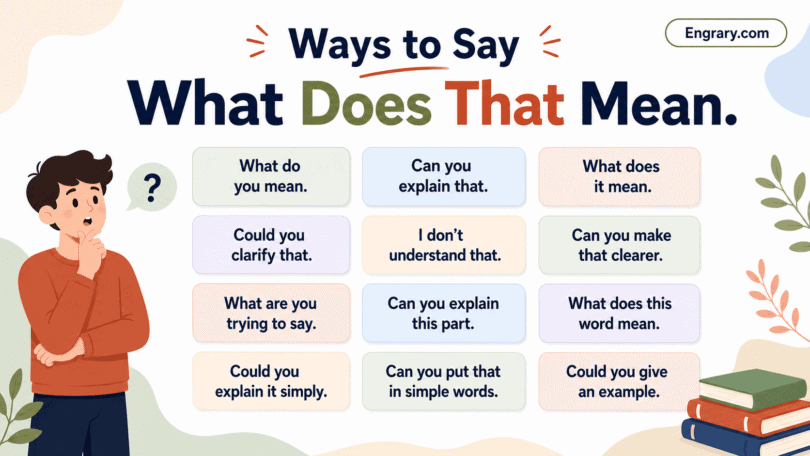
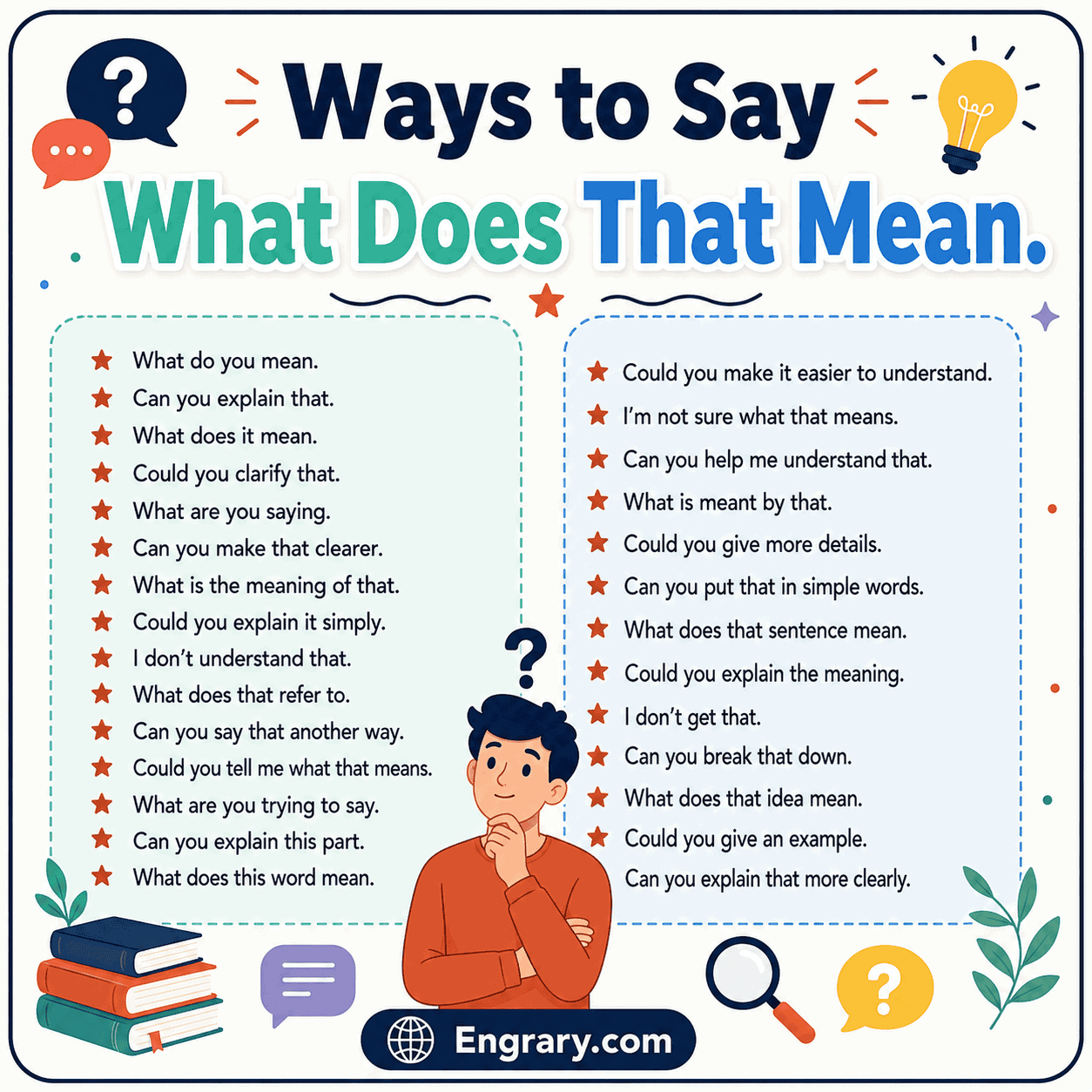
“What does that mean?” is a natural English question, but it can sound too direct if the situation is formal, sensitive, or confusing. Sometimes you may need to ask about a word, phrase, result, instruction, intention, or practical effect.
For example, “Could you clarify that?” sounds polite and professional. When you need an easier explanation, “Could you explain that in simpler terms?” works well. In casual texts, “Wait, what does that mean?” sounds more natural. This guide gives you 100 ways to say “What does that mean?” in English with examples for work, school, texts, word meanings, simpler explanations, practical impact, results, and polite conversations.
Quick Picks: Best “What Does That Mean?” Alternatives
| Situation | Best Phrase |
|---|---|
| Word meaning | What does this word mean? |
| Phrase meaning | What does that phrase mean? |
| Clarification | Could you clarify that? |
| Simpler explanation | Could you explain that in simpler terms? |
| Speaker intention | What do you mean by that? |
| Practical impact | What does that mean in practice? |
| Result interpretation | What does that tell us? |
| Professional wording | Could you clarify what this means for the project? |
| Casual text | Wait, what does that mean? |
| Confused reaction | I’m not sure I understand |
“What Does That Mean?”, “What Do You Mean?”, and “Could You Clarify?”: What’s the Difference?
These phrases are related, but they are not always used in the same way. “What does that mean?” usually asks about the meaning of a word, phrase, idea, result, or situation. “What do you mean?” often asks about the speaker’s intention or exact point. “Could you clarify?” sounds more polite and professional.
| Phrase | Meaning | Best Use |
|---|---|---|
| What does that mean? | Asks about the meaning of a word, phrase, idea, situation, result, or statement | Meanings, ideas, results, explanations |
| What do you mean? | Often asks about the speaker’s intention or exact point | Clarifying someone’s point |
| Could you clarify? | Polite and professional way to ask for more detail | Work, school, formal conversations |
| Could you explain that? | Neutral phrase for asking for explanation | Everyday clarification |
| What does that mean in practice? | Asks about real-life impact or practical result | Plans, policies, decisions, reports |
| What are you trying to say? | Direct; can sound challenging depending on tone | Use carefully |
| I’m not sure I understand | Polite way to show confusion | Respectful clarification |
| Could you explain this in simpler terms? | Asks for a clearer or easier explanation | Learning, complex topics |
Is “What Does That Mean?” Polite in English?
Yes, “What does that mean?” is natural and usually polite in English. You can use it when you need to understand a word, phrase, statement, result, or situation.
The question can sound a little blunt if your tone is sharp or if the topic is sensitive. To sound softer, say “Could you explain what that means?” or “I’m not sure I understand.” In professional settings, “Could you clarify that?” is often the safest choice.
Polite Ways to Say “What Does That Mean?” in English
Use these phrases when you want to ask for meaning or clarification respectfully.
Could you clarify that?
A polite phrase for asking someone to explain more clearly.
Example: Could you clarify that for me?
Could you explain what that means?
A clear and respectful way to ask for meaning.
Example: Could you explain what that means?
I’m not sure I understand
A polite way to show confusion.
Example: I’m not sure I understand the last part.
Could you explain that another way?
A phrase for asking for a different explanation.
Example: Could you explain that another way?
What do you mean by that?
A direct but common clarification question.
Example: What do you mean by that exactly?
Could you help me understand this?
A gentle phrase for asking for explanation.
Example: Could you help me understand this point?
Would you mind explaining that?
A very polite request for explanation.
Example: Would you mind explaining that again?
Could you make that clearer?
A polite phrase for asking for clarity.
Example: Could you make that clearer for me?
Could you give me more context?
A phrase for asking for background information.
Example: Could you give me more context about this?
Could you explain the meaning?
A simple phrase for asking what something means.
Example: Could you explain the meaning of this phrase?
Professional Ways to Say “What Does That Mean?” at Work
These phrases work well in emails, meetings, reports, client messages, and workplace discussions.
Could you clarify what this means for the project?
A professional phrase for asking about project impact.
Example: Could you clarify what this means for the project?
Could you explain the impact of this?
A phrase for asking how something affects a situation.
Example: Could you explain the impact of this change?
What does this mean for our timeline?
A work-focused phrase for schedule impact.
Example: What does this mean for our timeline?
Could you clarify the next step?
A professional phrase for understanding what to do next.
Example: Could you clarify the next step?
Could you explain this in more detail?
A polite phrase for asking for more information.
Example: Could you explain this in more detail?
Could you help me understand the implication?
A formal phrase for asking about meaning or effect.
Example: Could you help me understand the implication of this decision?
What does this mean for the team?
A phrase for asking about group impact.
Example: What does this mean for the team?
Could you provide more context?
A polished phrase for asking for background.
Example: Could you provide more context around this update?
How should we interpret this?
A professional phrase for understanding meaning.
Example: How should we interpret this result?
Could you explain how this affects our plan?
A clear phrase for practical work impact.
Example: Could you explain how this affects our plan?
“What Does That Mean?” Email Phrases for Work
Use these phrases when you need clarification in a professional email.
Could you clarify what this means?
A polite email-friendly question.
Example: Could you clarify what this means for the deadline?
Could you provide additional context?
A formal phrase for more background.
Example: Could you provide additional context on this point?
I’d appreciate a bit more clarification.
A polished way to ask for explanation.
Example: I’d appreciate a bit more clarification on the requirement.
Could you explain how this should be understood?
A formal phrase for meaning or interpretation.
Example: Could you explain how this should be understood?
Could you confirm what this refers to?
A useful phrase for unclear references.
Example: Could you confirm what this refers to in the report?
“What Does That Mean?” Phrases for Meetings
These phrases help you ask for clarification during meetings without sounding rude.
Could you expand on that point?
A professional phrase for more detail.
Example: Could you expand on that point?
Can we clarify what that means before moving on?
A meeting-friendly phrase for pausing to understand.
Example: Can we clarify what that means before moving on?
Could you walk us through that?
A phrase for asking someone to explain step by step.
Example: Could you walk us through that process?
What should we take from that?
A phrase for understanding the main meaning.
Example: What should we take from that result?
Could you explain the main takeaway?
A phrase for asking for the key point.
Example: Could you explain the main takeaway?
Simple Ways to Ask “What Does That Mean?” About a Word or Phrase
These phrases are useful when you do not understand a word, phrase, sentence, expression, or term.
What does this word mean?
A simple question about vocabulary.
Example: What does this word mean?
What does that phrase mean?
A question about a phrase or expression.
Example: What does that phrase mean in this sentence?
What does this sentence mean?
A question about a full sentence.
Example: What does this sentence mean?
Could you explain this word?
A polite question about vocabulary.
Example: Could you explain this word to me?
Could you explain this phrase?
A polite question about a phrase.
Example: Could you explain this phrase in simple English?
What is the meaning of this?
A clear phrase for meaning.
Example: What is the meaning of this expression?
What does this expression mean?
A question about idioms or expressions.
Example: What does this expression mean?
Could you define this word?
A more formal way to ask for a word meaning.
Example: Could you define this word?
Could you explain the meaning in simple words?
A helpful phrase for easier explanation.
Example: Could you explain the meaning in simple words?
What does this mean in English?
A phrase for translation or language learning.
Example: What does this mean in English?
Ways to Say “What Does That Mean?” When You Need a Simpler Explanation
Use these phrases when the original explanation is too complex, unclear, or technical.
Could you explain that in simpler terms?
A polite phrase for an easier explanation.
Example: Could you explain that in simpler terms?
Could you say that another way?
A natural phrase for rephrasing.
Example: Could you say that another way?
Could you break that down for me?
A casual phrase for step-by-step explanation.
Example: Could you break that down for me?
Can you make that easier to understand?
A direct phrase for simpler wording.
Example: Can you make that easier to understand?
Could you explain it more simply?
A polite phrase for simpler explanation.
Example: Could you explain it more simply?
Can you put that in plain English?
A natural phrase for simple, clear language.
Example: Can you put that in plain English?
Could you give me a simple example?
A phrase for asking for an example.
Example: Could you give me a simple example?
I’m not following. Could you explain?
A polite phrase for confusion.
Example: I’m not following. Could you explain?
Could you make it clearer?
A short phrase for more clarity.
Example: Could you make it clearer?
Could you simplify that?
A direct phrase for making something easier.
Example: Could you simplify that for me?
Ways to Say “What Does That Mean?” in Text Messages
These phrases sound natural in texts, chats, DMs, and casual messages.
What does that mean?
A direct casual question.
Example: What does that mean?
Wait, what does that mean?
A natural text reply when something surprises or confuses you.
Example: Wait, what does that mean?
What do you mean?
A short question about someone’s point or intention.
Example: What do you mean?
I’m confused
A casual way to show confusion.
Example: I’m confused. Can you explain?
Can you explain?
A short request for clarification.
Example: Can you explain what happened?
What does that mean exactly?
A phrase for asking for a precise meaning.
Example: What does that mean exactly?
Huh? What do you mean?
A very casual phrase for confusion.
Example: Huh? What do you mean by that?
I don’t get it
A casual phrase for not understanding.
Example: I don’t get it.
Can you say that again?
A text-friendly phrase for repetition or clarification.
Example: Can you say that again?
What are you trying to say?
A direct phrase that can sound challenging.
Example: What are you trying to say?
Ways to Ask “What Does That Mean?” Without Sounding Rude
These phrases help you ask for clarification gently, especially in sensitive or professional conversations.
Could you clarify that for me?
A polite phrase for meaning.
Example: Could you clarify that for me?
I want to make sure I understand
A respectful phrase before asking for clarification.
Example: I want to make sure I understand. What does that mean for us?
Could you explain what you mean?
A soft phrase for asking about someone’s point.
Example: Could you explain what you mean by that?
I may be missing something
A gentle way to show confusion without blaming the speaker.
Example: I may be missing something. Could you explain?
Could you help me understand?
A polite and humble phrase.
Example: Could you help me understand this part?
Just to clarify, what does that mean?
A phrase for checking meaning.
Example: Just to clarify, what does that mean for the schedule?
Could you give me a little more context?
A polite request for background.
Example: Could you give me a little more context?
I’m not sure I follow
A respectful phrase for not understanding.
Example: I’m not sure I follow. Could you explain?
Would you mind explaining that?
A very polite phrase for clarification.
Example: Would you mind explaining that in another way?
Could you rephrase that?
A polite phrase for asking someone to say it differently.
Example: Could you rephrase that for me?
Ways to Say “What Does That Mean?” When Asking About Someone’s Intention
Use these phrases when you want to understand what someone meant, implied, or intended.
What do you mean by that?
A direct question about someone’s meaning.
Example: What do you mean by that?
What are you trying to say?
A direct phrase that can sound challenging.
Example: What are you trying to say exactly?
Could you clarify your point?
A polite phrase for understanding someone’s idea.
Example: Could you clarify your point?
What exactly do you mean?
A phrase for asking for precision.
Example: What exactly do you mean by “soon”?
Could you explain what you meant?
A gentle phrase for intention.
Example: Could you explain what you meant earlier?
Are you saying that…?
A phrase for checking interpretation.
Example: Are you saying that we should wait?
Do you mean this in a positive way?
A phrase for checking tone or intention.
Example: Do you mean this in a positive way?
Could you explain your intention?
A formal phrase for asking about purpose.
Example: Could you explain your intention behind that comment?
What did you mean when you said that?
A clear question about a previous statement.
Example: What did you mean when you said that?
Could you be more specific?
A phrase for asking for clearer details.
Example: Could you be more specific about what you meant?
Ways to Say “What Does That Mean?” in Practice
These phrases ask about real-life effects, practical results, or what should happen next.
What does that mean in practice?
A clear phrase for practical meaning.
Example: What does that mean in practice?
What does that mean for us?
A phrase for personal or group impact.
Example: What does that mean for us?
How does that affect me?
A direct phrase for personal impact.
Example: How does that affect me?
What does that change?
A phrase for understanding what is different now.
Example: What does that change about the plan?
What are the practical implications?
A formal phrase for real-world effects.
Example: What are the practical implications of this decision?
What happens next?
A simple phrase for next steps.
Example: What happens next?
How should we apply this?
A phrase for using information practically.
Example: How should we apply this policy?
What does this look like in real life?
A phrase for concrete examples.
Example: What does this look like in real life?
How does this work practically?
A phrase for understanding practical use.
Example: How does this work practically?
What should we do with this information?
A phrase for action after understanding.
Example: What should we do with this information?
Academic and Learning Phrases for “What Does That Mean?”
These phrases are useful for students, teachers, English learners, and academic discussions.
Could you explain this concept?
A phrase for learning ideas or topics.
Example: Could you explain this concept?
What does this term mean?
A question about academic vocabulary.
Example: What does this term mean in biology?
Could you define this?
A formal phrase for asking for a definition.
Example: Could you define this term?
Could you give an example?
A phrase for understanding through examples.
Example: Could you give an example of this idea?
What does this mean in this context?
A phrase for context-based meaning.
Example: What does this mean in this context?
How should I understand this?
A thoughtful phrase for interpretation.
Example: How should I understand this passage?
Could you explain the main idea?
A phrase for understanding the key point.
Example: Could you explain the main idea?
Could you simplify this concept?
A phrase for easier learning.
Example: Could you simplify this concept?
What is the meaning of this passage?
A phrase for reading or literature.
Example: What is the meaning of this passage?
Could you explain this step?
A phrase for process-based learning.
Example: Could you explain this step in the solution?
Data and Result Phrases for “What Does That Mean?”
Use these phrases when asking about reports, numbers, charts, results, scores, outcomes, or trends.
What does this result mean?
A direct phrase for result interpretation.
Example: What does this result mean?
What does this tell us?
A phrase for understanding information.
Example: What does this tell us about the trend?
How should we interpret this data?
A professional phrase for data analysis.
Example: How should we interpret this data?
What does this number indicate?
A phrase for interpreting a number.
Example: What does this number indicate?
What does this trend suggest?
A phrase for understanding a pattern.
Example: What does this trend suggest?
What does this outcome mean?
A phrase for interpreting results.
Example: What does this outcome mean for the test?
What should we take from this?
A phrase for identifying the takeaway.
Example: What should we take from this report?
What does this show?
A simple phrase for results or evidence.
Example: What does this chart show?
What does this mean for the report?
A phrase for work or academic reports.
Example: What does this mean for the report?
What is the takeaway here?
A phrase for the main point.
Example: What is the takeaway here?
“What Does That Mean?” Phrases That Can Sound Too Direct
Some clarification phrases can sound rude, sarcastic, impatient, or confrontational if used in the wrong tone.
| Phrase | Why to Use Carefully | Better Situation |
|---|---|---|
| What is that supposed to mean? | Can sound offended or confrontational | Use only when you need to address tone |
| What are you talking about? | Can sound rude or impatient | Casual situations only |
| That makes no sense | Blunt and dismissive | Avoid in polite conversations |
| What does that even mean? | Can sound sarcastic | Casual or frustrated tone |
| Are you serious? | May sound challenging | Use carefully |
| I don’t get it | Casual and vague | Informal conversations |
| Explain yourself | Very direct and confrontational | Avoid unless serious |
| What’s your point? | Can sound impatient | Use carefully |
| Say that again? | Casual; tone matters | Informal conversations |
| Huh? | Very informal | Close friends or casual chats |
Mistakes to Avoid with “What Does That Mean?”
Many English learners ask “What does that mean?” when they actually need a more specific question. If you do not understand a word, ask “What does this word mean?” When you need real-life impact, say “What does that mean in practice?”
Avoid blunt phrases like “What are you talking about?” or “That makes no sense” in polite or professional conversations. Softer options such as “Could you clarify that?” “I’m not sure I understand,” and “Could you explain that in simpler terms?” sound more respectful.
Real-Life “What Does That Mean?” Example Sentences
Word meaning
A: This word is “temporary.”
B: What does this word mean?
Professional clarification
A: We may need to adjust the timeline.
B: Could you clarify what this means for the project?
Simpler explanation
A: The system requires multi-factor authentication.
B: Could you explain that in simpler terms?
Speaker intention
A: That was an interesting choice.
B: What do you mean by that?
Data result
A: The number dropped this month.
B: What does this trend suggest?
Best “What Does That Mean?” Phrase Choices by Situation
| Situation | Better Phrase |
|---|---|
| Word meaning | What does this word mean? |
| Phrase meaning | What does that phrase mean? |
| Clarification | Could you clarify that? |
| Simpler explanation | Could you explain that in simpler terms? |
| Speaker intention | What do you mean by that? |
| Practical impact | What does that mean in practice? |
| Result interpretation | What does that tell us? |
| Professional wording | Could you clarify what this means for the project? |
| Casual text | Wait, what does that mean? |
| Confused reaction | I’m not sure I understand |
How to Ask for Meaning Clearly and Politely
A clear question should explain what part you do not understand. Instead of asking only “What does that mean?” say “What does this word mean?” “Could you explain that phrase?” or “What does that mean for our timeline?”
Polite wording is especially important at work, school, or in sensitive conversations. Use phrases like “Could you clarify that?” “I’m not sure I understand,” or “Would you mind explaining that?” to sound respectful and open.
Summary
“What does that mean?” is natural in English, but the best alternative depends on what you want to understand. You may be asking about a word, phrase, idea, intention, result, report, practical effect, or next step.
To ask politely, say “Could you clarify that?” or “Could you explain what that means?” At work, use “Could you clarify what this means for the project?” or “How should we interpret this?” When something is too complex, try “Could you explain that in simpler terms?” or “Can you put that in plain English?”
FAQs
Another way to say “What does that mean?” is “Could you clarify that?” You can also say “Could you explain what that means?” “I’m not sure I understand,” or “Could you explain that in simpler terms?”
A polite way to say “What does that mean?” is “Could you clarify that for me?” You can also say “Would you mind explaining that?” or “I want to make sure I understand.”
A professional way to say “What does that mean?” is “Could you clarify what this means for the project?” You can also say “Could you provide more context?” or “How should we interpret this?”
In a text, you can say “Wait, what does that mean?” “What do you mean?” “I’m confused,” “Can you explain?” or “What does that mean exactly?”
“What does that mean?” usually asks about the meaning of a word, phrase, idea, result, or situation. “What do you mean?” often asks about the speaker’s intention or exact point.
You May Also Like