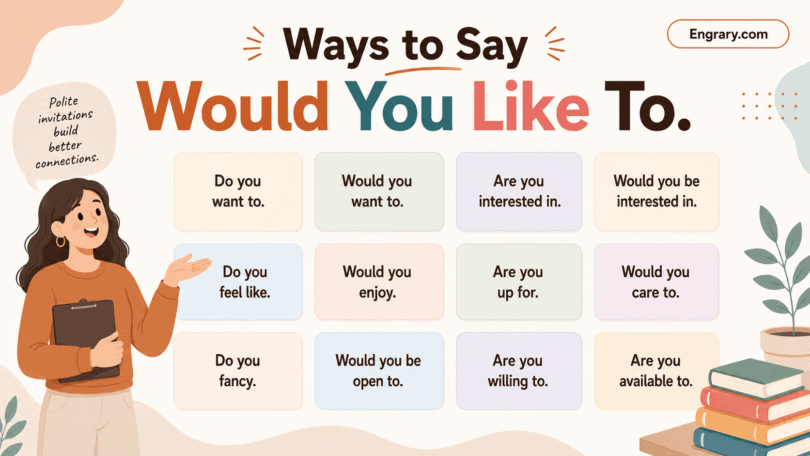
“Would you like to…?” is a polite English phrase used for invitations, offers, suggestions, and checking someone’s interest. It sounds softer than “Do you want to…?” and works well in daily conversations, professional emails, customer service, meetings, and friendly plans.
For example, “Would you like to join us?” is a polite invitation. In a work email, “Would you be interested in scheduling a call?” sounds professional. When offering help, “Would you like me to assist you?” sounds clear, respectful, and useful.
This guide gives you 100 ways to say “Would you like to…?” in English with examples for invitations, offers, suggestions, customer service, work, texts, food and drinks, preferences, and polite daily conversations.
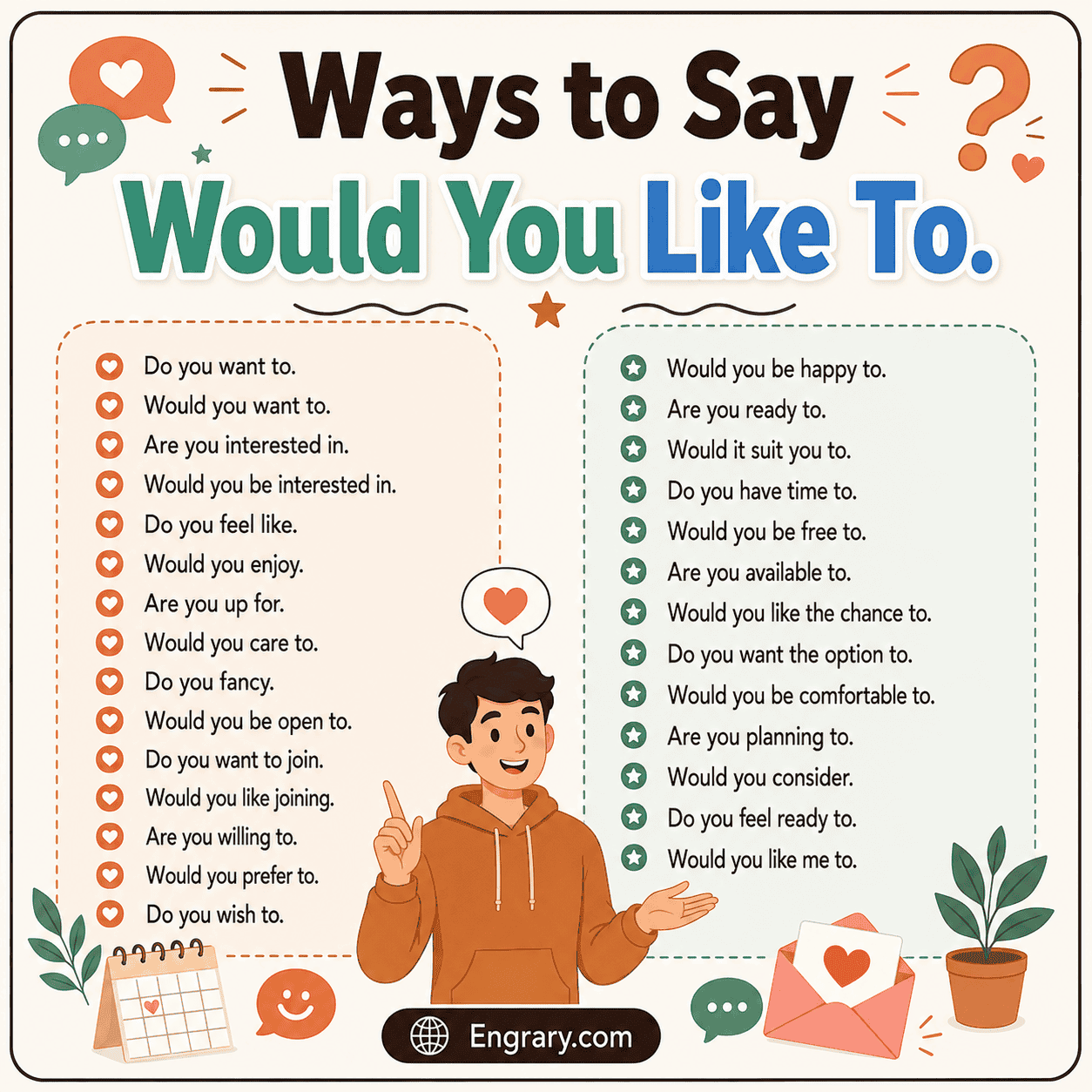
Best Alternatives to “Would You Like To…?” by Situation
| Situation | Better Phrase |
|---|---|
| Polite invitation | Would you like to join us? |
| Casual invitation | Want to come with us? |
| Formal invitation | Would you be interested in attending? |
| Offer | Would you like some help? |
| Suggestion | Would you like to try this? |
| Asking preference | Would you prefer to meet later? |
| Checking interest | Are you interested in joining? |
| Work invitation | Would you like to schedule a call? |
| Customer service | Would you like me to assist you? |
| Text message | Want to hang out? |
When to Use “Would You Like To…?” in English
Use “Would you like to…?” when you want to invite, offer, suggest, or ask about someone’s interest politely. It is useful when you want your question to sound respectful instead of too direct.
You can use it with friends, coworkers, customers, guests, classmates, and people you do not know well. In casual settings, shorter phrases like “Want to…?” or “Do you feel like…?” may sound more natural. In formal settings, “Would you be interested in…?” often sounds more polished.
“Would You Like To…?” vs “Do You Want To…?” vs “Would You Be Interested In…?”
These phrases are related, but the tone is different. “Would you like to…?” is polite and natural. “Do you want to…?” is more direct. “Would you be interested in…?” sounds more formal and works well for professional invitations.
| Phrase | Meaning | Best Use |
|---|---|---|
| Would you like to…? | Polite and natural for invitations, offers, and suggestions | Polite invitations, offers, suggestions |
| Do you want to…? | Natural but more direct | Everyday casual questions |
| Would you be interested in…? | More formal and professional | Work, events, formal invitations |
| Are you interested in…? | Clear for checking interest | Offers, events, opportunities |
| Would you prefer to…? | Best for asking about preference | Choices and options |
| Do you feel like…? | Casual and friendly | Friends and relaxed plans |
| Want to…? | Very casual and common in texts | Texts and close relationships |
| Would you care to…? | Formal or old-fashioned in many contexts | Formal or stylized speech |
How to Use “Would You Like To…?” with Verbs and Nouns
“Would you like to…?” uses to + base verb when you ask about an action.
Examples:
- Would you like to join us?
- Would you like to come with me?
- Would you like to try this?
- Would you like to schedule a call?
- Would you like to learn more?
When you ask about a thing, use Would you like + noun without to.
Examples:
- Would you like some tea?
- Would you like a copy?
- Would you like more information?
- Would you like a seat?
- Would you like another option?
“Would You Like To…?” with Action Verbs
Use this pattern when the person may do an action.
Would you like to join us?
A polite phrase for inviting someone.
Example: Would you like to join us for lunch?
Would you like to come with me?
A friendly invitation phrase.
Example: Would you like to come with me to the store?
Would you like to try this?
A polite suggestion or offer.
Example: Would you like to try this new app?
Would you like to schedule a call?
A professional phrase for arranging a meeting.
Example: Would you like to schedule a call this week?
Would you like to continue?
A polite phrase for asking if someone wants to keep going.
Example: Would you like to continue with the next section?
“Would You Like…?” with Nouns
Use this pattern when you offer a thing, item, option, or information.
Would you like some help?
A polite offer of help.
Example: Would you like some help with that?
Would you like a drink?
A common offer for guests.
Example: Would you like a drink?
Would you like more information?
A professional or service-friendly phrase.
Example: Would you like more information about the plan?
Would you like a copy?
A useful phrase when offering documents or files.
Example: Would you like a copy of the report?
Would you like another option?
A polite phrase for offering choices.
Example: Would you like another option?
Polite Invitations and Offers Similar to “Would You Like To…?”
These phrases help you invite someone or offer something in a respectful way.
Would you like to…?
A polite and natural invitation or offer.
Example: Would you like to join us?
Would you be interested in…?
A formal way to check interest.
Example: Would you be interested in attending the event?
Would you care to…?
A formal phrase that may sound old-fashioned in casual speech.
Example: Would you care to join us for dinner?
Would you prefer to…?
A polite way to ask about preference.
Example: Would you prefer to meet tomorrow?
Would it interest you to…?
A formal phrase for checking interest.
Example: Would it interest you to learn more?
May I invite you to…?
A formal invitation phrase.
Example: May I invite you to join our webinar?
Would you like me to…?
A polite offer to do something for someone.
Example: Would you like me to explain it?
Would you be open to…?
A soft phrase for suggesting something.
Example: Would you be open to trying another option?
Would you consider…?
A polite phrase for asking someone to think about an idea.
Example: Would you consider joining the team?
Is this something you’d like to do?
A natural way to check interest.
Example: Is this something you’d like to do?
Professional Invitations for Emails, Meetings, and Calls
Professional invitations should sound clear, respectful, and specific. These phrases work well in emails, workplace chats, calls, and meetings.
Would you like to schedule a call?
A professional phrase for arranging a call.
Example: Would you like to schedule a call next week?
Would you be interested in joining the meeting?
A polished phrase for meeting invitations.
Example: Would you be interested in joining the meeting on Friday?
Would you like me to send the details?
A helpful work phrase.
Example: Would you like me to send the details by email?
Would you prefer to discuss this by email?
A professional preference question.
Example: Would you prefer to discuss this by email?
Would you like to review this together?
A collaborative work phrase.
Example: Would you like to review this together tomorrow?
Would you be open to a quick meeting?
A soft professional invitation.
Example: Would you be open to a quick meeting this afternoon?
Would you like to share your thoughts?
A polite phrase for inviting feedback.
Example: Would you like to share your thoughts on the proposal?
Would you be interested in moving forward?
A professional phrase for checking decision interest.
Example: Would you be interested in moving forward with this option?
Would you like me to follow up tomorrow?
A useful phrase for next steps.
Example: Would you like me to follow up tomorrow?
Would you prefer a written summary?
A professional phrase for offering an option.
Example: Would you prefer a written summary after the meeting?
Email Phrases for Inviting Someone Politely
Use these phrases when writing a professional invitation or offer in an email.
Would you be available for a call?
A polite email phrase for scheduling.
Example: Would you be available for a call this week?
Would you like to discuss this further?
A professional phrase for continuing a conversation.
Example: Would you like to discuss this further on a call?
Would you be interested in attending?
A formal event invitation.
Example: Would you be interested in attending our online session?
Would you like me to share the next steps?
A helpful email phrase.
Example: Would you like me to share the next steps?
Would you prefer that I send this by email?
A professional preference question.
Example: Would you prefer that I send this by email?
Meeting and Call Phrases for Checking Interest
These phrases are useful when inviting someone to speak, join, respond, or continue.
Would you like to add anything?
A meeting phrase for inviting input.
Example: Would you like to add anything before we move on?
Would you like to go first?
A polite meeting phrase.
Example: Would you like to go first?
Would you like to continue this discussion later?
A professional phrase for timing.
Example: Would you like to continue this discussion later?
Would you like to ask a question?
A helpful meeting phrase.
Example: Would you like to ask a question?
Would you like to set up another call?
A professional follow-up phrase.
Example: Would you like to set up another call next week?
Casual Ways to Invite Friends and Family
Casual invitations are shorter and more relaxed. They work well in texts, chats, and friendly conversations.
Want to come?
A short casual invitation.
Example: Want to come with us?
Want to hang out?
A friendly invitation.
Example: Want to hang out later?
Do you want to join us?
A natural everyday phrase.
Example: Do you want to join us for dinner?
Feel like going out?
A casual phrase for checking mood or interest.
Example: Feel like going out tonight?
Want to grab food?
A common casual invitation.
Example: Want to grab food after work?
Want to come with me?
A friendly phrase for inviting someone along.
Example: Want to come with me?
Do you feel like watching a movie?
A casual suggestion.
Example: Do you feel like watching a movie tonight?
Want to try this?
A relaxed offer or suggestion.
Example: Want to try this dessert?
Want to meet later?
A casual planning phrase.
Example: Want to meet later today?
Wanna come over?
A very informal phrase for close friends or family.
Example: Wanna come over later?
Offering Help with “Would You Like To…?” Alternatives
Use these phrases when you want to help someone politely.
Would you like some help?
A simple polite offer.
Example: Would you like some help with those bags?
Would you like me to help?
A direct offer to help.
Example: Would you like me to help with this?
Would you like me to take care of this?
A helpful phrase for handling something.
Example: Would you like me to take care of this for you?
Would you like assistance with this?
A formal support phrase.
Example: Would you like assistance with this form?
Would you like me to show you?
A polite phrase for demonstrating something.
Example: Would you like me to show you how it works?
Would you like me to explain it?
A helpful phrase for clarification.
Example: Would you like me to explain it again?
Would you like me to handle this?
A phrase for offering to manage a task.
Example: Would you like me to handle this request?
Would you like support with this?
A professional and polite offer.
Example: Would you like support with this process?
Would you like me to walk you through it?
A phrase for step-by-step help.
Example: Would you like me to walk you through it?
Would you like any help getting started?
A useful phrase for beginners or new tasks.
Example: Would you like any help getting started?
Offering Food, Drinks, or Service Politely
These phrases are useful when hosting guests, serving customers, or offering something in daily life.
Would you like some tea?
A polite drink offer.
Example: Would you like some tea?
Would you like a drink?
A common offer for guests.
Example: Would you like a drink?
Would you like something to eat?
A polite food offer.
Example: Would you like something to eat?
Would you like some water?
A simple and helpful offer.
Example: Would you like some water?
Would you like coffee or tea?
A polite choice question.
Example: Would you like coffee or tea?
Would you like dessert?
A common restaurant or hosting phrase.
Example: Would you like dessert?
Would you like another serving?
A polite offer for more food.
Example: Would you like another serving?
Would you like anything else?
A service-friendly phrase.
Example: Would you like anything else?
Would you care for some coffee?
A formal or polite offer.
Example: Would you care for some coffee?
Can I get you something to drink?
A natural service phrase.
Example: Can I get you something to drink?
Suggesting an Activity Without Sounding Pushy
A suggestion should feel like an option, not pressure. These phrases help you sound polite and flexible.
Would you like to try this?
A polite suggestion.
Example: Would you like to try this method?
Would you like to consider another option?
A careful suggestion.
Example: Would you like to consider another option?
Would you like to start with this?
A phrase for suggesting a first step.
Example: Would you like to start with this section?
Would you like to take a break?
A thoughtful suggestion.
Example: Would you like to take a break?
Would you like to look at another choice?
A polite phrase for offering alternatives.
Example: Would you like to look at another choice?
Would you like to do this instead?
A natural phrase for suggesting a change.
Example: Would you like to do this instead?
Would you like to test it first?
A useful phrase for trying something safely.
Example: Would you like to test it first?
Would you like to compare both options?
A helpful suggestion for decisions.
Example: Would you like to compare both options?
Would you like to think about it?
A soft phrase that gives space.
Example: Would you like to think about it?
Would you like to discuss this further?
A professional suggestion.
Example: Would you like to discuss this further?
Checking Someone’s Interest Before Making Plans
These phrases help you see whether someone is interested before you make a plan, offer, or invitation.
Would you be interested in joining?
A polite interest-checking phrase.
Example: Would you be interested in joining the group?
Are you interested in trying this?
A clear question about interest.
Example: Are you interested in trying this class?
Would this interest you?
A formal way to ask if something is appealing.
Example: Would this interest you?
Is this something you’d like to do?
A natural phrase for checking interest.
Example: Is this something you’d like to do?
Would you be open to this?
A soft phrase for checking willingness.
Example: Would you be open to this idea?
Does this sound interesting to you?
A friendly way to check interest.
Example: Does this sound interesting to you?
Would you like to learn more?
A common offer for more information.
Example: Would you like to learn more about the program?
Are you open to discussing this?
A professional phrase for starting a conversation.
Example: Are you open to discussing this next week?
Would you consider joining us?
A polite phrase for invitation or opportunity.
Example: Would you consider joining us for the event?
Is this something you would enjoy?
A friendly phrase for personal interest.
Example: Is this something you would enjoy?
Asking About Preferences and Options
Use these phrases when you want to give someone a choice.
Would you prefer to meet later?
A polite preference question.
Example: Would you prefer to meet later?
Would you rather talk tomorrow?
A natural phrase for choosing between times.
Example: Would you rather talk tomorrow?
Would you like to do this now or later?
A clear choice question.
Example: Would you like to do this now or later?
Would you prefer tea or coffee?
A polite choice phrase.
Example: Would you prefer tea or coffee?
Which option would you prefer?
A professional phrase for choices.
Example: Which option would you prefer?
Would you like to go first or second?
A clear preference question.
Example: Would you like to go first or second?
Would you prefer a call or an email?
A useful workplace phrase.
Example: Would you prefer a call or an email?
Would you like the short version or the full version?
A helpful phrase for explaining information.
Example: Would you like the short version or the full version?
Would you rather stay here or go out?
A casual choice question.
Example: Would you rather stay here or go out?
What would you like to do?
A simple open preference question.
Example: What would you like to do this weekend?
Customer Service Ways to Say “Would You Like To…?”
Customer service language should sound helpful, clear, and not too pushy.
Would you like me to assist you?
A polite customer service offer.
Example: Would you like me to assist you with this?
Would you like help with that?
A simple support phrase.
Example: Would you like help with that?
Would you like me to check that for you?
A helpful service phrase.
Example: Would you like me to check that for you?
Would you like to speak with a representative?
A professional support phrase.
Example: Would you like to speak with a representative?
Would you like me to send more information?
A useful phrase for follow-up.
Example: Would you like me to send more information?
Would you like to continue?
A common service or online process phrase.
Example: Would you like to continue?
Would you like to update your details?
A service phrase for account information.
Example: Would you like to update your details?
Would you like to review your options?
A helpful phrase for choices.
Example: Would you like to review your options?
Would you like me to explain the next step?
A clear support phrase.
Example: Would you like me to explain the next step?
Would you like a copy of the receipt?
A common customer service question.
Example: Would you like a copy of the receipt?
Short Text Messages for Casual Invitations
These short phrases work well in texts, chats, and DMs.
Want to hang out?
A casual invitation.
Example: Want to hang out tonight?
Want to meet later?
A short planning phrase.
Example: Want to meet later?
Want to join us?
A casual group invitation.
Example: Want to join us for dinner?
Want to call?
A short text phrase.
Example: Want to call later?
Want to grab coffee?
A casual invitation for coffee.
Example: Want to grab coffee tomorrow?
Wanna come?
A very informal invitation.
Example: Wanna come with us?
Want to try this?
A short suggestion.
Example: Want to try this place?
Want to come over?
A casual invitation to visit.
Example: Want to come over later?
Want to talk?
A short invitation to have a conversation.
Example: Want to talk for a bit?
Want to go together?
A casual phrase for going with someone.
Example: Want to go together?
Phrases That Can Sound Too Direct or Pushy
Some invitation and offer phrases can sound too direct, too casual, or too forceful in the wrong situation.
| Phrase | Why to Use Carefully | Better Situation |
|---|---|---|
| Do you want to…? | Natural, but more direct than “Would you like to…?” | Casual everyday speech |
| Want to…? | Casual, not ideal for formal situations | Texts and close friends |
| You want to…? | Can sound blunt or awkward | Avoid in polite invitations |
| Are you coming or not? | Impatient and pushy | Avoid unless joking with close friends |
| Should we…? | Suggests a shared decision, not always an invitation | Group decisions |
| You should… | Advice, not an invitation | Use for recommendations |
| Why don’t you…? | Can sound like advice or pressure | Gentle suggestions with care |
| Join us | Can sound like a command without soft wording | Casual encouragement |
| Interested? | Very short and casual | Texts only |
| Wanna…? | Very informal | Close friends and casual texts |
Common Grammar Mistakes with “Would You Like To…?”
Many learners mix up Would you like to + verb and Would you like + noun. Use to before an action, but do not use to before a noun.
Correct examples:
- Would you like to join us?
- Would you like to try this?
- Would you like some tea?
- Would you like a copy?
Avoid saying “Would you like to tea?” because tea is a noun. Say “Would you like some tea?” instead. Also avoid using very casual phrases like “Wanna…?” in professional emails or formal invitations.
Real-Life Examples for Invitations, Offers, and Suggestions
Polite invitation
A: Would you like to join us for dinner?
B: Yes, I’d love to.
Professional invitation
A: Would you be interested in attending the meeting?
B: Yes, please send me the details.
Offer of help
A: Would you like me to explain it?
B: Yes, that would help.
Food or drink offer
A: Would you like some coffee?
B: No, thank you.
Casual text
A: Want to hang out later?
B: Sure, sounds good.
Best “Would You Like To…?” Phrase Choices for Work, Texts, and Daily Life
| Situation | Better Phrase |
|---|---|
| Polite invitation | Would you like to join us? |
| Casual invitation | Want to come with us? |
| Formal invitation | Would you be interested in attending? |
| Offer | Would you like some help? |
| Suggestion | Would you like to try this? |
| Asking preference | Would you prefer to meet later? |
| Checking interest | Are you interested in joining? |
| Work invitation | Would you like to schedule a call? |
| Customer service | Would you like me to assist you? |
| Text message | Want to hang out? |
How to Invite or Offer Something Politely
A polite invitation should make the other person feel free to say yes or no. Instead of saying “Join us,” try “Would you like to join us?” or “Would you be interested in coming?”
When offering help, be clear about what you can do. Phrases like “Would you like me to explain it?” “Would you like any help getting started?” and “Would you like me to send more information?” sound helpful without feeling pushy.
Summary
“Would you like to…?” is a polite English phrase for invitations, offers, suggestions, and checking interest. It is softer than “Do you want to…?” and works well in both daily conversations and professional situations.
For polite invitations, say “Would you like to join us?” or “Would you be interested in attending?” To offer help, use “Would you like some help?” or “Would you like me to explain it?” In casual texts, “Want to hang out?” and “Want to join us?” sound natural with friends.
FAQs
Another way to say “Would you like to…?” is “Would you be interested in…?” You can also say “Would you prefer to…?” “Are you interested in…?” or “Do you feel like…?”
A polite way to say “Would you like to…?” is “Would you be interested in…?” You can also say “Would you care to…?” in formal settings or “Would you be open to…?” for a softer suggestion.
“Would you like to…?” is softer and more polite. “Do you want to…?” is natural but more direct, so it works better in casual conversations.
Use “Would you like to” before a base verb, such as “Would you like to join us?” Use “Would you like” before a noun, such as “Would you like some tea?”
Instead of “Would you like to join us?” you can say “Would you be interested in joining us?” “Do you want to come with us?” “Want to join?” or “Would you like to come along?”
You May Also Like