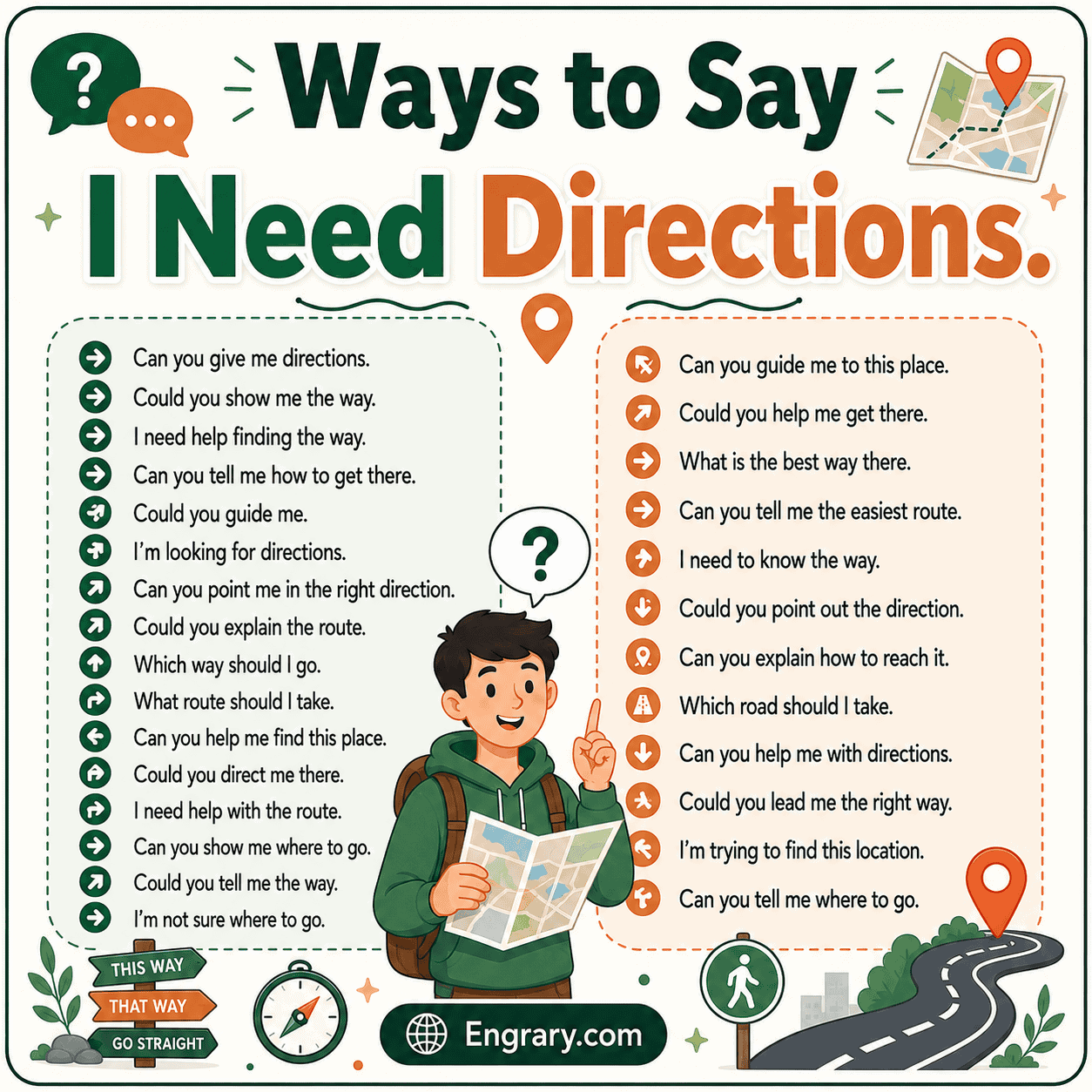
“I need directions” is a useful English phrase when you are lost, unsure where to go, or trying to find the best route to a place. You can use it while traveling, walking in a new city, driving, taking public transport, using a map, or asking someone for help.
This phrase explains that you need help finding the way. For example, “Could you help me with directions?” sounds polite when asking a stranger. In a travel situation, “I’m a bit lost. Could you point me in the right direction?” sounds natural and respectful.
This guide gives you ways to say “I need directions” in English with examples for lost situations, walking, driving, taxis, public transport, maps, hotels, airports, stations, text messages, and polite direction requests.
Best Alternatives to “I Need Directions” by Situation
| Situation | Better Phrase |
|---|---|
| General help | I need directions |
| Polite help request | Could you help me with directions? |
| Lost situation | I’m a bit lost. Could you help me? |
| Route request | What’s the best way to get there? |
| Step-by-step help | Could you give me step-by-step directions? |
| Walking directions | Could you tell me how to walk there? |
| Driving directions | What’s the best driving route? |
| Public transport | Which bus should I take? |
| Map help | Could you show me on the map? |
| Casual text | Can you send me the location? |
“I Need Directions” vs “How Do I Get There?” vs “Where Is It?”
These phrases are related, but they do not ask for the same thing. “I need directions” states that you need help. “How do I get there?” asks for the route. “Where is it?” asks for the location.
| Phrase | Meaning | Best Use |
|---|---|---|
| I need directions | States that you need help finding the way | Lost or unsure situations |
| How do I get there? | Asks for the route | Directions and travel |
| Where is it? | Asks for the location | Finding a place |
| Could you give me directions? | Polite request for route help | Asking strangers or staff |
| Could you point me in the right direction? | Polite and natural when you are unsure | Lost or confused situations |
| Can you show me on the map? | Asks for visual help | Map or phone navigation |
| I’m lost | Explains your situation | Asking for help |
| Which way should I go? | Asks for the next direction | Walking or driving |
When “I Need Directions” Sounds Natural in English
“I need directions” sounds natural when you want to explain your problem before asking for help. It works well when you are lost, confused, or unsure which route to take.
In polite conversations, add a request after the phrase. For example, “I need directions. Could you help me?” sounds clearer than only saying “I need directions.” When speaking to staff, hotel workers, drivers, or strangers, softer phrases like “Could you help me with directions?” sound more respectful.
Polite Ways to Say “I Need Directions” in English
Use these phrases when asking strangers, staff, receptionists, drivers, or people in public places.
Could you help me with directions?
A polite way to ask for help finding a place.
Example: Could you help me with directions to the station?
Could you give me directions?
A simple and respectful request.
Example: Could you give me directions to the hotel?
Could you point me in the right direction?
A natural phrase when you are unsure where to go.
Example: Could you point me in the right direction?
I need help finding this place
A clear phrase when showing an address or location.
Example: I need help finding this place.
Do you know how I can get there?
A polite question for asking about a route.
Example: Do you know how I can get there from here?
Could you tell me the best way to get there?
A helpful phrase when there may be several routes.
Example: Could you tell me the best way to get there?
Could you show me the way?
A polite phrase for asking someone to guide you.
Example: Could you show me the way to the exit?
Would you mind helping me with directions?
A very polite request.
Example: Would you mind helping me with directions?
Could you explain how to get there?
A useful phrase when you need details.
Example: Could you explain how to get there by bus?
May I ask for directions?
A formal and polite phrase.
Example: May I ask for directions to the museum?
Ways to Say You Are Lost and Need Help
These phrases help you explain that you are confused, lost, or going the wrong way.
I’m a bit lost. Could you help me?
A polite phrase for asking for help when lost.
Example: I’m a bit lost. Could you help me?
I think I’m going the wrong way
A natural phrase when your route feels wrong.
Example: I think I’m going the wrong way.
I’m not sure where I am
A clear phrase when you feel lost.
Example: I’m not sure where I am.
Could you help me find this address?
A practical phrase when showing an address.
Example: Could you help me find this address?
I can’t find the place
A simple phrase when you cannot locate something.
Example: I can’t find the place.
I’m trying to get to the station
A useful phrase that names your destination.
Example: I’m trying to get to the station.
I think I missed my turn
A helpful phrase when walking or driving.
Example: I think I missed my turn.
Could you point me back to the main road?
A clear phrase when you need to return to a main route.
Example: Could you point me back to the main road?
I’m having trouble finding this location
A polite phrase for explaining the problem.
Example: I’m having trouble finding this location.
Do you know where this place is?
A natural question when showing a name or address.
Example: Do you know where this place is?
Asking for Step-by-Step Directions
Use these phrases when you need clear, detailed directions instead of a quick answer.
Could you give me step-by-step directions?
A clear request for detailed help.
Example: Could you give me step-by-step directions?
Could you explain the route slowly?
A polite phrase when you need slower instructions.
Example: Could you explain the route slowly?
Could you walk me through the directions?
A natural phrase for detailed guidance.
Example: Could you walk me through the directions?
What should I do first?
A useful question for the first step.
Example: What should I do first?
Where should I turn next?
A practical route question.
Example: Where should I turn next?
What street should I take?
A useful question for walking or driving.
Example: What street should I take?
Could you give me simple directions?
A helpful phrase when you want easy instructions.
Example: Could you give me simple directions?
Can you explain the route clearly?
A direct but polite request.
Example: Can you explain the route clearly?
Could you tell me each step?
A phrase for detailed directions.
Example: Could you tell me each step?
What’s the easiest way to get there?
A useful phrase for a simple route.
Example: What’s the easiest way to get there?
Walking Direction Phrases When You Need Help
These phrases are useful when you are walking in a city, hotel, mall, airport, school, office, or public place.
Can I walk there from here?
A useful question for short distances.
Example: Can I walk there from here?
Could you tell me how to walk there?
A clear walking-direction request.
Example: Could you tell me how to walk there?
Which way should I walk?
A simple walking question.
Example: Which way should I walk?
Is it within walking distance?
A natural phrase for checking if walking is possible.
Example: Is it within walking distance?
Do I go straight from here?
A practical route question.
Example: Do I go straight from here?
Should I turn left or right?
A useful phrase when you are unsure.
Example: Should I turn left or right?
Is there a shortcut?
A helpful phrase for finding a faster route.
Example: Is there a shortcut?
Which street should I take?
A practical walking phrase.
Example: Which street should I take?
How long does it take on foot?
A phrase for walking time.
Example: How long does it take on foot?
Is it far to walk?
A natural walking-distance question.
Example: Is it far to walk?
Asking Which Way to Walk
Use these phrases when you need the next direction or want to check if you are going the right way.
Which way do I go?
A simple direction question.
Example: Which way do I go from here?
Should I go this way?
A useful phrase when pointing or checking.
Example: Should I go this way?
Do I keep going straight?
A common walking-direction question.
Example: Do I keep going straight after the lights?
Do I turn left here?
A clear route-checking question.
Example: Do I turn left here?
Do I turn right after the light?
A specific direction question.
Example: Do I turn right after the light?
Should I cross the street?
A practical walking question.
Example: Should I cross the street here?
Is it on this road?
A useful phrase when you are close.
Example: Is it on this road?
Is it before or after the station?
A helpful phrase for location order.
Example: Is it before or after the station?
Which direction should I head?
A natural phrase for general direction.
Example: Which direction should I head?
Am I walking the right way?
A useful phrase when you feel unsure.
Example: Am I walking the right way?
Asking About Landmarks Nearby
Landmarks help when street names are hard to follow or when you are in an unfamiliar area.
Is it near any landmark?
A useful question for easier navigation.
Example: Is it near any landmark?
Is it close to the station?
A simple landmark question.
Example: Is it close to the station?
Is it near the main road?
A practical travel phrase.
Example: Is it near the main road?
Is it across from the bank?
A useful phrase for opposite-side locations.
Example: Is it across from the bank?
Is it next to the pharmacy?
A clear nearby-place question.
Example: Is it next to the pharmacy?
Is it behind the building?
A helpful exact-location question.
Example: Is it behind the building?
Is it beside the hotel?
A practical travel phrase.
Example: Is it beside the hotel?
What landmark should I look for?
A helpful phrase when you need something visible.
Example: What landmark should I look for?
Is it near the mall?
A natural location question.
Example: Is it near the mall?
Is it opposite the park?
A useful direction phrase.
Example: Is it opposite the park?
Driving, Taxi, and Rideshare Direction Phrases
Use these phrases when driving, taking a taxi, using a rideshare, or asking about roads.
What’s the best driving route?
A useful driving-direction question.
Example: What’s the best driving route?
Which road should I take?
A practical driving phrase.
Example: Which road should I take?
Is this the right road?
A clear route-checking question.
Example: Is this the right road to the airport?
Should I take the highway?
A useful question for longer routes.
Example: Should I take the highway?
Is there parking nearby?
A practical question before driving somewhere.
Example: Is there parking nearby?
Can you take me there?
A simple phrase for a taxi or rideshare driver.
Example: Can you take me there?
Could you drop me off there?
A polite taxi or rideshare phrase.
Example: Could you drop me off there?
What’s the fastest route?
A useful phrase when you are in a hurry.
Example: What’s the fastest route?
Is traffic bad on the way?
A helpful question for driving time.
Example: Is traffic bad on the way?
Can you follow this route?
A useful phrase when showing a route on your phone.
Example: Can you follow this route?
Public Transport Phrases for Getting Directions
These phrases help when using buses, trains, subways, trams, or public transport systems.
Which bus should I take?
A useful bus question.
Example: Which bus should I take?
Which train goes there?
A clear train question.
Example: Which train goes there?
Can I get there by subway?
A useful city travel phrase.
Example: Can I get there by subway?
Where is the nearest bus stop?
A practical public transport question.
Example: Where is the nearest bus stop?
Which platform do I need?
A useful train or subway question.
Example: Which platform do I need?
Do I need to change trains?
A helpful route question.
Example: Do I need to change trains?
How many stops is it?
A common public transport question.
Example: How many stops is it?
Where should I get off?
A very useful phrase for buses and trains.
Example: Where should I get off?
Is this the right bus?
A practical phrase before boarding.
Example: Is this the right bus?
Does this train stop there?
A useful question before getting on.
Example: Does this train stop there?
Ways to Ask for Directions Using a Map or Phone
These phrases are useful when using Google Maps, Apple Maps, a map pin, a shared location, or a phone.
Could you show me on the map?
A useful phrase for visual help.
Example: Could you show me on the map?
Can you send me the location?
A natural text or phone phrase.
Example: Can you send me the location?
Could you share the address?
A polite phrase for getting the exact place.
Example: Could you share the address?
Can you drop a pin?
A casual phrase for sending a map pin.
Example: Can you drop a pin?
Is this the right route?
A useful map-checking question.
Example: Is this the right route?
Which route should I follow?
A clear navigation question.
Example: Which route should I follow?
Could you mark it on the map?
A polite phrase for map help.
Example: Could you mark it on the map?
Can you help me find it on Google Maps?
A practical modern direction phrase.
Example: Can you help me find it on Google Maps?
Is the map showing the right place?
A useful phrase when the location may be wrong.
Example: Is the map showing the right place?
Could you send me the exact location?
A clear phrase for phone navigation.
Example: Could you send me the exact location?
Travel Phrases for Hotels, Airports, Stations, and Tourist Places
Use these phrases when traveling, checking in, sightseeing, or moving through busy places.
I need directions to the hotel
A clear travel phrase.
Example: I need directions to the hotel.
How do I get to the airport?
A common travel question.
Example: How do I get to the airport?
Could you tell me how to get to the train station?
A polite station-direction phrase.
Example: Could you tell me how to get to the train station?
Which way is the departure area?
A useful airport or station question.
Example: Which way is the departure area?
How do I get to Gate 12?
A common airport phrase.
Example: How do I get to Gate 12?
Is there a shuttle to the hotel?
A useful airport or hotel phrase.
Example: Is there a shuttle to the hotel?
What’s the best way to get downtown?
A practical travel question.
Example: What’s the best way to get downtown?
Can I get there by taxi?
A simple travel phrase.
Example: Can I get there by taxi?
Where is the tourist information desk?
A helpful travel support question.
Example: Where is the tourist information desk?
Could you help me get back to the main road?
A useful phrase when lost.
Example: Could you help me get back to the main road?
Ways to Ask Someone to Repeat or Slow Down Directions
Use these phrases when directions are confusing, fast, or hard to understand.
Could you repeat that?
A polite phrase for hearing directions again.
Example: Could you repeat that?
Could you say that again more slowly?
A polite request for slower speech.
Example: Could you say that again more slowly?
Sorry, did you say left or right?
A useful clarification question.
Example: Sorry, did you say left or right?
Could you explain that one more time?
A polite phrase for asking again.
Example: Could you explain that one more time?
What should I do after that?
A helpful step-by-step question.
Example: What should I do after that?
Could you show me again?
A useful phrase when using a map or phone.
Example: Could you show me again?
I didn’t catch the street name
A natural phrase when you missed a detail.
Example: I didn’t catch the street name.
Could you write that down?
A helpful phrase for difficult names or addresses.
Example: Could you write that down?
Could you say the address again?
A clear phrase for repeating an address.
Example: Could you say the address again?
Can you repeat the last part?
A natural phrase for repeating part of the directions.
Example: Can you repeat the last part?
Short Text Messages for Asking for Directions
These short phrases work well in texts, chats, DMs, and casual messages.
Can you send me the location?
A useful text request.
Example: Can you send me the location?
Send me the address, please
A short but polite message.
Example: Send me the address, please.
Can you drop a pin?
A common map-location request.
Example: Can you drop a pin?
How do I get there?
A simple direction text.
Example: How do I get there?
I need directions
A short message for help.
Example: I need directions.
Which way should I go?
A quick route question.
Example: Which way should I go?
Is this the right route?
A useful map-checking message.
Example: Is this the right route?
Where should I park?
A practical driving question.
Example: Where should I park?
How far is it?
A short distance question.
Example: How far is it?
Can you guide me?
A casual phrase for ongoing help.
Example: Can you guide me?
Phrases That Can Sound Too Direct or Awkward
Some direction phrases are understandable, but they can sound rude, incorrect, or unclear in the wrong situation.
| Phrase | Why to Use Carefully | Better Situation |
|---|---|---|
| I need directions now | Can sound demanding | Avoid unless urgent |
| Give me directions | Too direct without “please” | Use “Could you give me directions?” |
| Tell me way | Incorrect and unclear | Avoid |
| I am losted | Incorrect grammar | Say “I’m lost” |
| Direction, please | Too short in formal situations | Use a full polite question |
| Send location | Fine in texts, too direct in polite requests | Casual texts only |
| How go there? | Incorrect grammar | Say “How do I get there?” |
| Where I go? | Incorrect grammar | Say “Where should I go?” |
| I need to find way | Unnatural phrasing | Say “I need to find the way” |
| Explain road | Unnatural and unclear | Say “Could you explain the route?” |
Common Direction Mistakes with “I Need Directions”
Many English learners say “I am losted,” but the correct phrase is “I’m lost.” You can also say “I’m a bit lost” if you want to sound softer.
Avoid direct phrases like “Give me directions” unless you add polite wording. Better options include “Could you give me directions?” or “Could you point me in the right direction?” Also, mention your destination and travel method when possible, such as “I’m trying to get to the station. Can I walk there from here?”
Real-Life Examples for Lost, Travel, Map, and Transport Situations
Lost situation
A: I’m a bit lost. Could you help me?
B: Sure. Where are you trying to go?
Travel
A: I need directions to the hotel.
B: Take the airport shuttle outside Terminal 2.
Map help
A: Could you show me on the map?
B: Yes, it’s right here.
Public transport
A: Which bus should I take?
B: Take Bus 12 and get off at Central Station.
Clarifying directions
A: Could you repeat the last part?
B: Yes. Turn right after the pharmacy.
Best “I Need Directions” Phrase Choices for Travel, Texts, and Daily Life
| Situation | Better Phrase |
|---|---|
| General help | I need directions |
| Polite help request | Could you help me with directions? |
| Lost situation | I’m a bit lost. Could you help me? |
| Route request | What’s the best way to get there? |
| Step-by-step help | Could you give me step-by-step directions? |
| Walking directions | Could you tell me how to walk there? |
| Driving directions | What’s the best driving route? |
| Public transport | Which bus should I take? |
| Map help | Could you show me on the map? |
| Casual text | Can you send me the location? |
How to Ask for Directions Without Sounding Confused
A clear direction request should include the place you want to reach and the kind of help you need. Instead of saying only “I need directions,” say “I need directions to the hotel” or “Could you help me find this address?”
When you feel lost, stay simple and polite. Phrases like “I’m a bit lost. Could you help me?” or “Could you point me in the right direction?” sound natural and clear. If the directions are hard to follow, ask “Could you repeat that?” or “Could you say that again more slowly?”
Summary
“I need directions” is useful when you are lost, unsure, or trying to find the best way to reach a place. It can be used for walking, driving, taxis, public transport, travel, maps, and phone navigation.
For polite help, say “Could you help me with directions?” or “Could you point me in the right direction?” If you are lost, say “I’m a bit lost. Could you help me?” For map help, use “Could you show me on the map?” or “Can you send me the location?”
FAQs
Another way to say “I need directions” is “Could you help me with directions?” You can also say “Could you give me directions?” or “Could you point me in the right direction?”
A polite way to say “I need directions” is “Could you help me with directions?” You can also say “Would you mind helping me with directions?” or “May I ask for directions?”
“I need directions” explains that you need help finding the way. “How do I get there?” asks for the route to a specific place.
You can say “I’m a bit lost. Could you help me?” or “I’m not sure where I am. Could you point me in the right direction?”
Instead of “Give me directions,” say “Could you give me directions?” “Could you help me find the way?” or “Could you point me in the right direction?”
You May Also Like