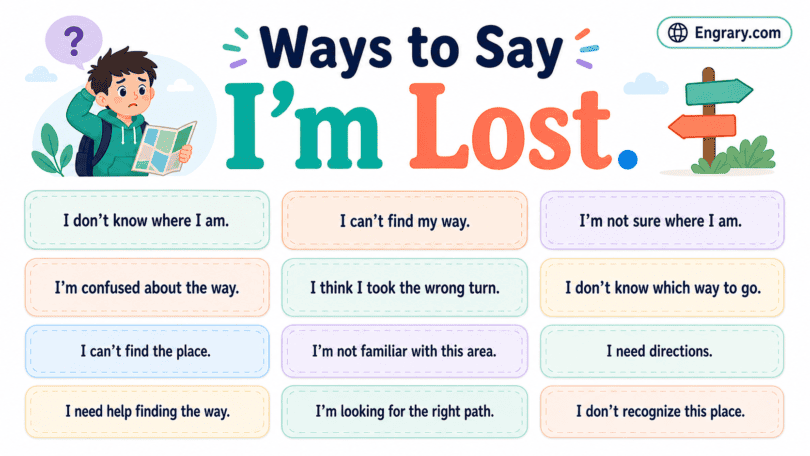
“I’m lost” is a useful phrase, but it can mean different things in English. Sometimes, it means you do not know where you are. At other times, it means you feel confused, stuck, unsure, or unable to follow something.
For example, “I don’t know where I am” works when you are physically lost, while “I’m not following” works in a lesson, meeting, or conversation. Meanwhile, “I feel lost right now” sounds more emotional. Therefore, this guide gives you 100 natural ways to say “I’m lost” with examples for travel, directions, buildings, meetings, classes, emotions, quick texts, and everyday conversations.
Best Ways to Say “I’m Lost” by Situation
| Situation | Best Phrase |
|---|---|
| Physically lost | I don’t know where I am |
| Need directions | Could you point me in the right direction? |
| Lost while traveling | I think I took a wrong turn |
| Lost in a building | I can’t find the exit |
| Lost in a station, airport, or campus | I’m trying to find the right place |
| Mentally lost | I’m not following |
| Lost in a conversation or meeting | I’m not following the last point |
| Need clarification | Could you explain that again? |
| Professional setting | I may need some clarification |
| Classroom or learning | I don’t understand this part |
| Emotionally lost | I feel lost right now |
| Lost in life | I don’t know what to do next |
| Quick text | Can you send your location? |
| Idiom | I’m at a loss |
I’m Lost vs I’m Confused vs I’m Disoriented vs I’m at a Loss
| Phrase | Meaning | Best Use |
|---|---|---|
| I’m lost | You do not know where you are, what to do, or how to follow something | Physical, mental, or emotional situations |
| I’m confused | You do not understand clearly | Explanations, lessons, conversations |
| I’m disoriented | You feel physically or mentally unsure of where you are | Serious location or health-related confusion |
| I’m at a loss | You do not know what to say or do | Emotional, formal, or reflective situations |
| I’m not following | You cannot follow an explanation | Meetings, lessons, conversations |
| I’m stuck | You cannot move forward | Tasks, decisions, problems |
| I’m in the dark | You do not have enough information | Professional or casual situations |
| I feel directionless | You feel unsure about your path or future | Emotional or life-direction situations |
Is “I’m Lost” Natural and Polite?
Yes, “I’m lost” is natural in everyday English. You can use it when you do not know where you are, when you cannot follow an explanation, or when you feel unsure about what to do next.
However, polite or professional situations often need more specific wording. Instead of only saying “I’m lost,” you can say “I may need some clarification,” “Could you point me in the right direction?” or “I’m not following the last point.” As a result, your message sounds clearer and more helpful.
Everyday Ways to Say “I’m Lost”
These phrases work well in normal conversations when you feel unsure, confused, or unable to find your way.
I’m lost
A simple phrase for physical or mental confusion.
Example: I’m lost and not sure where to go.
I don’t know where I am
A clear phrase for being physically lost.
Example: I don’t know where I am right now.
I’m confused
A general phrase when something does not make sense.
Example: I’m confused about what happened.
I’m not following
A natural phrase when you cannot follow an explanation.
Example: I’m not following this part.
I don’t understand
A simple phrase for mental confusion.
Example: I don’t understand the instructions.
I’m stuck
A phrase for not knowing how to move forward.
Example: I’m stuck on this problem.
I have no idea what to do
A casual phrase for feeling lost about the next step.
Example: I have no idea what to do now.
I’m not sure where to go
A practical phrase for location or direction confusion.
Example: I’m not sure where to go from here.

Ways to Say You Are Physically Lost
Use these phrases when you do not know your location or cannot find your way.
I don’t know where I am
A clear phrase when you do not recognize your location.
Example: I don’t know where I am on this map.
I think I’m lost
A natural phrase when you are unsure about your location.
Example: I think I’m lost.
I can’t find my way
A phrase for not knowing how to reach your destination.
Example: I can’t find my way back.
I lost my way
A simple phrase for going in the wrong direction.
Example: I lost my way after the station.
I’m not sure where to go
A useful phrase when you need direction.
Example: I’m not sure where to go next.
I seem to be in the wrong place
A polite phrase when you are not where you should be.
Example: I seem to be in the wrong place.
I think I took a wrong turn
A phrase for travel or walking directions.
Example: I think I took a wrong turn.
I don’t recognize this area
A phrase for unfamiliar places.
Example: I don’t recognize this area.
Polite Ways to Ask for Directions
These phrases help you ask for help respectfully when you are lost.
Could you help me find my way?
A polite question for asking for direction help.
Example: Could you help me find my way to the station?
Could you point me in the right direction?
A polite phrase for general direction help.
Example: Could you point me in the right direction?
Do you know how to get to this place?
A useful question when you have a destination.
Example: Do you know how to get to this place?
Could you show me where this is?
A polite phrase when you can show a map, address, or name.
Example: Could you show me where this is?
I’m sorry, I’m not familiar with this area
A polite phrase before asking for help.
Example: I’m sorry, I’m not familiar with this area.
Would you mind helping me with directions?
A respectful question for direction help.
Example: Would you mind helping me with directions?
Could you tell me where I am on the map?
A practical phrase when using a map.
Example: Could you tell me where I am on the map?
Is this the right way to the entrance?
A polite question for confirming direction.
Example: Is this the right way to the entrance?
Ways to Say You Are Lost While Traveling
These phrases work well when you are traveling, walking around a new city, using transport, or looking for a place.
I’m trying to get to this address
A useful phrase when asking for travel help.
Example: I’m trying to get to this address.
I can’t find the station
A clear phrase when you cannot locate public transport.
Example: I can’t find the station.
I think I missed my stop
A phrase for bus, train, or subway travel.
Example: I think I missed my stop.
I got off at the wrong place
A travel phrase when you exited too early or too late.
Example: I got off at the wrong place.
I’m not sure which way to go
A useful travel phrase for direction confusion.
Example: I’m not sure which way to go.
My map is not helping
A casual phrase when your map does not make things clear.
Example: My map is not helping.
I can’t find my hotel
A travel phrase for hotel direction problems.
Example: I can’t find my hotel.
I need help finding my way back
A clear phrase for returning to a known place.
Example: I need help finding my way back.
Ways to Say You Are Lost in a Building, Station, Airport, or Campus
Use these phrases when you are inside a large place and cannot find the right room, floor, gate, or exit.
I can’t find the exit
A simple phrase for leaving a place.
Example: I can’t find the exit.
I’m looking for room 204
A specific phrase for schools, offices, or buildings.
Example: I’m looking for room 204.
I can’t find the right floor
A phrase for buildings, hotels, offices, or hospitals.
Example: I can’t find the right floor.
I’m not sure which hallway to take
A useful phrase for large buildings.
Example: I’m not sure which hallway to take.
I think I’m in the wrong building
A clear phrase for campuses or office areas.
Example: I think I’m in the wrong building.
I can’t find the reception desk
A practical phrase for hotels, offices, and hospitals.
Example: I can’t find the reception desk.
I’m trying to find the entrance
A phrase for getting into the correct place.
Example: I’m trying to find the entrance.
Could you direct me to the main lobby?
A polite phrase for large buildings.
Example: Could you direct me to the main lobby?
Ways to Say You Are Mentally Lost or Confused
These phrases work when you do not understand an idea, explanation, task, or situation.
I’m not following
A natural phrase when you cannot follow an explanation.
Example: I’m not following this part.
I’m confused
A simple phrase when something is unclear.
Example: I’m confused about the answer.
I don’t understand
A direct phrase for not understanding something.
Example: I don’t understand the question.
I’m having trouble keeping up
A phrase for struggling to follow speed or details.
Example: I’m having trouble keeping up with the explanation.
I’m lost on this part
A specific phrase for one confusing section.
Example: I’m lost on this part of the lesson.
I can’t make sense of this
A phrase for something that feels unclear or confusing.
Example: I can’t make sense of this message.
I’m not sure what this means
A useful phrase when a word, idea, or instruction is unclear.
Example: I’m not sure what this means.
I need this explained another way
A practical phrase for asking for a clearer explanation.
Example: I need this explained another way.
Ways to Say You Are Lost in a Conversation or Meeting
These phrases help when you cannot follow what someone is saying in a discussion, meeting, or group conversation.
I’m not following the last point
A polite phrase for meeting confusion.
Example: I’m not following the last point.
I lost track of the discussion
A natural phrase when the conversation moved too quickly.
Example: I lost track of the discussion.
I’m not sure where we are in the conversation
A phrase for losing the flow of a discussion.
Example: I’m not sure where we are in the conversation.
I missed the connection between those points
A professional phrase for unclear logic.
Example: I missed the connection between those points.
I’m having trouble following the thread
A phrase for complex conversations.
Example: I’m having trouble following the thread.
Could we go back one step?
A useful phrase for reviewing a previous point.
Example: Could we go back one step?
Could you repeat the main point?
A polite phrase for asking someone to restate the idea.
Example: Could you repeat the main point?
I need a quick recap
A natural phrase for summarizing what you missed.
Example: I need a quick recap before we continue.
Ways to Ask for Clarification When You Feel Lost
Sometimes, the best response is not only saying you are lost. Instead, ask for clarification so the other person can help you.
Could you explain that again?
A polite question for another explanation.
Example: Could you explain that again?
Could you say that another way?
A useful phrase for asking for simpler wording.
Example: Could you say that another way?
Could you give me an example?
A helpful phrase when an example would make things clearer.
Example: Could you give me an example?
What do you mean by that?
A direct question for meaning.
Example: What do you mean by that?
Can you walk me through it?
A practical phrase for step-by-step help.
Example: Can you walk me through it?
Could you break that down?
A casual phrase for a simpler explanation.
Example: Could you break that down for me?
What am I missing?
A natural question when you think you missed something important.
Example: What am I missing here?
Can we go over that one more time?
A polite phrase for reviewing something again.
Example: Can we go over that one more time?
Professional Ways to Say “I’m Lost”
Use these phrases in work emails, meetings, projects, and professional conversations.
I may need some clarification
A professional phrase for asking for help.
Example: I may need some clarification on this process.
I’m not fully following the process
A workplace phrase for process confusion.
Example: I’m not fully following the process yet.
Could you walk me through this?
A professional phrase for step-by-step guidance.
Example: Could you walk me through this part?
I’m unclear about the next step
A polished phrase for task confusion.
Example: I’m unclear about the next step.
I’m having trouble following the details
A professional phrase for complex information.
Example: I’m having trouble following the details.
Could you clarify this part?
A direct professional question.
Example: Could you clarify this part of the report?
I may be missing some context
A polite phrase that avoids blame.
Example: I may be missing some context here.
I’m not clear on the expectations
A professional phrase for role or task confusion.
Example: I’m not clear on the expectations.
Classroom and Learning Phrases for Feeling Lost
These phrases work well for students, teachers, tutors, and learning situations.
I don’t understand this part
A clear phrase for classroom confusion.
Example: I don’t understand this part of the lesson.
I’m lost in the lesson
A phrase for not following a lesson.
Example: I’m lost in the lesson now.
I’m stuck on this question
A phrase for not knowing how to answer.
Example: I’m stuck on this question.
Could you explain this again?
A polite classroom phrase.
Example: Could you explain this again?
I’m having trouble following the class
A phrase for struggling to keep up.
Example: I’m having trouble following the class.
This topic is confusing me
A natural phrase for difficult topics.
Example: This topic is confusing me.
I need help with this step
A practical phrase for learning.
Example: I need help with this step.
Could you give another example?
A helpful classroom phrase.
Example: Could you give another example?
Emotional Ways to Say “I’m Lost”
Use these phrases when “lost” means emotionally unsure, overwhelmed, or uncertain.
I feel lost right now
A direct phrase for emotional uncertainty.
Example: I feel lost right now.
I feel unsure about everything
A phrase for emotional confusion.
Example: I feel unsure about everything lately.
I don’t know how I feel
A phrase for emotional uncertainty.
Example: I don’t know how I feel about this.
I feel overwhelmed and unsure
A phrase for feeling emotionally burdened.
Example: I feel overwhelmed and unsure.
I’m trying to find my way
A hopeful phrase for emotional or personal uncertainty.
Example: I’m trying to find my way again.
I’m struggling to find my footing
A phrase for trying to regain stability.
Example: I’m struggling to find my footing after everything.
I need time to figure things out
A calm phrase for emotional processing.
Example: I need time to figure things out.
I feel like I don’t know where I stand
A phrase for emotional or relationship uncertainty.
Example: I feel like I don’t know where I stand.
Ways to Say You Feel Lost in Life
These phrases work when you feel unsure about your future, goals, choices, or direction.
I don’t know what to do next
A clear phrase for life-direction uncertainty.
Example: I don’t know what to do next.
I feel unsure about my path
A thoughtful phrase for future uncertainty.
Example: I feel unsure about my path.
I feel stuck
A simple phrase for not moving forward.
Example: I feel stuck in life right now.
I’m not sure where my life is going
A direct phrase for feeling directionless.
Example: I’m not sure where my life is going.
I feel directionless
A concise phrase for lacking direction.
Example: I feel directionless after graduation.
I’m searching for direction
A hopeful phrase for trying to find a path.
Example: I’m searching for direction.
I’m still figuring out my path
A natural phrase for uncertainty and growth.
Example: I’m still figuring out my path.
I don’t know where to go from here
A phrase for uncertainty after a change or problem.
Example: I don’t know where to go from here.
Idioms for Feeling Lost
Idioms can make your English sound more expressive. However, use them carefully because some are informal or figurative.
I’m at a loss
This means you do not know what to say or do.
Example: I’m at a loss for words.
I’m in the dark
This means you do not have enough information.
Example: I’m in the dark about the decision.
I’m at sea
This means you feel very confused.
Example: I’m at sea with these instructions.
I’m going around in circles
This means you keep trying but make no progress.
Example: I’m going around in circles trying to solve this.
I’m drawing a blank
This means you cannot remember or think of an answer.
Example: I’m drawing a blank.
I’m out of my depth
This means something feels beyond your current ability or knowledge.
Example: I’m out of my depth with this task.
I can’t find my bearings
This means you cannot understand where you are or what is happening.
Example: I can’t find my bearings in this new city.
I’m lost in the weeds
This means you are confused by too many details.
Example: I’m lost in the weeds with this project.
Short Texts and Quick Messages for “I’m Lost”
These short messages work well in texts, chats, and quick replies.
I’m lost
A short direct message.
Example: I’m lost.
I need directions
A clear short text for help.
Example: I need directions.
I can’t find the place
A quick message when you cannot find a location.
Example: I can’t find the place.
I think I’m in the wrong area
A useful message when your location seems wrong.
Example: I think I’m in the wrong area.
Can you send your location?
A practical text when you need help finding someone.
Example: Can you send your location?
I missed my stop
A short travel message.
Example: I missed my stop.
I can’t find the entrance
A quick message for buildings or events.
Example: I can’t find the entrance.
Can you explain again?
A short message for mental confusion.
Example: Can you explain again?
Phrases to Use Carefully
Some “I’m lost” alternatives can sound too dramatic, informal, serious, or self-critical.
| Phrase | Why to Use Carefully | Better Situation |
|---|---|---|
| I’m clueless | Can sound self-critical | Casual conversations only |
| I have no idea what’s going on | Casual and blunt | Friends or informal settings |
| I’m totally lost | Strong and informal | Casual or emotional situations |
| I’m hopelessly lost | Dramatic | Use for humor or strong emphasis |
| I’m lost without you | Romantic or emotional, not general | Close personal relationships |
| I’m disoriented | Can sound serious or health-related | Physical confusion or safety situations |
| I’m out of my depth | Can sound like you lack ability | Honest professional or learning situations |
| I don’t know anything | Too self-critical | Avoid |
| I’m wandering aimlessly | Dramatic or literary | Creative writing or emotional expression |
| I’m a mess | Very emotional and informal | Close friends only |
Common Mistakes When Saying “I’m Lost”
Many English learners use “I’m lost” for every kind of confusion. Although the phrase is correct, it helps to be specific about whether you mean location, directions, instructions, emotions, or life direction.
In professional settings, avoid overly casual phrases like “I’m clueless” or “I have no idea what’s going on.” Instead, say “I may need some clarification” or “I’m not fully following the process.” Also, if you are physically lost, ask for help clearly instead of only saying “I’m lost.”
Natural Conversation Examples
Physically lost
A: Are you nearby?
B: I don’t know where I am. Can you send your location?
Asking for directions
A: Do you need help?
B: Yes, could you point me in the right direction?
Work meeting
A: Does everyone understand the plan?
B: I’m not following the last point. Could you explain it again?
Classroom
A: Are you okay with this topic?
B: I’m lost in the lesson. Could you give another example?
Emotional situation
A: How are you feeling?
B: I feel lost right now, but I’m trying to find my way.
What to Say Instead of “I’m Lost” in Different Situations
| Situation | Better Phrase |
|---|---|
| Physically lost | I don’t know where I am |
| Need directions | Could you point me in the right direction? |
| Traveling | I think I took a wrong turn |
| Building, airport, station, or campus | I’m trying to find the right place |
| Quick text | Can you send your location? |
| Class or lesson | I don’t understand this part |
| Conversation or meeting | I’m not following the last point |
| Asking for clarification | Could you explain that again? |
| Professional setting | I may need some clarification |
| Emotional situation | I feel lost right now |
| Life direction | I don’t know what to do next |
| Idiom | I’m at a loss |
How to Choose the Right “I’m Lost” Phrase
Choose your phrase based on what kind of “lost” you mean. If you are physically lost, say “I don’t know where I am” or ask “Could you point me in the right direction?”
When you do not understand something, phrases like “I’m not following,” “Could you explain that again?” or “I may need some clarification” sound clearer. However, if you feel emotionally lost, phrases like “I feel lost right now” or “I don’t know what to do next” express your feelings more naturally.
Summary
There are many ways to say “I’m lost,” and the best phrase depends on the situation. For physical location problems, “I don’t know where I am,” “I think I took a wrong turn,” and “Could you point me in the right direction?” work well.
However, mental, professional, classroom, and emotional situations need different wording. In meetings, say “I’m not following the last point.” For learning, use “I don’t understand this part.” When describing emotional uncertainty, try “I feel lost right now” or “I’m still figuring out my path.”
FAQs
Another way to say “I’m lost” is “I don’t know where I am.” If you mean confusion, you can say “I’m not following,” “I’m confused,” or “I’m at a loss.”
You can say “Could you point me in the right direction?” when asking for directions. In a conversation or meeting, say “I may need some clarification” or “Could you explain that again?”
You can say “I don’t know where I am,” “I think I took a wrong turn,” or “Could you help me find my way?” If you are texting someone, ask “Can you send your location?”
A professional way to say “I’m lost” is “I may need some clarification.” You can also say “I’m not fully following the process” or “Could you walk me through this?”
“I’m at a loss” means you do not know what to say or do. For example, “I’m at a loss for words” means you cannot find the right words.
You May Also Like