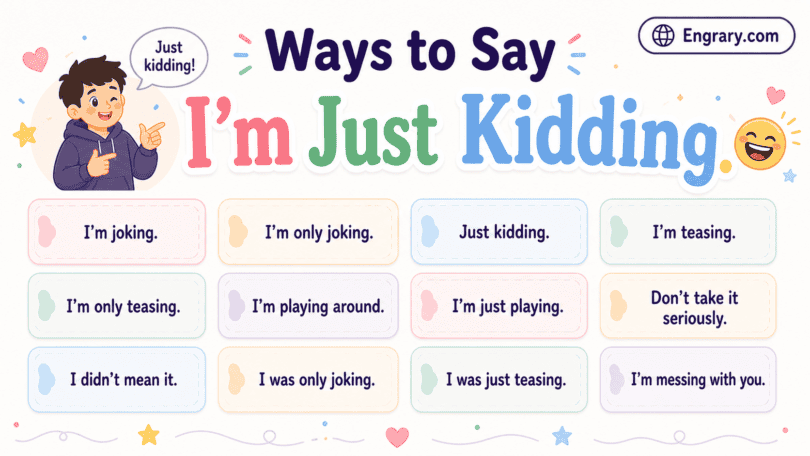
“I’m just kidding” is a common phrase in English, but it does not always fit every situation. Sometimes, you may need a softer phrase, a casual text reply, a professional-safe comment, or a short apology when a joke does not land well.
For example, “I’m joking” sounds simple and direct, while “I didn’t mean that seriously” sounds more careful. Meanwhile, “Sorry, that came out wrong” works better when a joke may have hurt or confused someone. Therefore, this guide gives you 80 natural ways to say “I’m just kidding” with examples for conversations, texts, teasing, professional settings, playful messages, and awkward jokes.
Best Ways to Say “I’m Just Kidding” by Situation
| Situation | Best Phrase |
|---|---|
| General joking | I’m just kidding |
| Simple clarification | I’m joking |
| Polite clarification | I didn’t mean that seriously |
| Professional setting | I meant that lightly |
| Casual message | Just joking |
| Quick text | JK |
| Playful teasing | I’m just teasing you |
| Didn’t mean it literally | I didn’t mean that literally |
| Joke came out wrong | Sorry, that came out wrong |
| Flirty or affectionate | I’m only joking, love |
| Funny or sarcastic | Okay, okay, I’m kidding |
I’m Just Kidding vs I’m Joking vs I’m Teasing vs I’m Not Serious
| Phrase | Meaning | Best Use |
|---|---|---|
| I’m just kidding | You did not mean it seriously | Everyday conversations |
| I’m joking | Simple and direct | General clarification |
| I’m only joking | Softer and slightly more polite | Casual or polite situations |
| I’m teasing | Playfully making fun of someone | Close relationships |
| I’m messing with you | Very casual and playful | Friends or informal chats |
| I’m not serious | Clear and direct | Avoiding confusion |
| I didn’t mean that literally | The statement was not meant as a fact | Clarifying exaggeration |
| That was meant lightly | The comment was not meant to be serious or harsh | Polite or professional settings |
Is “I’m Just Kidding” Polite and Natural?
Yes, “I’m just kidding” is natural in everyday English. You can use it with friends, family, classmates, and people who understand your humor.
However, this phrase can sound weak if the joke was hurtful or misunderstood. In careful situations, use softer wording like “I didn’t mean that seriously,” “That was meant lightly,” or “Sorry, that came out wrong.” These phrases sound more thoughtful than simply saying “just kidding.”
Everyday Ways to Say “I’m Just Kidding”
These phrases work well in normal conversations when you want to show that your words were not serious.
I’m just kidding
A common phrase for saying your comment was a joke.
Example: I’m just kidding; I know you did a great job.
I’m joking
A simple and direct phrase for clarifying humor.
Example: I’m joking. Don’t worry.
Just joking
A short phrase for saying something was not serious.
Example: Just joking. I didn’t mean that.
I’m only joking
A softer phrase for casual or polite clarification.
Example: I’m only joking, so don’t take it seriously.
It was a joke
A clear phrase for explaining your meaning.
Example: It was a joke, not a real comment.
I didn’t mean it
A simple phrase for saying your words were not serious.
Example: I didn’t mean it. I was joking.
I wasn’t serious
A clear phrase for correcting misunderstanding.
Example: I wasn’t serious about leaving.
Don’t take that seriously
A direct phrase for softening a comment.
Example: Don’t take that seriously. I was joking.
Polite Ways to Say “I’m Just Kidding”
Use these phrases when you want to sound gentle, respectful, or careful.
I didn’t mean that seriously
A polite phrase for clarifying your intent.
Example: I didn’t mean that seriously.
Please don’t take that seriously
A respectful phrase for avoiding confusion.
Example: Please don’t take that seriously; I was joking.
That was meant lightly
A careful phrase for a light comment.
Example: That was meant lightly, not as criticism.
I was just trying to be funny
A polite phrase for explaining your humor.
Example: I was just trying to be funny.
I didn’t mean it that way
A useful phrase when your joke sounded wrong.
Example: I didn’t mean it that way.
I hope that didn’t come across wrong
A thoughtful phrase for checking your tone.
Example: I hope that didn’t come across wrong.
That was meant as a joke
A clear phrase for explaining a joking comment.
Example: That was meant as a joke.
I should have said that more clearly
A polite phrase for taking responsibility.
Example: I should have said that more clearly.
Professional Ways to Say “I’m Just Kidding”
Workplace humor needs careful wording. These phrases help you sound light without seeming rude or careless.
I meant that lightly
A professional phrase for softening a comment.
Example: I meant that lightly, of course.
That was just a light comment
A work-safe phrase for a casual joke.
Example: That was just a light comment.
I didn’t mean that literally
A professional phrase for clarifying exaggeration.
Example: I didn’t mean that literally.
I was speaking in a lighthearted way
A polished phrase for explaining tone.
Example: I was speaking in a lighthearted way.
Please don’t take that literally
A formal phrase for avoiding misunderstanding.
Example: Please don’t take that literally.
I hope that didn’t come across the wrong way
A careful phrase for workplace tone.
Example: I hope that didn’t come across the wrong way.
That was meant as a small joke
A professional phrase for a mild joke.
Example: That was meant as a small joke.
Let me rephrase that more clearly
A responsible phrase when your joke may confuse someone.
Example: Let me rephrase that more clearly.
Casual Ways to Say “I’m Just Kidding”
These phrases sound relaxed and natural with friends, family, classmates, or close coworkers.
I’m kidding
A casual phrase for saying you are not serious.
Example: I’m kidding. You’re fine.
Kidding
A short casual reply.
Example: Kidding!
I’m messing with you
A playful phrase for joking with someone.
Example: I’m messing with you.
I’m just playing
A casual phrase for playful joking.
Example: I’m just playing.
I’m only playing
A softer casual phrase.
Example: I’m only playing, don’t worry.
Don’t worry, I’m joking
A casual phrase for reassurance.
Example: Don’t worry, I’m joking.
I’m not serious
A clear casual phrase.
Example: I’m not serious about that.
I’m just messing around
A relaxed phrase for playful joking.
Example: I’m just messing around.
Short Texts and Quick Replies for “I’m Just Kidding”
These short phrases work well in texts, chats, comments, and social messages.
JK
A common text abbreviation for “just kidding.”
Example: JK.
Kidding
A quick text for clarifying a joke.
Example: Kidding.
Joking
A short reply that shows you were not serious.
Example: Joking.
Just joking
A quick phrase for casual messages.
Example: Just joking.
Just kidding
A clear short text.
Example: Just kidding.
Not serious
A brief phrase for avoiding confusion.
Example: Not serious.
Lol, kidding
A casual text phrase with a playful tone.
Example: Lol, kidding.
I’m playing
A short casual phrase.
Example: I’m playing.
Playful Ways to Say “I’m Just Kidding”
Use these phrases when the mood is light and the other person understands your humor.
I’m just messing with you
A playful phrase for joking.
Example: I’m just messing with you.
I’m pulling your leg
An idiom that means you are joking.
Example: I’m pulling your leg.
I’m joking around
A friendly phrase for playful humor.
Example: I’m joking around.
I’m just having fun
A light phrase for harmless joking.
Example: I’m just having fun.
I’m being silly
A gentle phrase for playful behavior.
Example: I’m being silly.
I’m only fooling around
A casual phrase for joking.
Example: I’m only fooling around.
I’m just goofing around
A playful phrase for silly joking.
Example: I’m just goofing around.
I’m playing with you
A casual phrase for friendly joking.
Example: I’m playing with you.
Ways to Say You’re Teasing Someone
Teasing can feel personal, so use these phrases with care and kindness.
I’m only teasing
A gentle phrase for playful teasing.
Example: I’m only teasing.
I’m just teasing you
A clear phrase for friendly teasing.
Example: I’m just teasing you.
I’m teasing, don’t worry
A reassuring phrase for playful comments.
Example: I’m teasing, don’t worry.
I’m saying that playfully
A polite phrase for explaining your tone.
Example: I’m saying that playfully.
I’m poking fun, not being mean
A careful phrase for friendly teasing.
Example: I’m poking fun, not being mean.
I’m just giving you a hard time
A casual phrase for playful teasing.
Example: I’m just giving you a hard time.
I’m joking with you, not at you
A thoughtful phrase for showing kindness.
Example: I’m joking with you, not at you.
I hope you know I’m teasing
A careful phrase when you want to avoid hurt feelings.
Example: I hope you know I’m teasing.
Ways to Say You Didn’t Mean It Seriously
These phrases help when your words may sound real, harsh, or confusing.
I didn’t mean that seriously
A clear phrase for correcting misunderstanding.
Example: I didn’t mean that seriously.
I didn’t mean it literally
A useful phrase when you used exaggeration.
Example: I didn’t mean it literally.
I wasn’t being serious
A direct phrase for clarifying a comment.
Example: I wasn’t being serious.
That wasn’t meant seriously
A careful phrase for explaining intent.
Example: That wasn’t meant seriously.
I didn’t actually mean that
A natural phrase for clarifying your meaning.
Example: I didn’t actually mean that.
I was exaggerating
A phrase for explaining an overstatement.
Example: I was exaggerating for effect.
I said that in a joking way
A clear phrase for tone.
Example: I said that in a joking way.
I was being playful
A warm phrase for explaining light intent.
Example: I was being playful.
Ways to Soften a Joke That Came Out Wrong
Sometimes, “just kidding” is not enough. These phrases help you take responsibility when a joke sounds rude, harsh, or confusing.
Sorry, that came out wrong
A clear phrase for correcting your tone.
Example: Sorry, that came out wrong.
I was joking, but I didn’t mean to upset you
A thoughtful phrase when someone feels hurt.
Example: I was joking, but I didn’t mean to upset you.
That didn’t land the way I intended
A natural phrase when your joke failed.
Example: That didn’t land the way I intended.
I meant that as a joke, not seriously
A clear phrase for explaining intent.
Example: I meant that as a joke, not seriously.
I should have phrased that better
A responsible phrase for poor wording.
Example: I should have phrased that better.
I was trying to be funny, but I missed the mark
A honest phrase for a failed joke.
Example: I was trying to be funny, but I missed the mark.
I didn’t mean to hurt your feelings
A caring phrase after a hurtful joke.
Example: I didn’t mean to hurt your feelings.
Let me take that back
A direct phrase for withdrawing a comment.
Example: Let me take that back.
Flirty and Affectionate Ways to Say “I’m Just Kidding”
These phrases work best with a partner or someone you are close to. Avoid them in professional or formal situations.
I’m just teasing you
A sweet phrase for playful teasing.
Example: I’m just teasing you.
I’m only joking, love
A warm phrase for a romantic partner.
Example: I’m only joking, love.
I’m kidding, sweetheart
An affectionate phrase for someone close.
Example: I’m kidding, sweetheart.
I’m playing with you
A casual affectionate phrase.
Example: I’m playing with you.
Don’t worry, I’m teasing
A gentle phrase for reassurance.
Example: Don’t worry, I’m teasing.
You know I’m joking
A familiar phrase for close relationships.
Example: You know I’m joking.
I’m only messing with you
A casual affectionate phrase.
Example: I’m only messing with you.
I didn’t mean it, I promise
A soft phrase for reassurance.
Example: I didn’t mean it, I promise.
Sarcastic or Funny Ways to Say “I’m Just Kidding”
These phrases can sound funny with the right person, but they may sound rude if the tone is wrong.
Okay, okay, I’m kidding
A playful phrase when someone reacts to your joke.
Example: Okay, okay, I’m kidding.
Don’t panic, I’m kidding
A funny phrase for reassurance.
Example: Don’t panic, I’m kidding.
Got you
A casual phrase when you fooled someone briefly.
Example: Got you.
I had you for a second
A playful phrase after a quick joke.
Example: I had you for a second.
I’m pulling your leg
A common idiom for joking.
Example: I’m pulling your leg.
Psych
A very casual slang phrase for saying you tricked someone.
Example: Psych.
Sike
A slang version of “psych.”
Example: Sike.
Tricked you
A playful phrase for a light joke.
Example: Tricked you.
Phrases to Use Carefully
Some “just kidding” phrases can sound rude, childish, dismissive, or insincere depending on the situation.
| Phrase | Why to Use Carefully | Better Situation |
|---|---|---|
| Relax, I’m joking | Can sound dismissive | Close friends only |
| Can’t you take a joke? | Blames the other person | Avoid |
| It was just a joke | Can dismiss someone’s feelings | Use with care and apology |
| I’m messing with you | Casual and can annoy people if overused | Friends or informal chats |
| Psych / Sike | Childish, old-fashioned, or very casual | Playful slang only |
| I was only teasing | Can sound like an excuse if the joke was personal | Gentle teasing only |
| Don’t be so serious | Dismissive | Avoid |
| Chill, I’m kidding | Too casual and possibly rude | Close friends only |
| No offense, just kidding | Often sounds insincere | Avoid |
| I’m joking, obviously | Can sound condescending | Avoid |
Common Mistakes When Saying “I’m Just Kidding”
Many English learners use “just kidding” after any joke, but the phrase can sound careless if the other person feels hurt. In that situation, a soft apology is better than repeating “I’m joking.”
In professional settings, avoid slang like “JK,” “sike,” or “psych.” Instead, use careful phrases like “I meant that lightly,” “I didn’t mean that literally,” or “Let me rephrase that more clearly.” Also, remember that tone is harder to read in texts, so keep jokes clear and kind.
Natural Conversation Examples
Casual joke
A: Did you really eat all the pizza?
B: No, I’m just kidding.
Polite clarification
A: Wait, are you serious?
B: No, I didn’t mean that seriously.
Professional setting
A: Did you mean that literally?
B: No, I meant that lightly.
Joke came out wrong
A: That sounded a bit harsh.
B: Sorry, that came out wrong. I didn’t mean to upset you.
Playful teasing
A: Are you making fun of me?
B: No, I’m joking with you, not at you.
What to Say Instead of “I’m Just Kidding” in Different Situations
| Situation | Better Phrase |
|---|---|
| General joke | I’m just kidding |
| Simple clarification | I’m joking |
| Polite correction | I didn’t mean that seriously |
| Professional setting | I meant that lightly |
| Casual chat | Just joking |
| Quick text | JK |
| Playful teasing | I’m just teasing you |
| Not literal | I didn’t mean that literally |
| Joke sounded wrong | Sorry, that came out wrong |
| Flirty message | I’m only joking, love |
| Funny reply | Okay, okay, I’m kidding |
How to Choose the Right “I’m Just Kidding” Phrase
Choose your phrase based on the relationship, tone, and situation. With friends, casual phrases like “I’m joking,” “just kidding,” and “I’m messing with you” usually sound natural.
For professional or sensitive situations, use more careful wording. Try “I meant that lightly,” “I didn’t mean that literally,” or “I hope that didn’t come across the wrong way.” When a joke hurts someone, take responsibility with “Sorry, that came out wrong” or “I didn’t mean to hurt your feelings.”
Summary
There are many ways to say “I’m just kidding,” and the best phrase depends on your tone and relationship with the listener. For everyday use, “I’m joking,” “just joking,” and “I’m only kidding” sound natural.
However, professional, polite, teasing, and sensitive situations need more careful wording. Use “I meant that lightly” at work, “I’m just teasing you” with close people, and “Sorry, that came out wrong” when a joke does not land well.
FAQs
Another way to say “I’m just kidding” is “I’m joking.” You can also say “just joking,” “I’m only kidding,” “I’m teasing,” or “I didn’t mean that seriously.”
You can say “I didn’t mean that seriously,” “That was meant lightly,” or “Please don’t take that seriously.” These phrases sound softer and more respectful.
A professional way to say “I’m just kidding” is “I meant that lightly.” You can also say “I didn’t mean that literally” or “I was speaking in a lighthearted way.”
You can say “Sorry, that came out wrong,” “I didn’t mean to upset you,” or “I was trying to be funny, but I missed the mark.” These phrases show more care than only saying “just kidding.”
“Joking” means saying something for humor. “Teasing” means playfully making fun of someone, so it can feel more personal and should be used carefully.
You May Also Like