
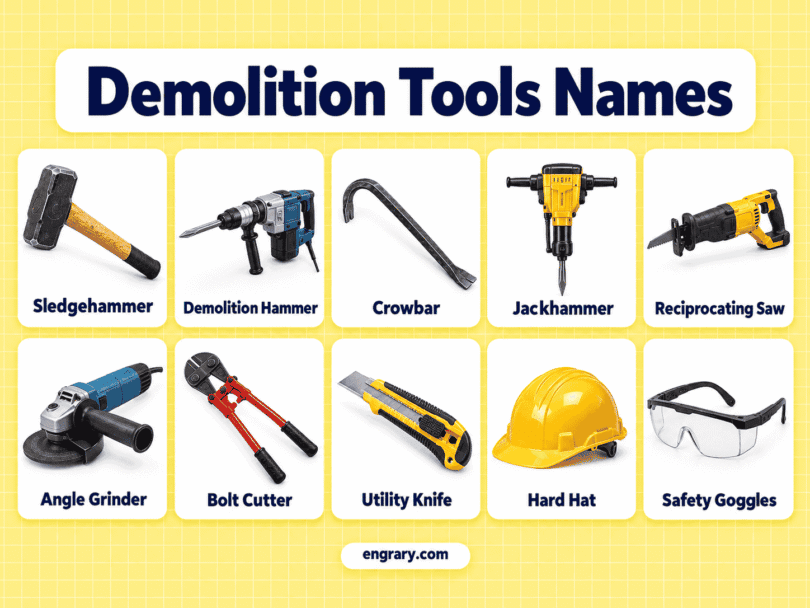
Demolition work uses specialized tools to pry materials apart, break hard surfaces, cut through building components, scrape away old finishes, and remove unwanted sections. Some tools work by hand, while others use electric, pneumatic, or hydraulic power.
This guide explains demolition tools names with simple uses and visual recognition clues. It covers prying bars, striking tools, powered breakers, saws, scrapers, and specialist concrete-demolition equipment so readers can identify each tool more easily from its shape and general purpose.
Tools Commonly Seen During Demolition Work
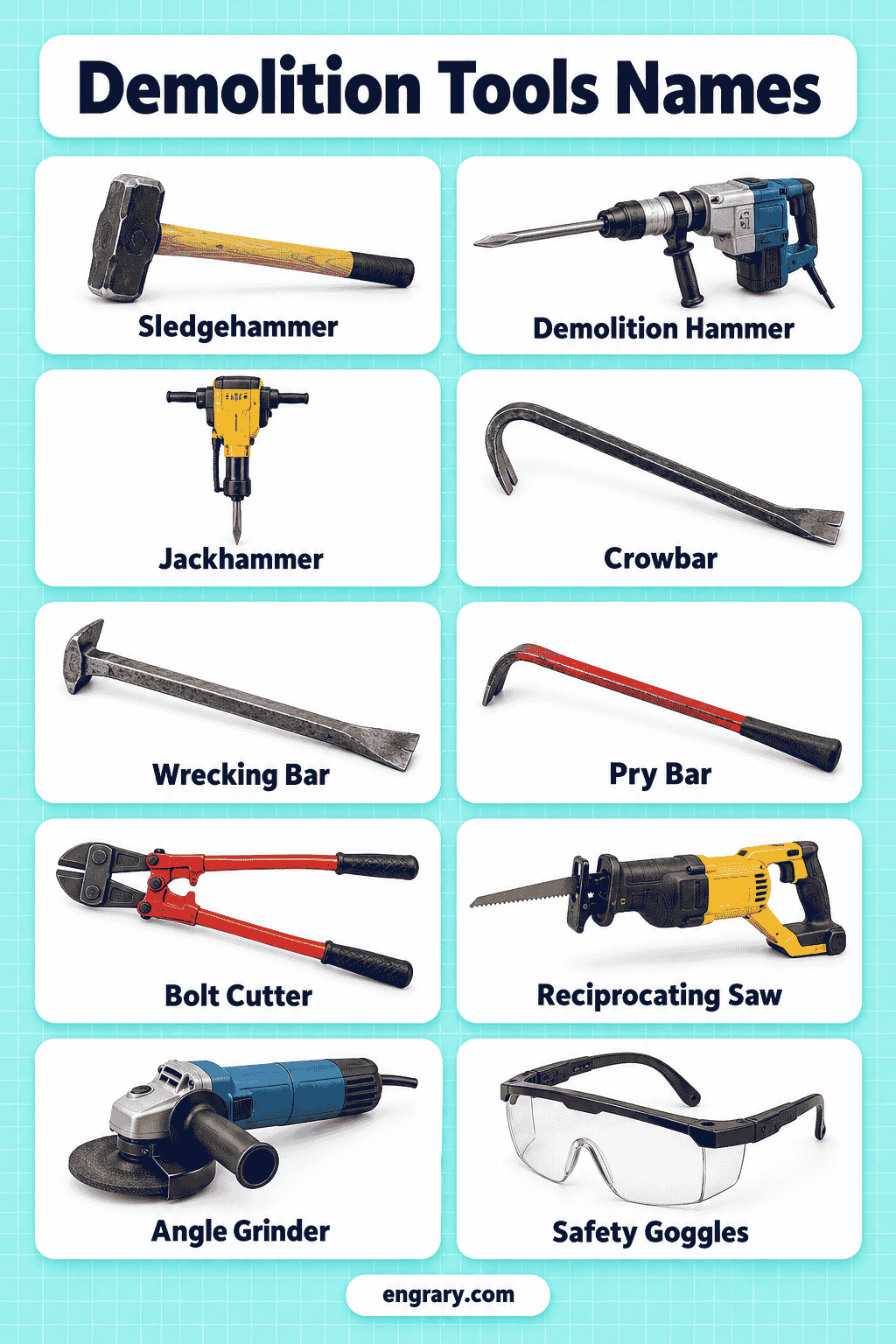
Demolition jobs use a mix of prying, striking, cutting, breaking, and removal tools. The following demolition tools are commonly seen during tear-out and removal work, and each has a distinctive form that makes it easier to recognize.
Wrecking Bar
A long metal bar with curved or flattened ends used for heavy prying and pulling during demolition work.
Pry Bar
A general levering tool with a strong metal body and shaped ends for lifting or separating materials.
Flat Bar
A thin, flat metal bar with bent ends that fits into narrow gaps more easily than a heavier wrecking bar.
Cat’s Paw
A compact nail-pulling tool with a small curved claw at one or both ends.
Nail Puller
A hand tool designed mainly to grip or lift nails from wood and other materials.
Sledgehammer
A large manual striking tool with a heavy metal head mounted on a long handle.
Club Hammer
A shorter striking tool with a compact, heavy head and a much shorter handle than a sledgehammer.
Cold Chisel
A hardened metal chisel with a flat cutting edge used for removing or separating hard materials.
Mason’s Chisel
A sturdy chisel with a broad working edge associated with masonry and demolition work.
Demolition Hammer
A powered breaking tool with a heavy body and chisel-style attachment.
Chipping Hammer
A smaller powered breaker used for lighter material-removal and chipping work.
Rotary Hammer
A powered tool that combines hammering with rotary drilling functions.
Jackhammer
A heavy vertical-style powered breaker commonly associated with concrete and pavement demolition.
Pneumatic Hammer
A powered hammer that uses compressed air as its energy source.
Reciprocating Saw
A portable saw with a long narrow blade that moves back and forth.
Demolition Saw
A heavy-duty cutting tool associated with demanding demolition and construction work.
Concrete Saw
A powered saw designed around cutting concrete and similar masonry materials.
Angle Grinder
A compact powered tool with a rotating disc commonly used for cutting or grinding hard materials.
Oscillating Multi-Tool
A small powered tool whose blade moves rapidly through a short oscillating motion.
Floor Scraper
A long- or short-handled scraper with a broad flat blade for removing material from floor surfaces.
Hand Scraper
A compact scraping tool with a short handle and flat working blade.
Tile Removing Chisel
A broad chisel designed specifically around lifting or breaking away tile during removal work.
Hydraulic Breaker
A heavy machine-mounted demolition attachment that breaks hard material through repeated impact.
Hydraulic Splitter
A specialist demolition tool that uses hydraulic force to split hard material apart.
Concrete Crusher
A heavy demolition attachment with opposing jaws that crush concrete rather than hammering it.
These tools represent the main vocabulary of prying, striking, powered breaking, cutting, scraping, and specialist demolition work.
Prying and Pulling Tools
Prying tools use leverage to lift, separate, or pull building materials apart. Although several names overlap, the tools often differ in length, thickness, and working-end shape.
Wrecking Bar
A wrecking bar is usually longer and heavier than many other pry tools. Its curved end and flattened tip make it easy to recognize.
Pry Bar
A pry bar is the broader name for a tool that uses leverage to separate materials. Depending on the design, it may look similar to a wrecking bar.
Flat Bar
A flat bar has a much thinner profile. Therefore, it fits into tighter spaces where a bulky bar may not fit.
Cat’s Paw
A cat’s paw has a small clawed end designed around nail removal. Its short body also separates it visually from full-length pry bars.
Nail Puller
A nail puller focuses mainly on gripping or levering nails from material. Some designs resemble pliers, while others use clawed levering ends.
The most important terminology point is that pry bar, wrecking bar, and crowbar can overlap in everyday English. For that reason, they should not automatically count as three completely separate tool types.
Manual Breaking Tools
Manual demolition tools rely on hand-applied impact rather than a motor. Their simple shapes make them some of the easiest demolition tools to identify.
Sledgehammer
A sledgehammer has a large metal head and long handle. It is much larger than an ordinary household hammer.
Club Hammer
A club hammer has a compact heavy head on a shorter handle. As a result, it looks more controlled and portable than a sledgehammer.
Hand Maul
A hand maul is another heavy striking tool with a robust head and shorter handle than a full sledgehammer.
Cold Chisel
A cold chisel has a hardened metal body and narrow cutting edge. It concentrates impact along a small working area.
Mason’s Chisel
A mason’s chisel usually has a wider edge than a cold chisel and a heavier appearance suited to masonry-related work.
These tools often appear together because the hammer provides impact while the chisel concentrates that force at a narrow edge.
Powered Breaking Tools
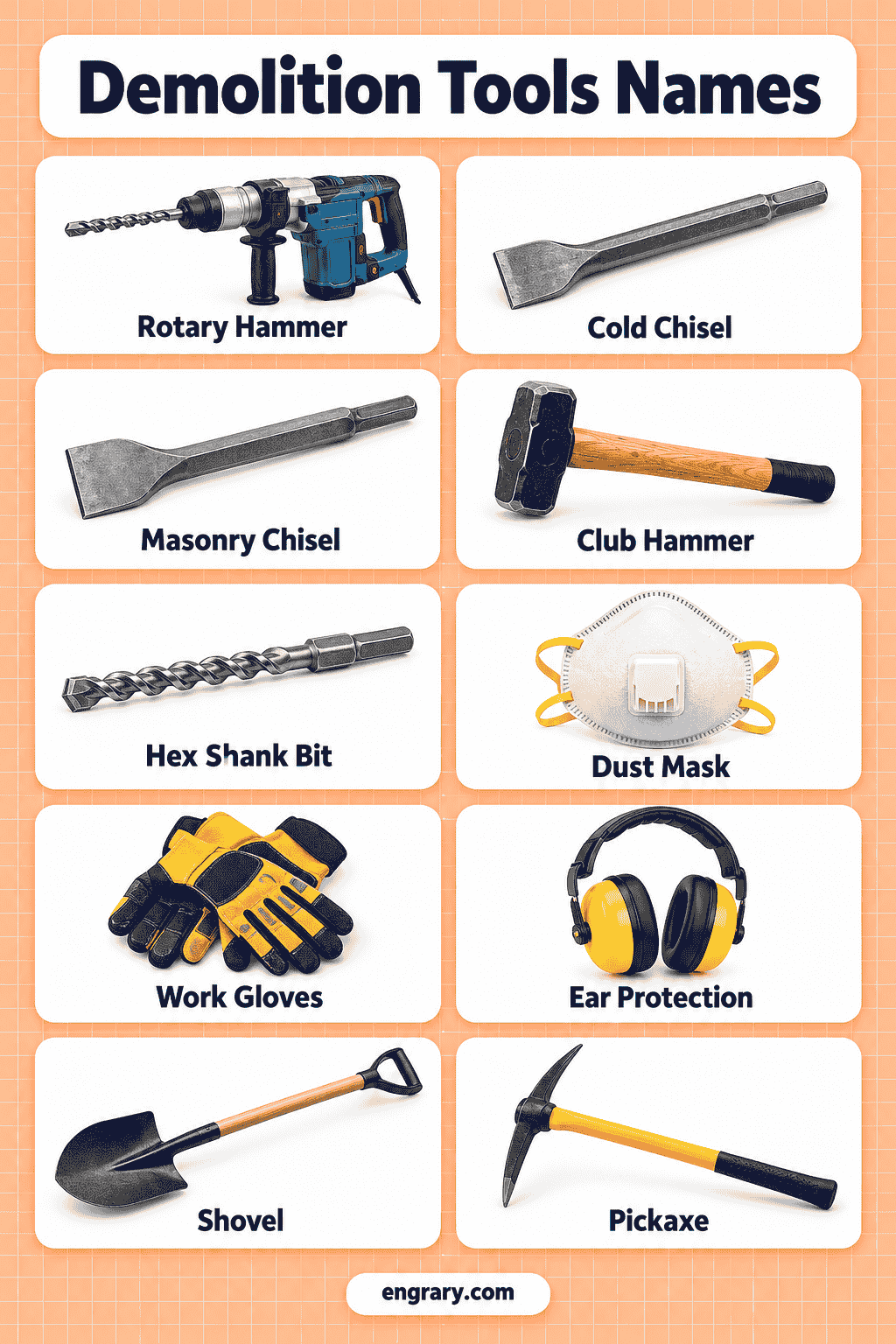
Powered breakers handle heavier demolition tasks than manual hammers. However, their names can be confusing because manufacturers and trades sometimes use overlapping terminology.
Chipping Hammer
A chipping hammer is usually smaller and lighter than a full demolition hammer. Its compact powered body makes it suitable for controlled breaking and removal work.
Demolition Hammer
A demolition hammer uses a powered hammering action and a long chisel-style attachment. Unlike a rotary hammer, its main identity centers on breaking and chiseling.
Rotary Hammer
A rotary hammer can combine rotary drilling with hammering. Therefore, it belongs partly to both drilling and demolition vocabulary.
Jackhammer
A jackhammer is a heavier breaker commonly recognized by its long vertical form and large working bit.
Pneumatic Hammer
A pneumatic hammer uses compressed air. The word pneumatic describes its power source rather than one unique demolition shape.
A useful hierarchy is:
Chipping hammer → lighter breaker
Demolition hammer → heavier handheld breaker
Jackhammer → heavier breaker family
Rotary hammer → drilling and hammering tool
Demolition Cutting Tools
Cutting tools help separate materials that cannot be removed efficiently through prying or impact alone. In demolition work, the most recognizable tools include reciprocating saws, heavy saws, grinders, and multi-tools.
Reciprocating Saw
A reciprocating saw has a long blade projecting from the front of an elongated powered body. The blade moves back and forth rather than rotating.
Demolition Saw
A demolition saw is a broad term for a heavy-duty saw used in demanding removal work. Depending on the design, the name can overlap with material-specific cutting tools.
Concrete Saw
A concrete saw is designed around cutting concrete and masonry materials. Its large circular blade gives it a different visual profile from a reciprocating saw.
Angle Grinder
An angle grinder has a compact body and circular rotating disc mounted at a right angle to the motor housing.
Oscillating Multi-Tool
An oscillating multi-tool uses a short exposed blade or attachment at the front. Because the attachment moves through a small oscillating arc, the tool looks very different from a reciprocating saw.
The reciprocating saw is one of the most recognizable portable demolition tools because of its long exposed blade and narrow front end.
Scraping and Removal Tools
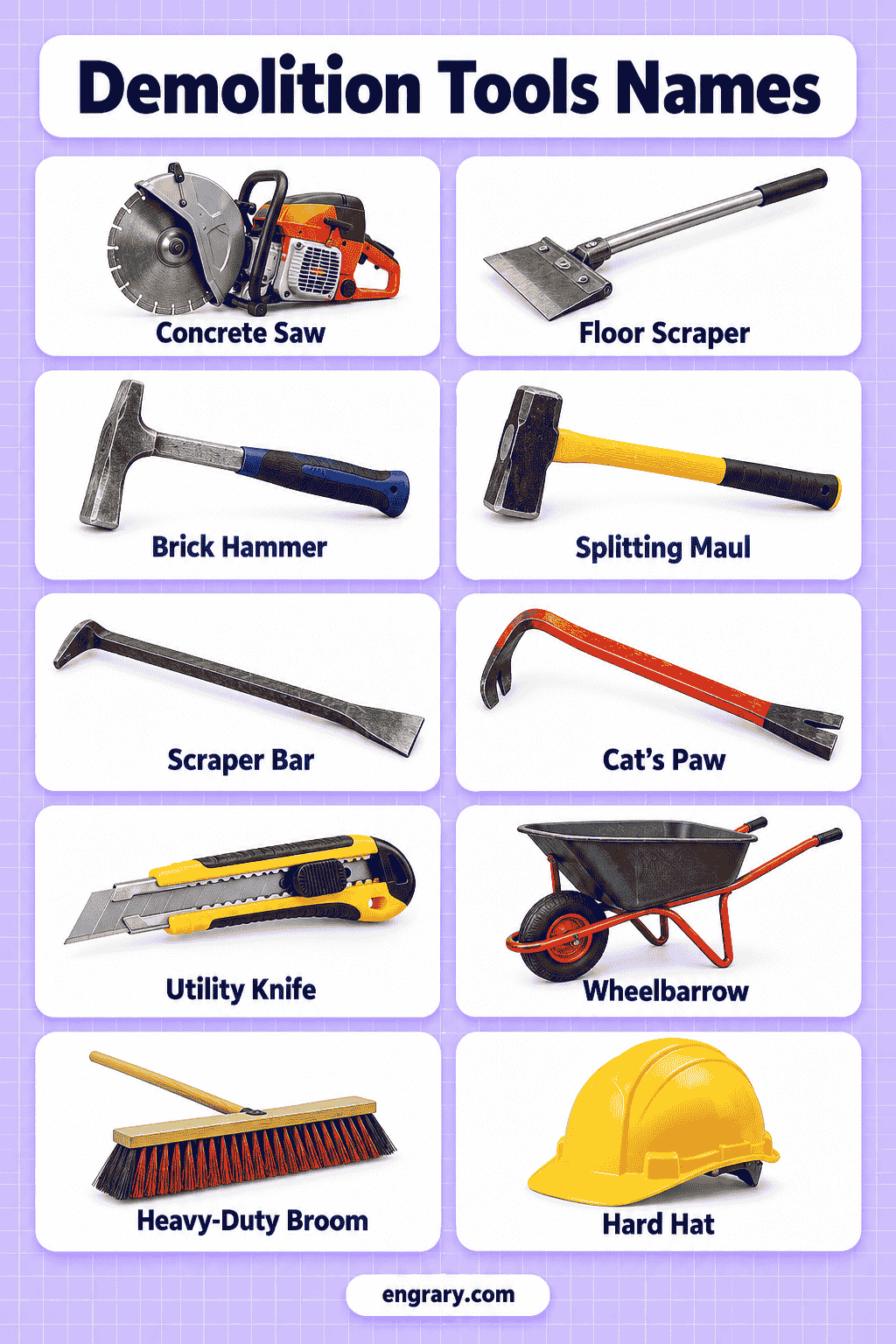
Not every demolition job involves heavy breaking. Some materials come away through scraping, lifting, or controlled removal, so this tool family has its own useful vocabulary.
Floor Scraper
A floor scraper has a wide blade positioned close to the floor. Long-handled versions allow the blade to work across broad areas.
Hand Scraper
A hand scraper is smaller and uses a short handle for more localized removal work.
Tile Removing Chisel
A tile removing chisel has a wide, flat cutting edge designed around tile-removal work.
Cold Chisel
A cold chisel may also appear during removal work. However, because it already belongs to the manual-breaking family, it should not count as another unique primary tool.
The key recognition clue is blade width: floor scrapers use broad flat blades, while chisels concentrate force along a narrower edge.
Specialist Tools for Concrete Demolition
Concrete demolition introduces specialist equipment that works at a much larger scale than hand tools. These terms are useful for vocabulary, but they belong to advanced demolition rather than ordinary light tear-out work.
Hydraulic Breaker
A hydraulic breaker, also called a hydraulic hammer in some contexts, is a machine-mounted impact tool. Its long breaker point projects from a heavy hydraulic body.
Hydraulic Splitter
A hydraulic splitter uses hydraulic force to separate hard material. Its identity centers on splitting rather than repeated hammering.
Concrete Crusher
A concrete crusher uses large opposing jaws. Therefore, it looks completely different from an impact breaker.
Diamond Wire Saw
A diamond wire saw uses a loop or length of diamond-abrasive wire as its cutting component.
Mounted Breaker
A mounted breaker is a general term for a breaker attached to a carrier machine such as an excavator. It may overlap with the term hydraulic breaker depending on the equipment.
A simple classification helps:
| Type | Examples |
|---|---|
| Handheld demolition tools | Wrecking Bar, Sledgehammer, Demolition Hammer, Reciprocating Saw, Floor Scraper |
| Machine-mounted tools | Hydraulic Breaker, Concrete Crusher, Mounted Breaker |
This distinction prevents very different tool scales from being mixed into one flat list.
Demolition Tools That Are Easy to Confuse
Several demolition tools have similar names or overlapping uses. However, their shapes and tool families often reveal the difference.
| Tools | Main Difference |
|---|---|
| Pry Bar vs Wrecking Bar | Pry bar is the broader levering term; wrecking bar usually refers to a longer, heavier demolition bar. |
| Flat Bar vs Wrecking Bar | Flat bar has a thin profile; wrecking bar is heavier and more curved. |
| Cat’s Paw vs Pry Bar | Cat’s paw focuses on nail pulling; pry bar covers broader levering work. |
| Sledgehammer vs Demolition Hammer | Sledgehammer is manual; demolition hammer is powered. |
| Chipping Hammer vs Demolition Hammer | Chipping hammer is generally lighter; demolition hammer is heavier and more demolition-focused. |
| Demolition Hammer vs Rotary Hammer | Demolition hammer focuses on breaking; rotary hammer also supports rotary drilling. |
| Jackhammer vs Breaker Hammer | These terms often overlap rather than describing completely different tools. |
| Reciprocating Saw vs Demolition Saw | Reciprocating saw describes a specific blade action; demolition saw is a broader heavy-cutting term. |
| Hydraulic Breaker vs Concrete Crusher | Hydraulic breaker uses impact; concrete crusher uses opposing jaws. |
Alternate Names for Demolition Tools
Demolition vocabulary varies by country, manufacturer, and trade. Therefore, several names may refer to the same tool family or closely related designs.
Pry Bar / Wrecking Bar / Crowbar
These terms often overlap in everyday use. Pry bar is the broadest term, while wrecking bar commonly suggests a heavier demolition design.
Jackhammer / Breaker Hammer / Paving Breaker
These names frequently describe the same heavy breaker family rather than three completely separate tools.
Hydraulic Breaker / Hydraulic Hammer
Both terms commonly describe a machine-mounted hydraulic impact breaker.
Reciprocating Saw / Sawzall
Reciprocating saw is the generic tool name. Sawzall is brand-derived wording that people sometimes use informally for the same tool family.
Mounted Breaker / Excavator Breaker
Both terms can describe a breaker attachment carried by heavy machinery.
Using one primary name and adding useful alternatives keeps the article broad without artificially inflating the final tool count.
Frequently Asked Questions
Common demolition tools include wrecking bars, pry bars, flat bars, sledgehammers, chisels, demolition hammers, chipping hammers, jackhammers, reciprocating saws, floor scrapers, hydraulic breakers, and concrete crushers.
A pry bar is the broader term for a levering tool, while a wrecking bar usually refers to a longer and heavier version associated more strongly with demolition work.
A demolition hammer usually refers to a handheld powered breaker, while jackhammer commonly describes a heavier vertical-style breaker. However, terminology can overlap between manufacturers and regions.
A rotary hammer combines rotary drilling with hammering functions, while a demolition hammer mainly focuses on hammering and chiseling.
Common concrete-demolition tools include sledgehammers, chisels, demolition hammers, jackhammers, concrete saws, hydraulic breakers, hydraulic splitters, concrete crushers, and diamond wire saws.
You May Also Like



Leave a Comment