
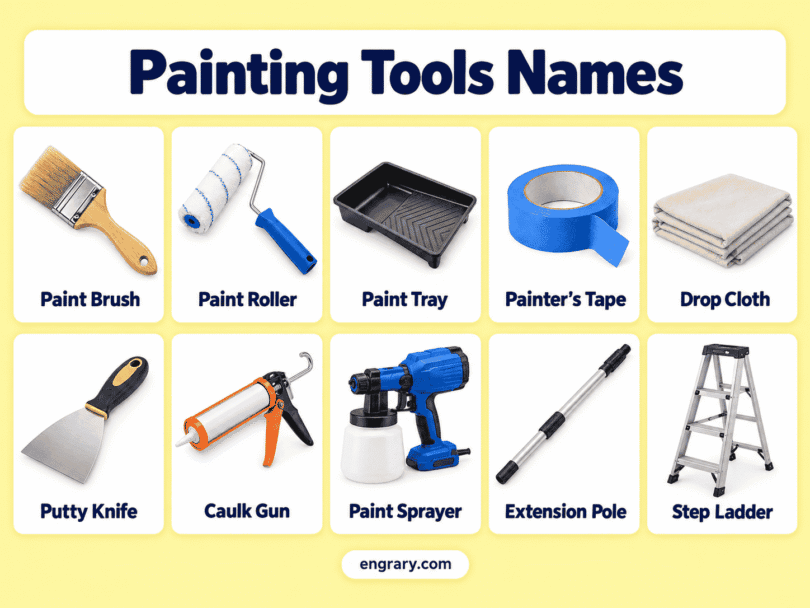
Painting requires more than a brush and a can of paint. Painters prepare surfaces, fill cracks, sand rough areas, protect nearby surfaces, load brushes and rollers, apply coatings, reach corners, spray larger areas, and clean their equipment after the job.
This guide explains painting tools names with simple uses and visual recognition clues. It covers brushes, rollers, paint-loading tools, preparation equipment, edging tools, masking supplies, sprayers, and cleaning tools, so each name connects with a clear shape and purpose.
Tools Used Throughout a Painting Job
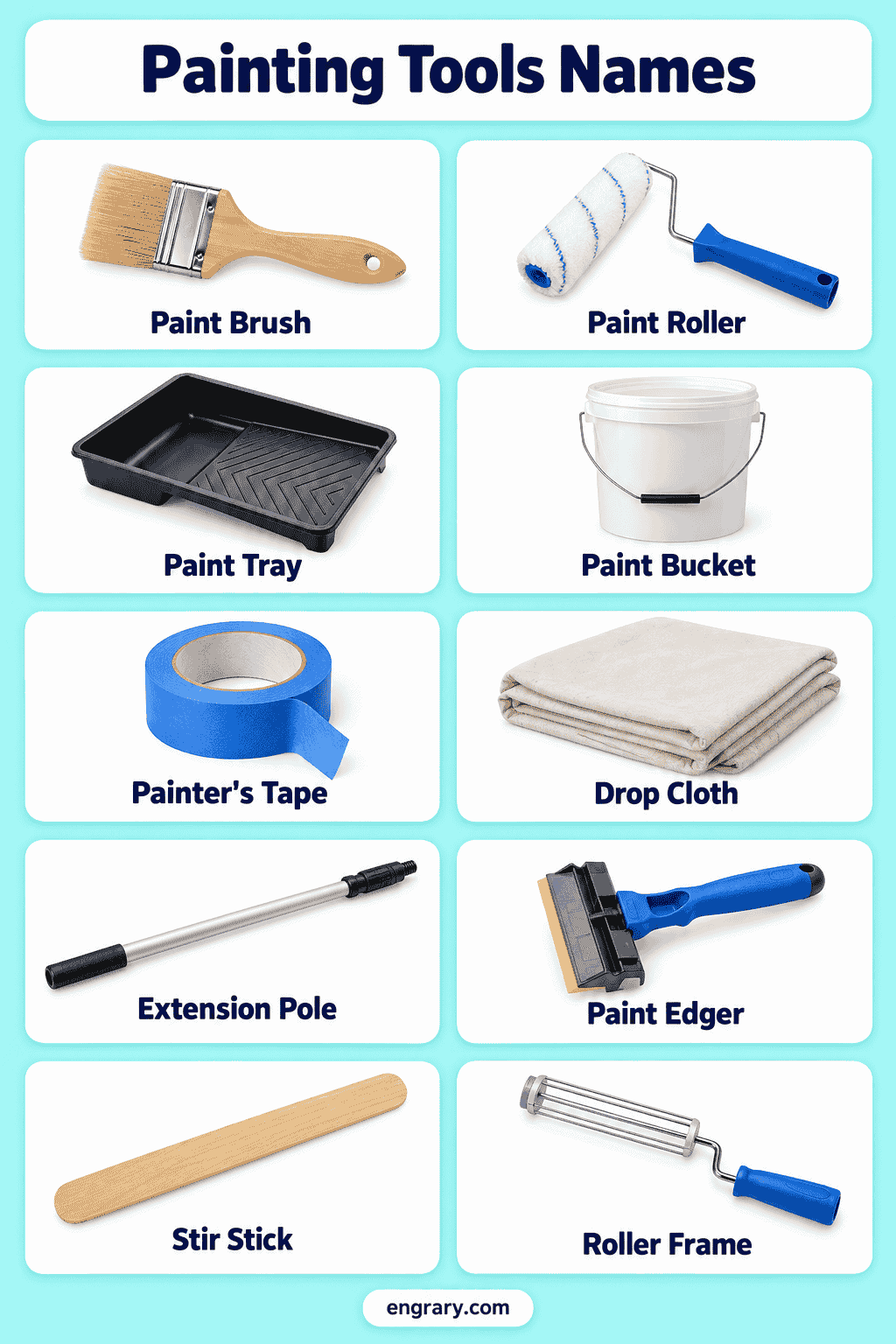
Different stages of painting call for different tools. For example, brushes and rollers apply paint, while scrapers and sanding tools prepare the surface. Meanwhile, trays, buckets, grids, tape, sprayers, and cleaning equipment support the work before, during, and after application.
Paint Brush
A handheld applicator with bristles fixed into a metal ferrule and attached to a handle.
Flat Brush
A brush with a straight bristle edge that works well across broad, flat areas.
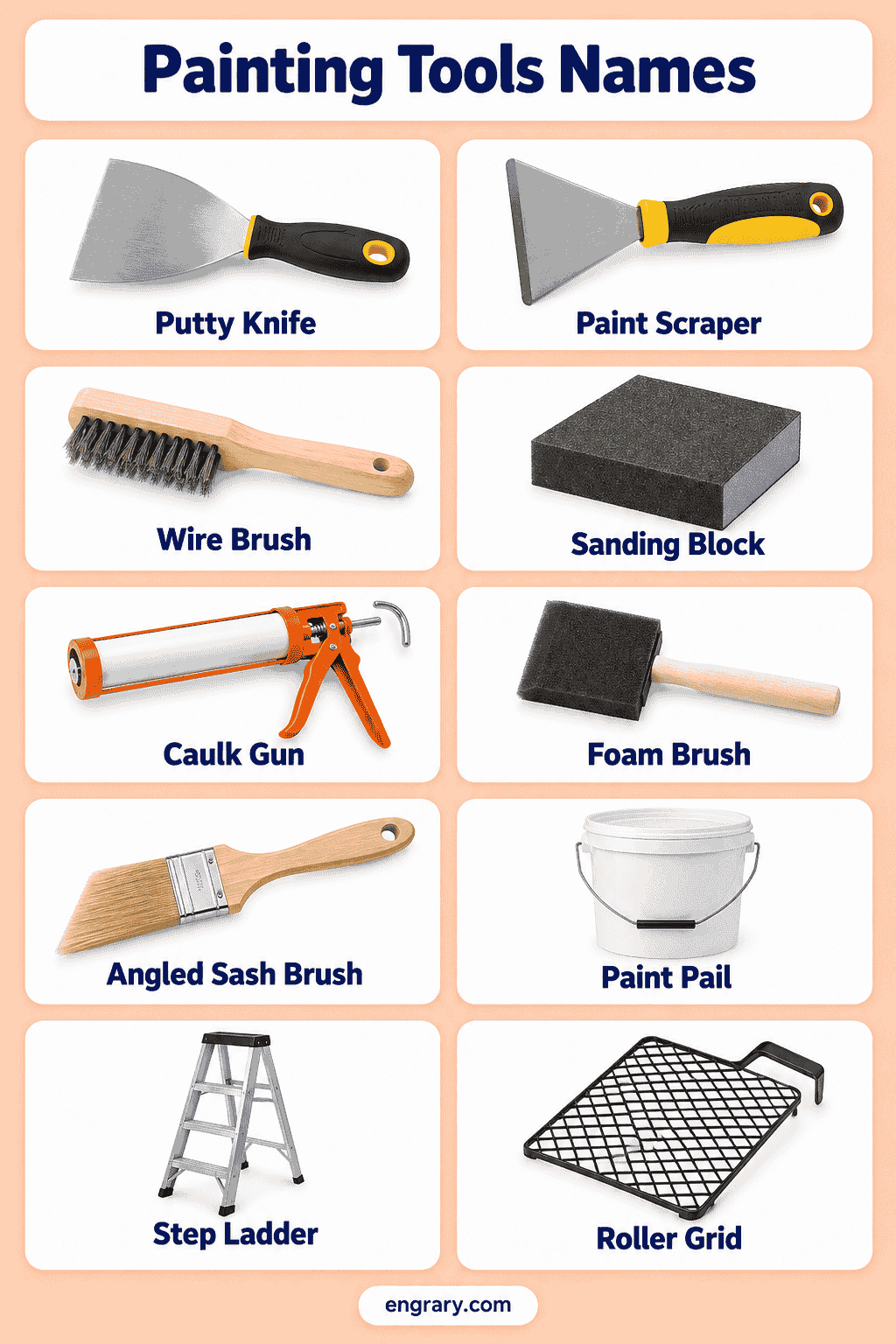
Angled Sash Brush
A brush with slanted bristles that helps painters control paint near corners, trim, and edges.
Wall Brush
A broader, thicker brush that holds more paint than many smaller trim brushes.
Foam Brush
A lightweight applicator with a foam head instead of traditional bristles.
Roller Frame
The reusable handle and metal support that holds a removable roller cover.
Roller Cover
A fabric- or foam-covered cylinder that carries paint and rotates on the roller frame.
Mini Roller
A compact roller with a narrow working width for smaller surfaces and restricted spaces.
Extension Pole
A long or telescoping pole that connects to a roller frame or compatible tool to increase reach.
Paint Tray
A shallow container with a deep paint well and a sloped loading area for rollers.
Roller Grid
A ridged or perforated screen that sits inside a paint bucket and helps load a roller evenly.
Paint Bucket
A larger container that holds paint and can work with a roller grid.
Paint Scraper
A short-handled tool with a rigid blade for removing loose or peeling coating.
Putty Knife
A flat-bladed hand tool used for spreading filler and smoothing small surface repairs.
Sanding Block
A handheld block that supports abrasive material during manual surface sanding.
Pole Sander
A flat sanding head attached to a long pole for reaching larger wall or ceiling areas.
Caulking Gun
A trigger-operated frame that pushes sealant or caulk from a cartridge.
5-in-1 Painter’s Tool
A multi-purpose metal blade with several edges and cutouts for common painting-related tasks.
Paint Edger
A small guided applicator that helps apply paint close to edges without using a full-size roller.
Paint Pad
A flat pad applicator used for smooth paint application over smaller areas.
Painter’s Tape
A masking tape designed to protect edges and create cleaner paint lines.
Drop Cloth
A protective sheet spread over floors, furniture, or other surfaces before painting.
Paint Sprayer
A powered or pressurized system that turns paint into a spray for application.
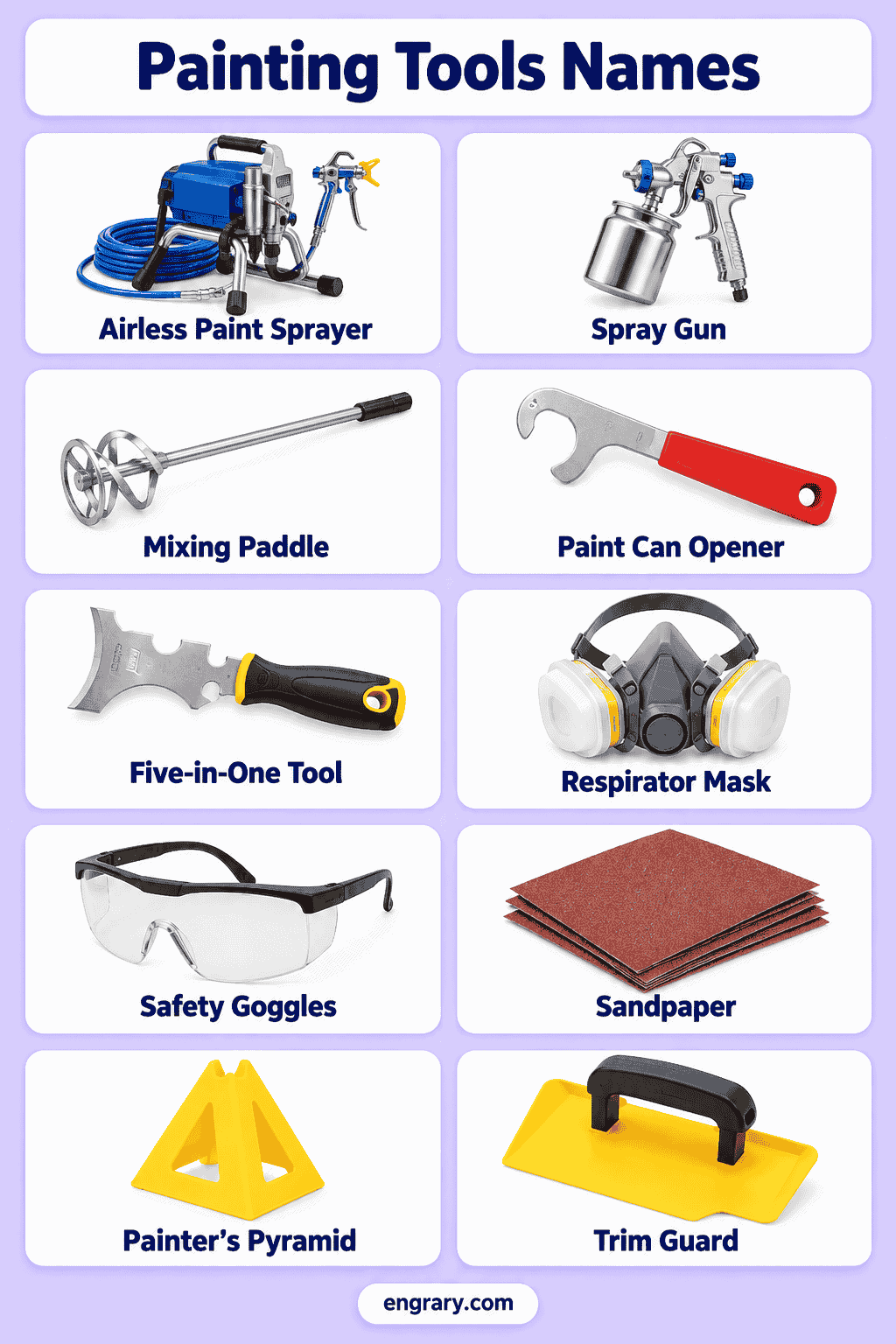
Airless Paint Sprayer
A spray system that pushes paint through a small opening at high pressure without compressed air.
HVLP Sprayer
A high-volume, low-pressure spray system that focuses on controlled paint application.
Together, these tools cover the main stages of surface preparation, paint handling, application, masking, spraying, and cleanup.
Paint Brushes and Their Shapes
Brushes vary mainly by bristle shape, thickness, and working width. Therefore, learning the outline of the bristle head often makes identification easier than memorizing sizes.
Flat Brush
A flat brush has a straight bristle edge. Its simple rectangular shape suits broad, even strokes on flat surfaces.
Wall Brush
A wall brush usually has a fuller bristle body and broader working width. As a result, it can carry more paint than many smaller brushes.
Angled Sash Brush
An angled sash brush has bristles cut on a diagonal. This sloping edge gives painters more control around trim, corners, and narrow boundaries.
Trim Brush
A trim brush is smaller and narrower than most wall brushes. Painters commonly use it where a broad brush would feel awkward.
Foam Brush
A foam brush uses a shaped foam pad instead of loose bristles. Its smooth head makes it easy to recognize.
Block Brush
A block brush has a broad rectangular head with a short handle or grip. It usually looks wider and more compact than a standard wall brush.
Round Brush
A round brush uses a rounded bristle bundle rather than a flat rectangular edge.
A useful visual rule is simple: flat brushes have straight edges, angled sash brushes slope at the tip, and round brushes form a circular bristle profile.
Paint Rollers and Their Parts
A paint roller is not one single piece. Instead, the roller system combines a reusable frame with a removable cover, and painters can add an extension pole when they need more reach.
Roller Frame
A roller frame includes the handle, bent metal arm, and support that holds the roller cover.
Roller Cover
A roller cover is the removable cylinder that carries paint. Depending on the design, it may use woven fabric, microfiber, foam, or another material.
Roller Sleeve
Roller sleeve is another common name for a roller cover. Therefore, the two terms should not count as separate tools in a tool list.
Mini Roller
A mini roller has a much shorter cover and narrower frame. Consequently, it fits better on doors, trim, furniture, and small wall sections.
Foam Roller
A foam roller uses a smooth foam cover instead of a fabric nap. It belongs to the roller family rather than forming a completely different painting system.
Extension Pole
An extension pole connects to compatible roller frames and lets the painter reach higher or farther without changing the roller itself.
The most important distinction is:
Roller frame → holds the roller
Roller cover → carries the paint
Extension pole → increases reach
Tools for Holding and Loading Paint
Painters need containers and loading tools that keep paint accessible while brushes and rollers work. Some systems use a shallow tray, while others use a bucket and roller grid.
Paint Tray
A paint tray has a deep well at one end and a sloped, textured area at the other. The roller picks up paint in the well and then moves across the ramp.
Paint Bucket
A paint bucket holds a larger volume of paint than most trays. It can also support a roller grid.
Roller Grid
A roller grid clips or rests inside a bucket. The painter rolls the cover across its ridged surface to remove excess paint and distribute it more evenly.
Paint Pail
A paint pail is a smaller handheld container that works well during brush painting.
Paint Can Opener
A paint can opener is a small metal tool shaped to lift paint-can lids without damaging the rim.
Paint Stirrer
A paint stirrer mixes paint before and during use. It may be a simple stick or a powered mixing attachment, depending on the job.
Paint Strainer
A paint strainer filters lumps, dried particles, or debris before application.
The main comparison in this group is paint tray vs bucket and grid. A tray combines the container and loading ramp, while a bucket system uses a separate grid.
Surface Preparation Tools
Good painting starts before the first coat goes on. Painters may need to remove loose material, fill defects, sand surfaces, clean rough areas, or seal gaps. Therefore, preparation tools deserve a major place in a painting vocabulary guide.
Paint Scraper
A paint scraper has a short handle and a firm metal blade. Painters use the blade to lift or remove loose coating from a surface.
Putty Knife
A putty knife has a thinner flat blade and often more flexibility. It works well for spreading filler over small holes and cracks.
Sanding Block
A sanding block holds abrasive material in a firm shape, which gives the user better control during hand sanding.
Sanding Sponge
A sanding sponge combines a flexible foam block with abrasive surfaces. It can follow curves and irregular shapes more easily than a rigid block.
Pole Sander
A pole sander has a flat sanding head attached to a long pole. As a result, it helps the painter work across walls and ceilings from a more convenient position.
Wire Brush
A wire brush uses stiff metal bristles to remove loose material and surface debris from suitable surfaces.
Caulking Gun
A caulking gun holds a cartridge inside a long frame. When the user squeezes the trigger, the plunger pushes material through the cartridge nozzle.
5-in-1 Painter’s Tool
A 5-in-1 painter’s tool has a broad metal blade, pointed corners, and a curved cutout. Its unusual blade profile makes it one of the easiest trade-specific painting tools to recognize.
This group also contains two tools that beginners often confuse: the paint scraper and putty knife. The scraper focuses more on removal, whereas the putty knife focuses more on filling and smoothing.
Tools for Edges and Detail Work
Large rollers cover broad surfaces quickly, but edges, corners, trim, and smaller areas need more control. For that reason, painters often switch to compact applicators.
Paint Edger
A paint edger usually has a small rectangular pad and some form of guide or wheel system that helps it follow an edge.
Paint Pad
A paint pad uses a flat absorbent surface instead of bristles or a cylindrical roller.
Angled Sash Brush
An angled sash brush also handles detailed edge work. However, unlike an edger, it relies on slanted bristles rather than a pad-and-guide mechanism.
These tools share a similar goal, but they look very different. The edger uses a guided pad, while the sash brush uses angled bristles.
Masking and Surface Protection
Painting also requires protection for areas that should remain unpainted. These products are technically supplies rather than tools in the strictest sense, but they remain important parts of painting vocabulary.
Painter’s Tape
Painter’s tape protects edges, trim, switches, and other areas while also helping create cleaner paint lines.
Masking Film
Masking film is a thin plastic sheet that protects larger surfaces from splashes or spray.
Masking Paper
Masking paper provides a paper-based protective barrier around edges and nearby surfaces.
Drop Cloth
A drop cloth covers floors, furniture, or other objects during painting.
Dust Sheet
Dust sheet is a common alternative term for a protective covering, particularly in British English.
Because drop cloth and dust sheet describe the same broad protective function, they should not automatically count as two completely separate tools.
Paint Spraying Tools
Spray equipment gives painting another distinct vocabulary family. The main terms describe the complete spraying system, the pressure method, or the handheld application component.
Paint Sprayer
A paint sprayer is the broad term for equipment that atomizes paint and projects it toward a surface.
Airless Paint Sprayer
An airless sprayer pumps paint at high pressure through a small opening. Its system often includes a pump, hose, and spray gun.
HVLP Sprayer
An HVLP sprayer uses high air volume at lower pressure. It often appears as a compact gun-and-cup setup or as part of a larger turbine system.
Spray Gun
A spray gun is the handheld applicator that controls the paint stream. It may form one part of a larger spray system.
At a basic vocabulary level, airless sprayers usually suggest larger-scale, higher-output application, while HVLP systems suggest more controlled fine-finish work.
Tools for Cleaning Painting Equipment
Brushes, rollers, and other applicators last longer when painters clean them properly. Therefore, several small tools exist specifically for maintenance.
Brush Comb
A brush comb has stiff teeth that separate bristles and help remove trapped material.
Roller Cleaner
A roller cleaner is designed to remove paint or excess liquid from roller covers.
Brush Spinner
A brush spinner holds a brush or roller and spins it rapidly to remove water or cleaning liquid.
These tools form a smaller family, so they should support the article rather than dominate it.
Painting Tools That Are Easy to Confuse
Several painting tools look similar or work during the same stage. However, their construction and purpose differ.
| Tools | Main Difference |
|---|---|
| Flat Brush vs Angled Sash Brush | A flat brush has a straight bristle edge; an angled sash brush has a sloping edge. |
| Roller Frame vs Roller Cover | The frame holds the roller; the cover carries the paint. |
| Mini Roller vs Standard Roller | A mini roller has a narrower working width for smaller areas. |
| Paint Tray vs Roller Grid | A tray includes its own loading ramp; a roller grid sits inside a bucket. |
| Paint Scraper vs Putty Knife | A scraper removes loose coating; a putty knife spreads filler and smooths repairs. |
| Putty Knife vs 5-in-1 Painter’s Tool | A putty knife has a simple flat blade; a painter’s tool has several shaped edges and cutouts. |
| Paint Edger vs Angled Sash Brush | An edger uses a guided pad; a sash brush uses slanted bristles. |
| Pole Sander vs Sanding Block | A pole sander adds long reach; a sanding block stays in the hand. |
| Airless Sprayer vs HVLP Sprayer | Airless systems favor higher-output spraying; HVLP systems favor more controlled application. |
Alternate Names for Painting Tools
Painting terminology can change by region, manufacturer, or trade. Therefore, some terms describe the same item or closely related versions rather than completely separate tools.
Roller Cover / Roller Sleeve
Both names describe the removable cylinder that fits over a roller frame.
Angled Sash Brush / Cutting-In Brush
Painters often use an angled sash brush for cutting in, so the terms may overlap depending on context.
Paint Pail / Paint Kettle
Both can refer to a smaller handheld paint container used during brush work.
Putty Knife / Filling Knife
These names may overlap, especially when the tool applies or smooths filler.
Drop Cloth / Dust Sheet
Both refer to protective coverings placed over floors, furniture, or other nearby surfaces.
Painter’s Tape / Masking Tape
Painter’s tape belongs to the broader masking-tape family, although products may differ in intended use.
Paint Pad / Pad Applicator
These terms commonly describe the same broad flat-pad application tool.
Paint Sprayer / Spray Gun
These terms are related but not always exact synonyms. A paint sprayer may describe the complete system, while the spray gun may describe only the handheld applicator.
Using one clear primary name and adding useful alternatives keeps the vocabulary broad without artificially increasing the tool count.
Frequently Asked Questions
Common painting tools include paint brushes, angled sash brushes, roller frames, roller covers, paint trays, roller grids, scrapers, putty knives, sanding tools, extension poles, paint edgers, caulking guns, sprayers, and cleaning tools.
The roller frame is the reusable handle and support. In contrast, the roller cover is the removable cylinder that actually holds and applies the paint.
A paint scraper mainly removes loose coating, while a putty knife usually spreads filler and smooths small repairs.
Common preparation tools include paint scrapers, putty knives, sanding blocks, sanding sponges, pole sanders, wire brushes, caulking guns, and 5-in-1 painter’s tools.
An airless sprayer pushes paint at high pressure without compressed air, while an HVLP system uses a high volume of air at lower pressure for more controlled application.
You May Also Like



Leave a Comment