
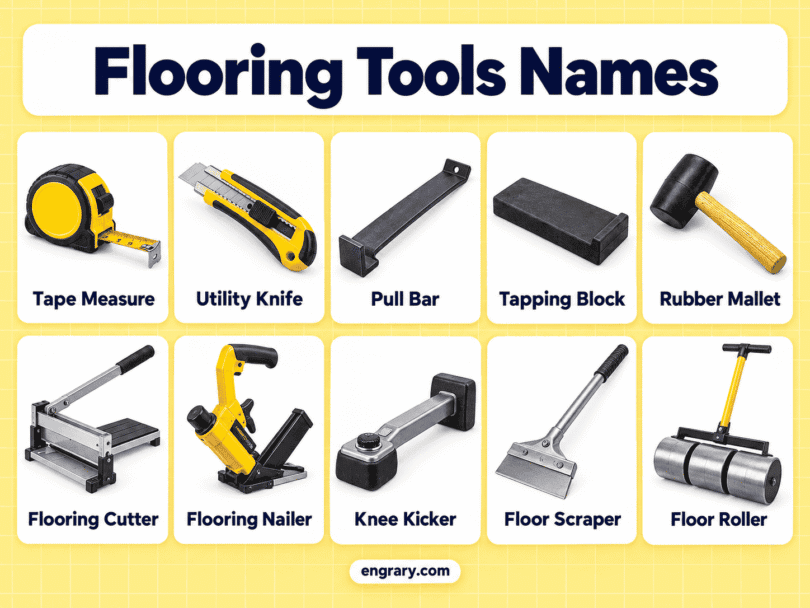
Flooring work involves several stages, and each stage needs different tools. Installers prepare the subfloor, measure the room, cut materials, fit planks, fasten hardwood, stretch carpet, roll resilient flooring, and finish edges around walls and doorways.
This guide explains flooring tools names with simple uses and visual recognition clues. It covers tools used with laminate, vinyl, hardwood, carpet, and floor preparation, so readers can connect each tool name with a clear job and recognizable shape.
Flooring Tools Used Across Different Floor Types
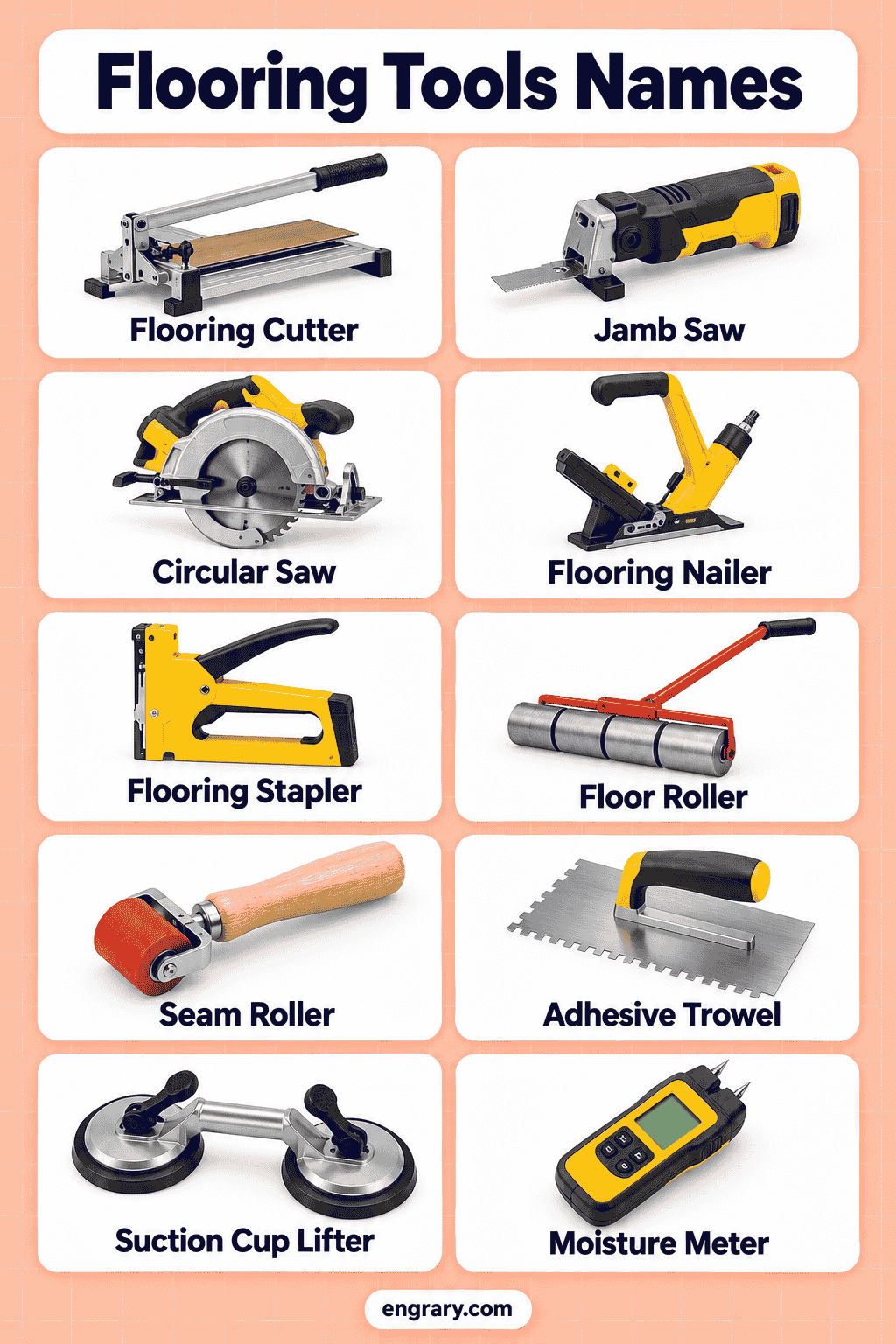
Different flooring materials require different tools. For example, floating floors need tapping blocks and pull bars, while hardwood often needs flooring nailers or staplers. Carpet work, meanwhile, uses tools such as knee kickers, power stretchers, and seam irons.
Tapping Block
A short rectangular block that helps installers join plank edges without striking the flooring directly.
Pull Bar
A long, narrow metal bar with bent ends that helps pull planks together near walls and tight edges.
Flooring Spacers
Small blocks or wedges that maintain a consistent perimeter gap during floating-floor installation.
Rubber Mallet
A soft-headed striking tool that works well with tapping blocks and other fitting accessories.
Flooring Cutter
A purpose-built cutting tool for suitable plank, laminate, vinyl, or resilient flooring materials.
Vinyl Cutter
A specialized cutter for vinyl and similar resilient floor coverings.
Utility Knife
A handheld knife with a replaceable blade for trimming flexible flooring materials.
Floor Roller
A heavy roller that presses flooring over a broad area after placement.
Seam Roller
A smaller roller that applies pressure along narrow seams and joined edges.
Flooring Nailer
A specialized fastening tool that drives flooring nails or cleats into hardwood.
Flooring Stapler
A similar tool that drives staples instead of flooring cleats.
Nail Set
A small metal punch that pushes nail heads below the wood surface.
Jamb Saw
A low-profile saw that cuts door jambs and casings close to floor level.
Oscillating Multi-Tool
A compact powered tool that makes controlled flush cuts with the right blade.
Carpet Knife
A sharp knife that cuts and trims carpet and backing material.
Knee Kicker
A compact carpet-positioning tool with a toothed head and padded rear end.
Power Stretcher
A long sectional tool that stretches carpet across a larger room area.
Seam Iron
A heated hand tool that joins carpet seams with compatible seam tape.
Wall Trimmer
A specialist cutting tool that trims excess carpet neatly along wall edges.
Carpet Tucker
A slim hand tool that pushes trimmed carpet edges into perimeter gaps.
Floor Scraper
A broad-bladed tool that removes residue, adhesive, or old flooring material.
Moisture Meter
A handheld device that checks moisture levels in flooring materials or substrates.
Chalk Line
A reel with chalk-coated string that creates long straight layout marks.
Spirit Level
A rigid tool with bubble vials that checks level and alignment.
Laser Level
A powered layout tool that projects visible reference lines across the floor or room.
Together, these tools cover the main stages of flooring work, from fitting and cutting to fastening, stretching, preparation, and layout.
Tools for Laminate and Floating Floors
Laminate, LVP, and floating wood floors use a distinctive group of fitting tools. Because these floors often connect with locking edges, installers need tools that close joints, maintain gaps, and trim around doorways without damaging the planks.
Tapping Block
A tapping block sits against the edge of a plank and receives the strike from a mallet. As a result, the installer can tighten the joint without hitting the flooring directly.
Pull Bar
A pull bar has hooked or bent ends that grip the plank edge. It becomes especially useful near walls where a tapping block cannot fit easily.
Flooring Spacers
Flooring spacers maintain the expansion gap around room edges. They usually look like wedges, blocks, or small plastic tabs.
Rubber Mallet
A rubber mallet provides a softer impact than a metal hammer. Therefore, it pairs well with tapping blocks and other fitting accessories.
Flooring Cutter
A flooring cutter usually has a rigid base, long handle, and cutting blade. Depending on the model, it may cut laminate, LVP, vinyl, or engineered flooring.
Jamb Saw
A jamb saw cuts close to floor level. Installers commonly use it to undercut door jambs so planks can slide underneath.
Oscillating Multi-Tool
An oscillating multi-tool can also undercut trim with the correct blade. However, unlike a jamb saw, it serves many other cutting and detail jobs.
The most important pair in this section is the tapping block and pull bar. Both tighten plank joints, but they work best in different positions.
Vinyl Flooring Tools
Vinyl and other resilient floors require accurate cutting, rolling, and seam work. Some installations also use adhesive, so installers may need tools for both placement and pressure.
Vinyl Cutter
A vinyl cutter is a purpose-built tool for cutting suitable resilient flooring. Some models use a guillotine-style blade, while others use a different lever mechanism.
Utility Knife
A utility knife works well for trimming many flexible flooring products. Its small size also makes it useful for detailed cuts.
Linoleum Knife
A linoleum knife usually has a curved or hooked blade. This blade shape helps guide the cut through resilient sheet material.
Floor Roller
A floor roller applies pressure across a large flooring area. Its heavy cylindrical body and long handle make it easy to recognize.
Hand Roller
A hand roller performs the same general pressing action over smaller sections. Consequently, it gives the installer more control in tight areas.
Seam Roller
A seam roller has a narrower head and focuses pressure along seams or joined edges.
Adhesive Trowel
An adhesive trowel spreads flooring adhesive in a controlled layer. Some versions use notched edges to create even ridges.
A simple visual rule helps here: floor rollers are large, hand rollers are compact, and seam rollers focus on narrow joints.
Hardwood Flooring Tools
Hardwood flooring introduces several specialist fastening tools. Unlike floating planks, many hardwood systems need nails, cleats, or staples along plank edges.
Flooring Nailer
A flooring nailer rests against the plank and drives a fastener at the required angle. Its large base and angled body make it look different from a standard finish nailer.
Pneumatic Flooring Nailer
A pneumatic flooring nailer uses compressed air to drive fasteners. Therefore, it includes an air connection in addition to the fastening body.
Flooring Stapler
A flooring stapler works in a similar position, but it drives staples instead of cleats or nails.
Cleat Nailer
A cleat nailer is a type of flooring nailer that drives cleat-style fasteners. In many contexts, the terms overlap.
Finish Nailer
A finish nailer is more general-purpose. Even so, installers may use it near edges, trim, or areas where a full flooring nailer cannot fit.
Nail Set
A nail set is a small hardened punch that drives a nail head below the wood surface.
Jamb Saw
A jamb saw also supports hardwood installation because installers often need to undercut trim before fitting planks underneath.
The main distinction is straightforward: flooring nailers drive nails or cleats, while flooring staplers drive staples.
Carpet Installation Tools
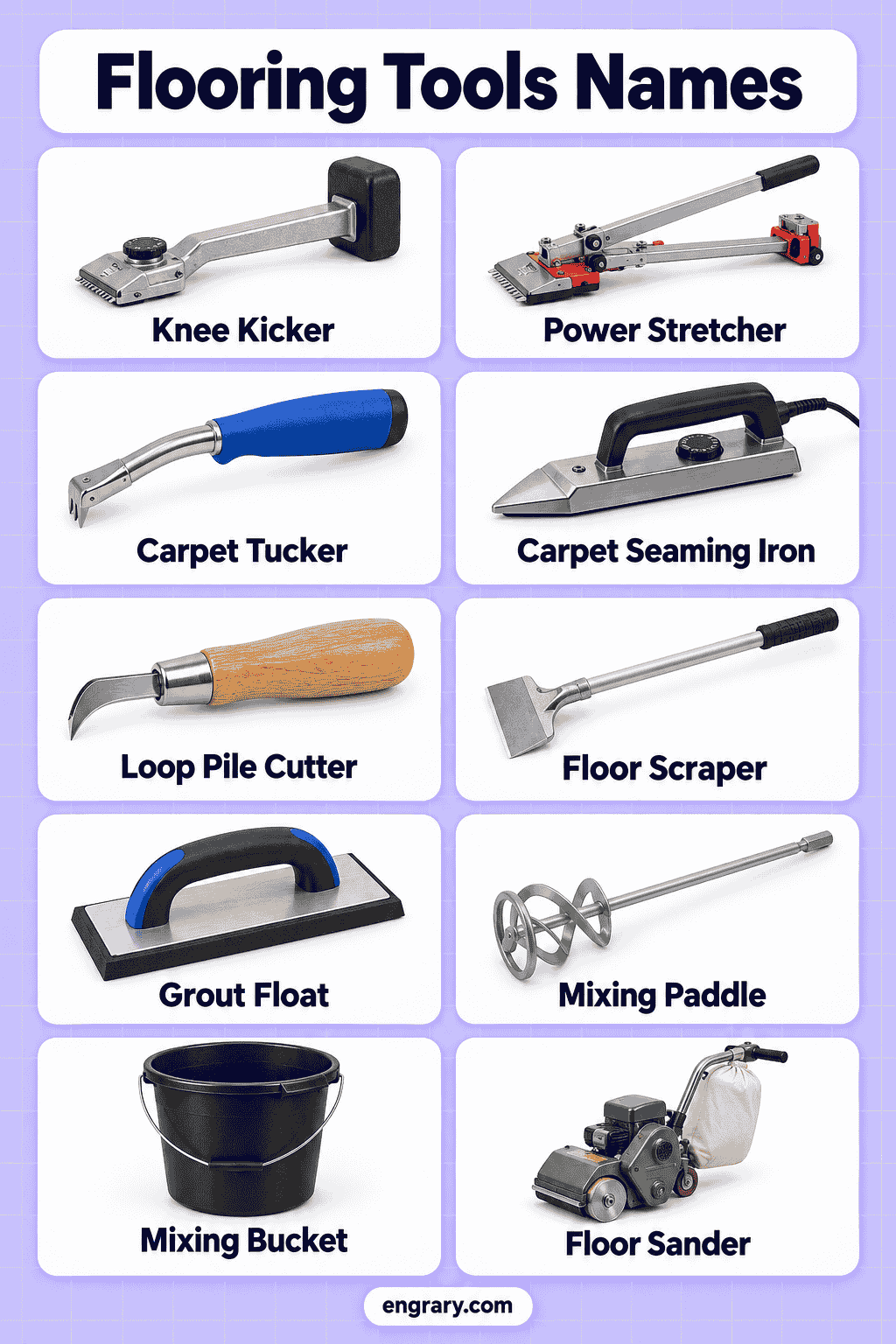
Carpet installation has some of the most distinctive tools in the flooring trade. Installers cut, stretch, join, trim, and tuck carpet, so this material needs its own vocabulary.
Carpet Knife
A carpet knife uses a sharp replaceable blade to cut carpet and backing material cleanly.
Knee Kicker
A knee kicker has a toothed gripping head, adjustable shaft, and padded rear section. Its unusual shape makes it one of the easiest flooring tools to identify.
Power Stretcher
A power stretcher uses a gripping head, pole sections, and a brace or tail block. Unlike a knee kicker, it spans a much larger area.
Seam Iron
A seam iron heats compatible seam tape so two carpet sections can join cleanly.
Carpet Seam Roller
A carpet seam roller presses over the joined carpet seam. Because it has a compact rolling head, it works over a much narrower area than a floor roller.
Wall Trimmer
A wall trimmer cuts excess carpet along the room perimeter. Its guided body helps keep the cut close to the wall.
Carpet Tucker
A carpet tucker pushes the trimmed carpet edge into the perimeter gap after cutting.
Stair Tool
A stair tool helps shape, position, or tuck carpet around stair edges and other narrow areas.
Carpet Puller
A carpet puller grips carpet so the installer can lift, move, or remove it more easily.
The clearest comparison in this group is knee kicker vs power stretcher. The kicker is compact, whereas the power stretcher reaches much farther across the room.
Floor Preparation Tools
Before new flooring goes down, installers often need to remove residue, check moisture, test flatness, or prepare compounds. For that reason, floor preparation deserves its own tool group.
Floor Scraper
A floor scraper has a broad, flat blade and a short or long handle. Installers use it to scrape away adhesive, residue, or loose material.
Flat Bar
A flat bar is a thin levering tool with flattened ends. It works well for lifting trim, boards, or other materials.
Pry Bar
A pry bar provides more leverage for lifting or separating stubborn materials.
Moisture Meter
A moisture meter checks moisture conditions before certain flooring installations. Some models use pins, while others use sensor-style contact surfaces.
Straightedge
A straightedge helps check flatness and guide long layout marks.
Grinder
A floor grinder or suitable grinder can abrade high spots or remove hard residue during surface preparation.
Mixing Paddle
A mixing paddle is the rotating attachment used to blend flooring compounds.
Mixing Drill
A mixing drill provides the power that turns the paddle.
The floor scraper is the easiest preparation tool to recognize because its broad blade works almost parallel to the floor.
Measuring and Layout Tools
Accurate flooring starts with good measurements and straight reference lines. These tools appear across many building trades, but they still play an important supporting role in flooring work.
Tape Measure
A tape measure checks room dimensions, plank lengths, and cutting measurements.
Chalk Line
A chalk line snaps a straight reference line across the floor.
Carpenter’s Square
A carpenter’s square gives the installer a fixed right-angle reference for marking cuts.
T-Square
A T-square has a long blade with a crosspiece at one end. It helps with long straight marks and square references.
Spirit Level
A spirit level uses bubble vials to check horizontal and vertical alignment.
Laser Level
A laser level projects straight visual reference lines across larger areas. As a result, it can speed up layout work.
Straightedge
A straightedge helps check flatness and guide long markings.
These tools support almost every flooring material, but they remain secondary to the more flooring-specific fitting, fastening, rolling, and carpet tools.
Flooring Tools That Are Easy to Confuse
Some flooring tools look similar or work at the same stage of installation. However, their main functions differ.
| Tools | Main Difference |
|---|---|
| Tapping Block vs Pull Bar | A tapping block works from an accessible plank edge; a pull bar tightens planks near walls and restricted edges. |
| Floor Roller vs Seam Roller | A floor roller applies pressure across a broad area; a seam roller focuses on narrow joints. |
| Flooring Nailer vs Flooring Stapler | A flooring nailer drives cleats or nails; a flooring stapler drives staples. |
| Flooring Cutter vs Utility Knife | A flooring cutter uses a dedicated cutting mechanism; a utility knife uses a handheld blade. |
| Jamb Saw vs Oscillating Multi-Tool | A jamb saw specializes in low undercuts; a multi-tool handles many cutting tasks. |
| Knee Kicker vs Power Stretcher | A knee kicker is compact; a power stretcher stretches carpet across a much larger area. |
| Wall Trimmer vs Carpet Tucker | A wall trimmer cuts excess carpet; a carpet tucker pushes the finished edge into place. |
| Floor Scraper vs Flat Bar | A floor scraper removes material across a surface; a flat bar uses leverage to lift material. |
Flooring Tool Names That Overlap
Flooring terminology often changes by trade, product type, or manufacturer. Therefore, some names refer to the same tool family rather than completely separate tools.
Flooring Nailer / Cleat Nailer
A cleat nailer is a flooring nailer that drives cleat fasteners. Because of that relationship, the two terms may overlap.
Power Stretcher / Carpet Stretcher
Carpet stretcher is a broad term, while power stretcher usually refers to the long sectional stretching system.
Jamb Saw / Undercut Saw
Both names can refer to tools used to cut door jambs and casings close to floor level.
Carpet Tucker / Stair Tool
These tools can overlap in some carpet jobs because both may help push or shape carpet at edges.
Vinyl Cutter / LVP Cutter / Plank Cutter
These names often reflect the flooring materials that a particular cutter can handle.
Flooring Pull Bar / Pull Bar
The shorter name usually means the same flooring fitting tool when the context is clear.
Flooring Tapping Block / Tapping Block
The longer name simply makes the flooring use more explicit.
Using one main name and adding useful alternatives keeps the article accurate without artificially increasing the number of tools.
Frequently Asked Questions
Common flooring tools include tapping blocks, pull bars, flooring cutters, floor rollers, flooring nailers, flooring staplers, jamb saws, knee kickers, power stretchers, seam irons, floor scrapers, moisture meters, and layout tools.
A tapping block tightens planks from an accessible edge. In contrast, a pull bar helps close joints near walls or other areas with limited working space.
A flooring nailer drives nails or cleats, while a flooring stapler drives staples. Although the tools may look similar, the fasteners differ.
Common carpet tools include a carpet knife, knee kicker, power stretcher, seam iron, carpet seam roller, wall trimmer, carpet tucker, stair tool, and carpet puller.
Floor preparation tools may include a floor scraper, flat bar, pry bar, moisture meter, straightedge, grinder, mixing paddle, and mixing drill.
You May Also Like



Leave a Comment