
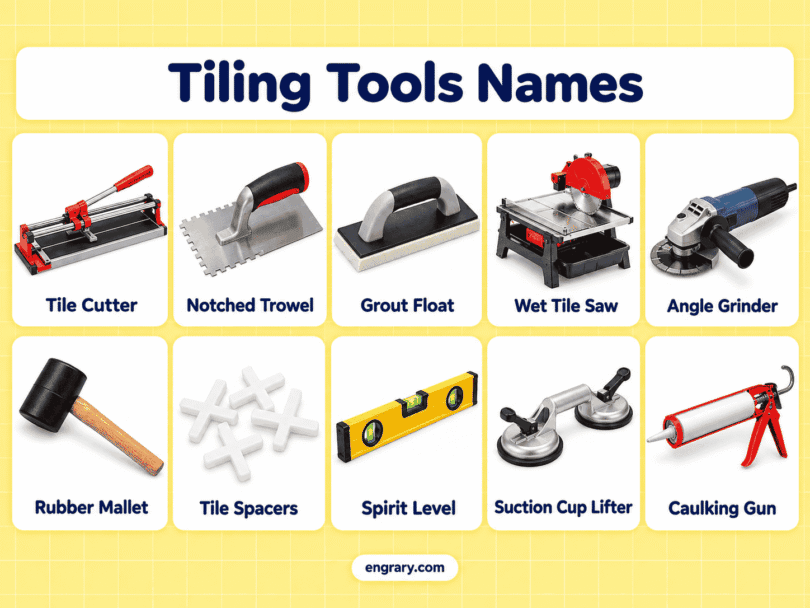
Tiling requires a specialized set of tools for measuring, cutting, spreading adhesive, spacing tiles, checking alignment, grouting joints, and handling large pieces. Many of these tools have distinctive shapes, so learning their names becomes much easier when you connect each one with a visible feature.
This guide explains tiling tools names with simple uses and recognition clues. It covers familiar hand tools such as tile cutters, nippers, notched trowels, grout floats, spacers, leveling clips, suction lifters, and other equipment commonly associated with tile work.
Tiling Tools to Know First
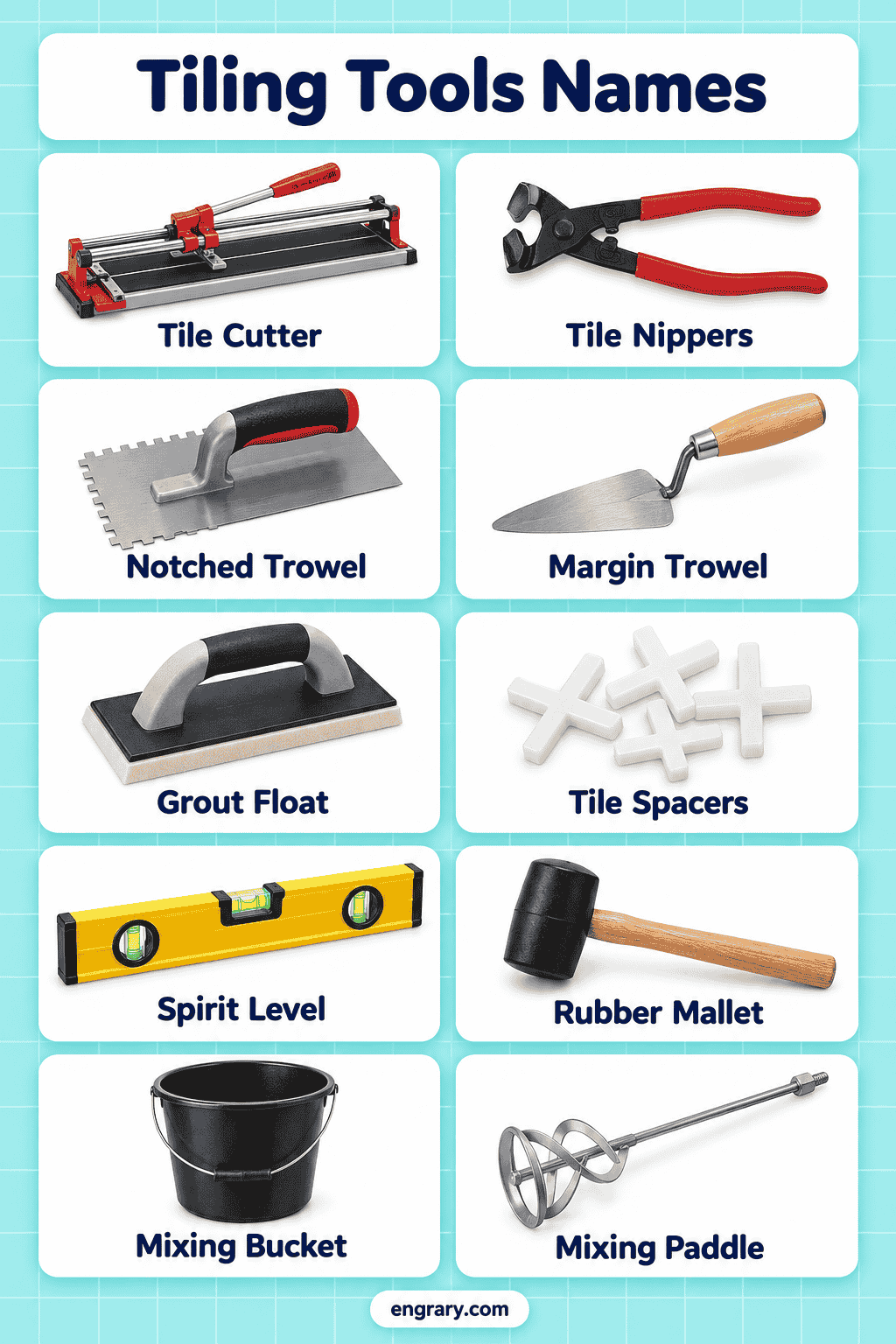
A tiler uses different tools at each stage of the job. Cutting tools shape tiles, trowels spread setting material, spacers control gaps, leveling systems help neighboring tiles stay aligned, and grout tools finish the joints. These are some of the most recognizable names to learn first.
Manual Tile Cutter
A long rail-mounted tool with a scoring wheel and snapping mechanism for making straight cuts in many tile types.
Tile Scribe
A compact handheld tool with a hard scoring tip used to mark a line across a tile surface.
Tile Nippers
Pliers-like cutting tools with short hardened jaws for trimming small sections from tile edges.
Wet Tile Saw
A powered tile-cutting machine with a diamond blade and water system around the cutting area.
Tile File
A hand tool with an abrasive surface for smoothing rough or freshly cut tile edges.
Diamond Hole Saw
A circular diamond-edged cutting attachment used to create round openings in tile.
Notched Trowel
A rectangular metal trowel with teeth along one or more edges for spreading and combing tile-setting material.
Square-Notch Trowel
A notched trowel whose teeth form square-shaped grooves.
V-Notch Trowel
A trowel with V-shaped teeth that create narrower ridges in setting material.
Margin Trowel
A small, narrow rectangular trowel useful for handling material and working in confined areas.
Rubber Mallet
A mallet with a rubber head that provides a softer striking surface than a metal hammer.
Tile Spacers
Small plastic pieces placed between tiles to maintain consistent joint spacing.
Tile Wedges
Small tapered pieces used for adjustment, support, or spacing where a fixed spacer may not fit.
Leveling Clips
Plastic components positioned at tile edges as part of a tile-leveling system.
Leveling Wedges
Reusable tapered pieces inserted into leveling clips to help control the relative height of adjoining tiles.
Tile Leveling Pliers
Special pliers designed to tension certain clip-and-wedge leveling systems.
Grout Float
A rectangular tool with a rubber-like face and top handle for spreading grout across tile joints.
Grout Sponge
A dense sponge used during grout cleanup and finishing.
Grout Rake
A narrow tool designed for removing existing grout from between tiles.
Chalk Line
A reel containing chalk-coated string that creates long straight layout marks.
Spirit Level
A straight tool with bubble vials for checking level and vertical alignment.
Laser Level
A powered layout tool that projects visible reference lines across a surface.
Profile Gauge
A tool with rows of movable pins that copy irregular shapes and contours.
Suction Lifter
A handled suction device used to grip and move smooth tile surfaces.
Mixing Paddle
A spiral or paddle-shaped attachment used with a powered mixer or drill to mix tile-setting materials.
Together, these tools cover the main vocabulary of cutting, setting, spacing, leveling, grouting, layout, handling, and preparation.
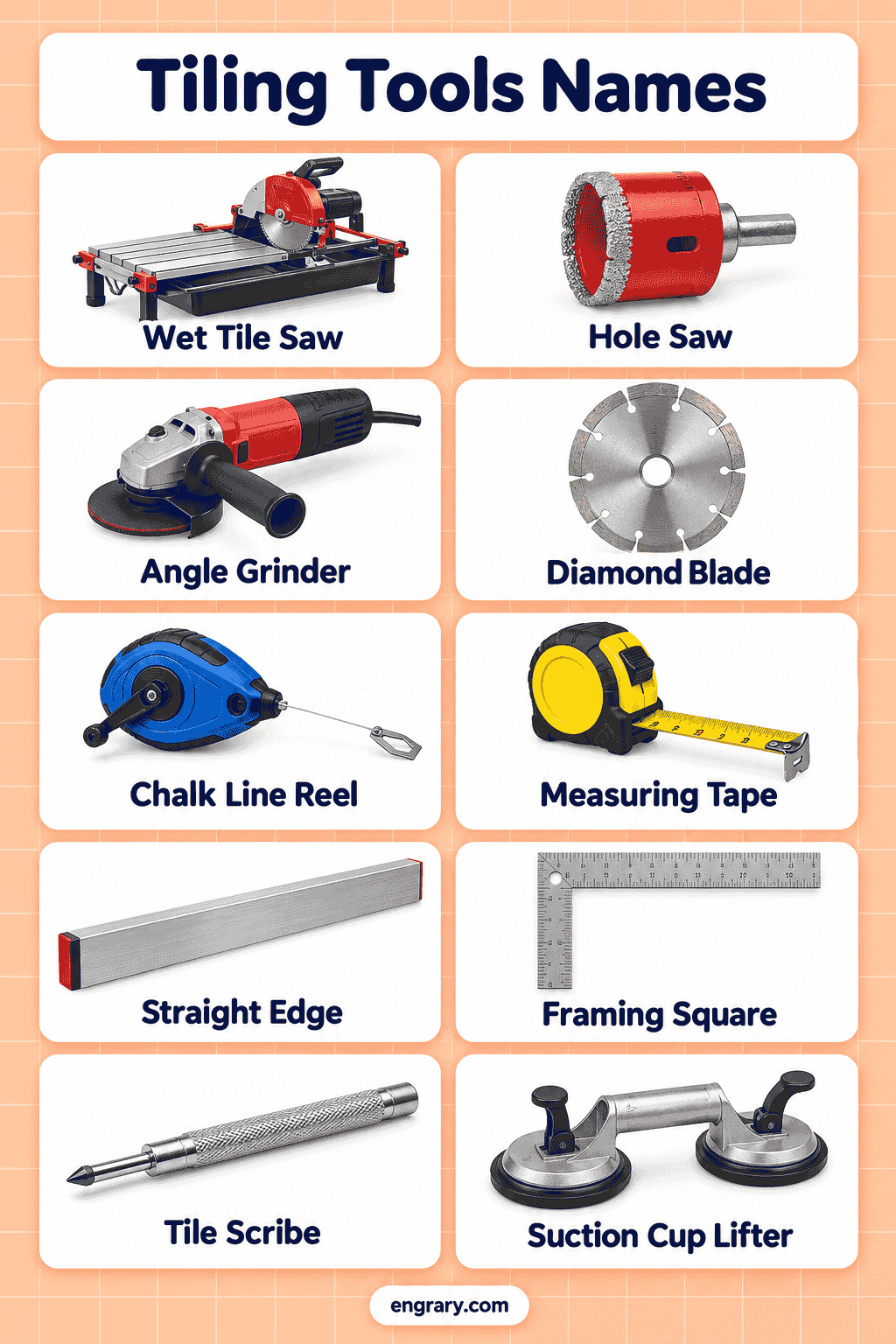
Tile Cutting Tools
Tile cutting requires more than one type of tool because straight cuts, small edge adjustments, curved areas, and circular holes all need different approaches. The shape of the cutting mechanism is usually the easiest way to identify each tool.
Manual Tile Cutter
A manual tile cutter has a flat base, parallel rails, a sliding scoring wheel, and a snapping mechanism. Its long rectangular frame makes it one of the most recognizable tiling tools.
Tile Scribe
A tile scribe is much smaller. It normally looks like a pen-shaped or compact hand tool with a hardened scoring point.
Tile Nippers
Tile nippers resemble short, heavy pliers. Instead of ordinary gripping jaws, they have hardened cutting edges designed for removing small sections from a tile.
Wet Tile Saw
A wet tile saw combines a powered diamond blade with a water-fed or water-tray system. Unlike a manual cutter, it cuts rather than scores and snaps the tile.
Tile Hand Saw
A tile hand saw uses an abrasive or specialist blade in a hand-operated frame. Its appearance is closer to a small saw than to a scoring tool.
Tile File
A tile file has a rough abrasive surface rather than a sharp cutting edge. It helps refine rough edges after cutting.
Diamond Hole Saw
A diamond hole saw is a cylindrical cutting attachment with diamond abrasive around its rim. Its circular shape immediately separates it from straight-cutting tools.
Tile Drill
A tile drill is the powered tool used with suitable tile-drilling bits or hole-cutting attachments. The drill itself is general-purpose, while the bit provides the tile-specific cutting edge.
Hole Cutter
A hole cutter is a broader term for tools or attachments designed to create circular openings in tile.
The easiest distinction is:
Scribe → scores by hand
Manual cutter → scores and snaps
Nippers → trim small sections
Wet saw → powered cutting
Notched Trowels and Setting Tools
Setting tools handle adhesive, mortar, and positioning. Notched trowels dominate this group because their tooth shape determines the pattern of ridges left in the setting material.
Notched Trowel
A notched trowel has a broad flat blade with evenly spaced teeth along one or more edges. The toothed edge is its clearest recognition feature.
Square-Notch Trowel
A square-notch trowel has teeth with squared sides. When viewed from the edge, the notches look rectangular or square.
V-Notch Trowel
A V-notch trowel has pointed triangular teeth that create V-shaped grooves.
U-Notch Trowel
A U-notch trowel has rounded notches that create curved ridges rather than sharply squared ones.
Margin Trowel
A margin trowel has a long, narrow rectangular blade. Unlike a notched trowel, it usually has smooth edges and suits smaller areas or material handling.
Flat Trowel
A flat trowel has a smooth blade without comb-like teeth. Its uncluttered working edge distinguishes it from notched versions.
Rubber Mallet
A rubber mallet has a soft cylindrical head. It provides a different kind of contact from steel hammers and is easy to recognize by its thick rubber face.
The most important visual difference in this family is the edge of the trowel. Square, V-shaped, and U-shaped notches identify different versions immediately.
Tile Spacing and Leveling Tools
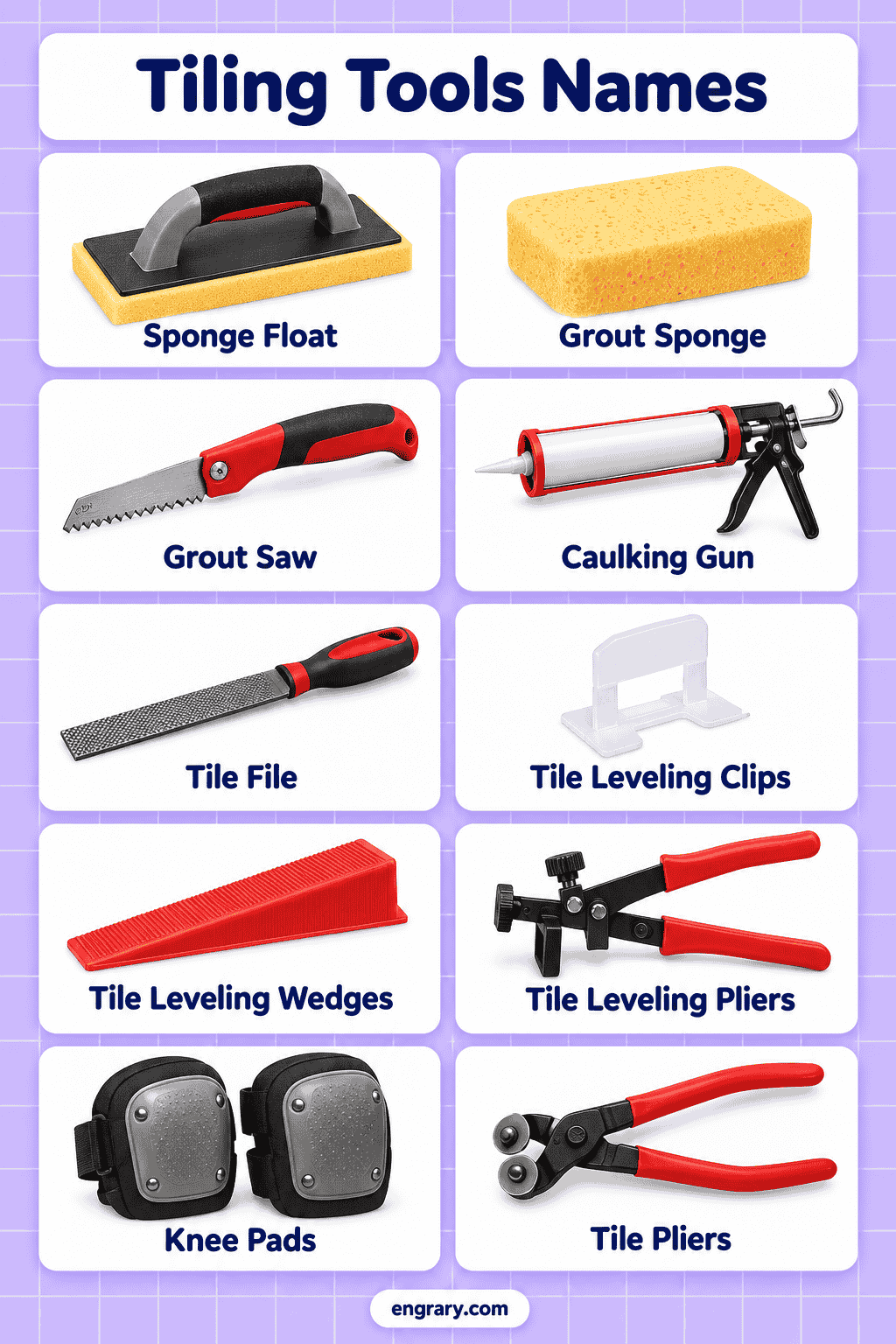
Small plastic accessories play an important role in tile layout, but several of them look similar. The key difference is whether they mainly control the gap between tiles or form part of a leveling system.
Tile Spacers
Tile spacers are small plastic pieces placed between tile edges. Common shapes include crosses, T-shapes, and straight separators.
Tile Wedges
Tile wedges have a simple tapered shape. Tilers use them where gradual adjustment or support is more useful than a fixed-width spacer.
Leveling Clips
Leveling clips sit beneath or between adjacent tile edges. A thin upper section remains accessible for the next component of the system.
Leveling Wedges
Leveling wedges slide through certain clips. They are larger and more substantial than many ordinary spacing wedges.
Leveling Caps
Leveling caps are reusable upper components found in some leveling systems. Their round or broad shape contrasts with narrow wedge-based designs.
Tile Leveling Pliers
Tile leveling pliers resemble specialist installation pliers. Their jaws and adjustment mechanism work with compatible clips and wedges.
The relationship is useful to remember:
Spacers → maintain joint width
Clips → sit between neighboring tiles in a leveling system
Wedges or caps → engage the clips
Pliers → tension certain systems
Because some leveling clips also establish a fixed joint gap, spacing and leveling functions can overlap. However, the tools should not be treated as exact synonyms.
Grouting Tools
Grout tools fall into two very different groups: tools that apply or finish fresh grout and tools that remove existing grout. Their names may sound similar, but their working faces look very different.
Grout Float
A grout float has a rectangular rubber or rubber-like base with a handle mounted above it. Its soft-faced underside separates it from a steel finishing trowel.
Grout Sponge
A grout sponge is a dense rectangular sponge, usually larger and firmer than an ordinary household sponge.
Grout Bag
A grout bag resembles a heavy piping bag with a nozzle at one end. It dispenses grout more locally than a broad float.
Grout Rake
A grout rake has a narrow working tip or abrasive blade designed for running along existing grout joints.
Grout Saw
A grout saw is another joint-removal tool. It usually has a small handle and abrasive or toothed blade.
Grout Finishing Tool
A grout finishing tool is a shaped hand tool used to refine the visible joint profile.
Caulking Gun
A caulking gun has a long open frame, trigger handle, and plunger for dispensing material from cartridges.
Sealer Applicator
A sealer applicator is a broad term for brushes, pads, bottles, or rollers used to apply tile or grout sealer.
The easiest distinction is:
Grout float → spreads grout
Sponge → cleans and refines
Rake or saw → removes existing grout
Measuring and Layout Tools
Accurate tile layout depends on straight reference lines, level checks, measurements, and careful marking. Most tools in this group also appear in other building trades, so their descriptions should stay tied to their role in tiling.
Tape Measure
A tape measure has a retractable marked blade for checking tile, wall, floor, and layout dimensions.
Chalk Line
A chalk line stores a chalk-coated string inside a compact reel. When snapped against a surface, it leaves a straight reference mark.
Spirit Level
A spirit level has a rigid straight body with bubble vials. It provides a visual reference for level and vertical alignment.
Laser Level
A laser level projects bright reference lines across floors or walls. Its compact electronic body distinguishes it from traditional straight levels.
Tile Square
A tile square gives a rigid right-angle reference for marking and checking square cuts or layout lines.
Straightedge
A straightedge is a long rigid bar used as a reference for straight marking or surface checks.
Marking Pencil
A marking pencil provides visible cutting or layout marks on tile and surrounding materials.
Profile Gauge
A profile gauge has many thin sliding pins arranged side by side. When pressed against an irregular object, the pins reproduce its outline.
Among these tools, the profile gauge is particularly distinctive because its movable pins make it unlike an ordinary ruler or square.
Tile Handling Tools
Large and smooth tiles can be awkward to grip by their edges alone. As tile formats have grown, suction-based handling tools have become increasingly recognizable in modern tiling work.
Tile Suction Cup
A tile suction cup has a round suction pad with a handgrip or locking lever above it.
Suction Lifter
A suction lifter uses one or more suction pads attached to a stronger handle or body.
Double Suction Lifter
A double suction lifter has two circular suction cups joined by a central handle.
Vacuum Lifter
A vacuum lifter uses a suction or vacuum mechanism to grip smooth surfaces. Some versions include a pump or powered vacuum system.
Carrying Frame
A carrying frame uses a larger rigid structure to support oversized tiles or panels across a wider area.
The difference is mainly one of scale:
Suction lifter → grips at one or more points
Carrying frame → supports a much larger portion of the tile
Mixing and Preparation Tools
Tile-setting materials often require thorough mixing before use. The terminology can become confusing because the paddle, power tool, and container are separate items.
Mixing Paddle
A mixing paddle is the spiral, cage, or blade-shaped attachment that rotates through the material.
Paddle Mixer
A paddle mixer is the powered machine that turns a mixing paddle.
Mixing Drill
A mixing drill is a heavy-duty drill used with an appropriate paddle attachment.
Mixing Bucket
A mixing bucket is a sturdy container that holds the material while the paddle rotates.
The simplest distinction is:
Paddle → attachment
Mixer or drill → powered tool
Bucket → container
These tools support many building trades, so they should remain secondary to more tile-specific tools such as cutters, trowels, spacers, and grout floats.
Tile Removal Tools
Tile removal has its own small tool family. These tools work on old tiles, adhesive residue, or grout rather than forming part of the main installation process.
Tile Removing Chisel
A tile removing chisel has a broad, flat working edge designed around lifting or separating tile material.
Floor Scraper
A floor scraper has a wide blade mounted on a short or long handle for scraping surfaces.
Grout Rake
A grout rake runs along existing joints to remove grout before repair or replacement.
Grout Saw
A grout saw uses a small abrasive or toothed blade to cut through hardened grout.
Because these are removal tools, they should not dominate a guide whose primary focus is tile installation vocabulary.
Tiling Tools That Are Easy to Confuse
Several tiling tools belong to the same broad family but perform different jobs. Comparing their visible features makes them much easier to identify.
| Tools | Main Difference |
|---|---|
| Manual Tile Cutter vs Wet Tile Saw | A manual cutter scores and snaps tile; a wet saw uses a powered diamond blade. |
| Tile Scribe vs Manual Tile Cutter | A scribe is a handheld scoring tool; a manual cutter combines rails, scoring, and snapping. |
| Tile Nippers vs Tile Cutter | Nippers trim small sections; a cutter suits straighter score-and-snap cuts. |
| Notched Trowel vs Margin Trowel | A notched trowel combs setting material; a margin trowel has a narrow smooth blade. |
| Tile Spacers vs Leveling Clips | Spacers mainly control joint width; leveling clips form part of a system that helps neighboring tiles stay aligned. |
| Tile Wedges vs Leveling Wedges | General wedges provide adjustment or support; leveling wedges fit compatible leveling clips. |
| Grout Float vs Grout Rake | A float spreads fresh grout; a rake removes existing grout. |
| Grout Float vs Grout Sponge | A float packs grout into joints; a sponge handles cleanup and finishing. |
| Suction Lifter vs Carrying Frame | A lifter grips tile locally; a frame supports larger panels across a wider area. |
Tiling Tool Names That Overlap
Some tiling terms vary between manufacturers, regions, and tool designs. Linking the related names prevents the same tool from being counted several times.
Notched Trowel / Notched Spreader
Both terms may describe a toothed tool used to spread and comb tile-setting material.
Tile Cutter / Manual Tile Cutter
Tile cutter often refers to the familiar manual rail-and-snap design, but the broader term can also cause confusion with powered cutting equipment. Manual tile cutter is more precise.
Grout Rake / Grout Removal Tool
A grout rake is one type of grout-removal tool, so the broader phrase should not automatically count as another tool.
Suction Cup / Tile Suction Cup
A tile suction cup is simply the tiling-specific use of a suction gripping device.
Paddle Mixer / Mixing Drill
These terms can overlap in everyday speech, although a dedicated paddle mixer and a drill fitted with a paddle are not always identical machines.
Using one clear primary term and mentioning useful alternatives gives readers broader vocabulary without inflating the list.
Frequently Asked Questions
Common tiling tools include manual tile cutters, tile nippers, wet tile saws, notched trowels, margin trowels, tile spacers, leveling clips, grout floats, grout sponges, spirit levels, suction lifters, and mixing paddles.
A manual tile cutter uses a scoring wheel and snapping mechanism, while a wet tile saw uses a powered diamond blade with water around the cutting area.
Tile spacers mainly establish consistent joint widths. Leveling clips form part of a leveling system that helps control the relative height of adjacent tile edges, although some clips also set a specific joint gap.
A notched trowel spreads and combs tile-setting material into repeated ridges. Square-, V-, and U-notch designs have differently shaped teeth.
Common grout tools include a grout float, grout sponge, grout bag, grout finishing tool, grout rake, and grout saw. Floats and sponges handle fresh grout, while rakes and saws remove existing grout.
You May Also Like



Leave a Comment