
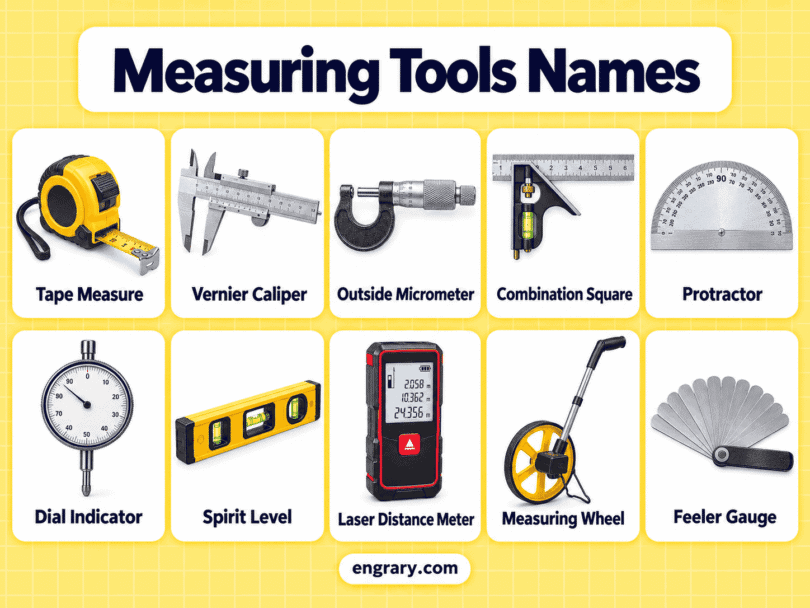
Measuring tools help people check length, distance, angle, level, weight, temperature, pressure, and many other physical quantities. Learning measuring tools names with pictures and uses makes it easier to recognize common instruments used at home, in workshops, construction sites, classrooms, and technical work.
This guide covers 55 measuring tools names with short descriptions and simple recognition clues. The list includes everyday measuring tools, precision instruments, gauges, levels, scales, electrical meters, and specialized measuring devices.
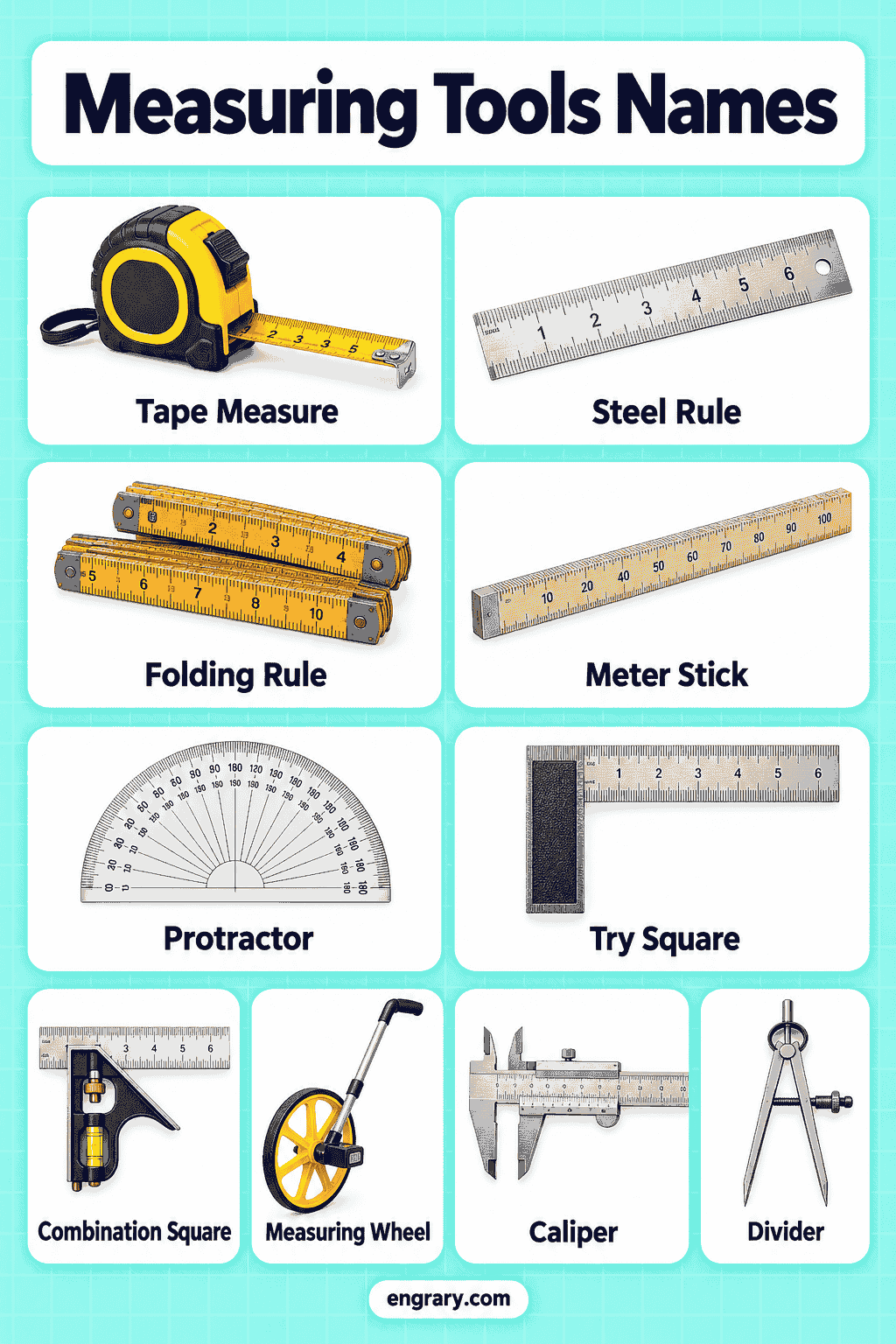
Measuring Tools Used for Different Types of Measurement
Different measurements require different tools. Some instruments measure simple length or distance, while others check very small dimensions, angles, level, pressure, temperature, or electrical quantities.
1. Ruler
A ruler is a straight measuring tool marked with units such as millimeters, centimeters, or inches. It is commonly used for short lengths and straight lines.
2. Steel Rule
A steel rule is a thin metal ruler with engraved measurement markings. Its rigid metal body makes it common in workshops and technical work.
3. Tape Measure
A tape measure has a flexible graduated blade stored inside a compact case. It is useful for measuring larger objects and distances.
4. Folding Rule
A folding rule consists of several rigid graduated sections joined by hinges. It folds into a compact shape when not in use.
5. Meter Stick
A meter stick is a straight measuring stick one meter long, usually marked in centimeters and millimeters.
6. Yardstick
A yardstick is a rigid measuring stick one yard long and usually marked in inches.
7. Measuring Wheel
A measuring wheel has a wheel attached to a handle and counter mechanism. Distance is measured as the wheel rolls along the ground.
8. Laser Distance Meter
A laser distance meter uses a laser beam and digital display to measure distance between two points.
9. Vernier Caliper
A Vernier caliper has sliding jaws with a main scale and Vernier scale. It measures outside, inside, and depth dimensions.
10. Dial Caliper
A dial caliper has sliding jaws connected to a round dial display. The dial shows small changes in measurement.
11. Digital Caliper
A digital caliper has sliding jaws and an electronic screen that displays the measurement directly.
12. Outside Micrometer
An outside micrometer has a C-shaped frame, spindle, and thimble. It measures outside thickness or diameter very precisely.
13. Inside Micrometer
An inside micrometer is designed to measure internal dimensions such as the diameter of a hole or bore.
14. Depth Micrometer
A depth micrometer has a flat base and movable measuring rod. It measures the depth of holes, slots, and recesses.
15. Height Gauge
A height gauge has a vertical graduated column mounted on a flat base. It measures or checks vertical dimensions from a reference surface.
16. Depth Gauge
A depth gauge measures the depth of holes, grooves, slots, or other recessed features.
17. Feeler Gauge
A feeler gauge consists of several thin metal blades of known thickness. It measures narrow gaps and clearances.
18. Bore Gauge
A bore gauge has a measuring head designed to check the internal diameter of a cylindrical opening.
19. Thickness Gauge
A thickness gauge measures the thickness of materials such as sheet metal, paper, coatings, or other thin sections.
20. Protractor
A protractor is a flat or semicircular tool marked in degrees. It is used to measure angles.
21. Combination Square
A combination square has a graduated ruler with an adjustable square head. It checks right angles, 45-degree angles, and short measurements.
22. Try Square
A try square has a fixed blade and stock positioned at a right angle. It checks whether two surfaces meet at 90 degrees.
23. Spirit Level
A spirit level has one or more liquid-filled bubble vials inside a straight body. It checks whether a surface is level or plumb.
24. Digital Level
A digital level uses an electronic sensor and display to show angle or level information.
25. Plumb Bob
A plumb bob is a pointed weight suspended from a cord. Gravity keeps the line vertical for checking plumb alignment.
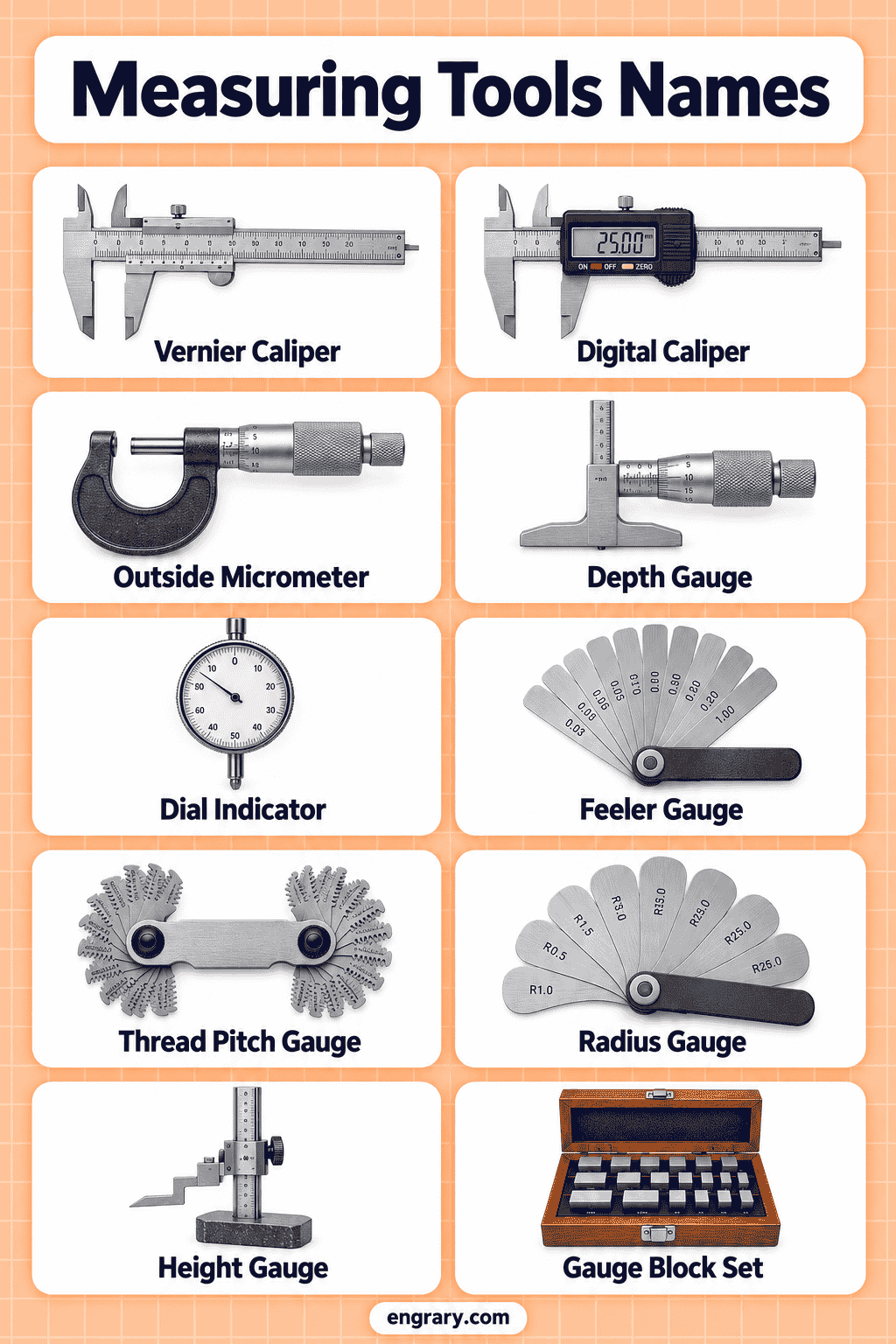
Tools for Measuring Length and Distance
Length-measuring tools range from simple rulers to electronic distance meters. Their size and flexibility determine the type of distance they can measure most easily.
26. Long Tape Measure
A long tape measure uses a longer flexible tape, often stored on a reel, for measuring larger distances.
27. Surveyor’s Tape
A surveyor’s tape is a long measuring tape designed for extended outdoor distance measurements.
28. Telescoping Measuring Rod
A telescoping measuring rod extends in sections to measure height, clearance, or distance over a larger range.
Precision Tools for Measuring Dimensions
Precision tools measure dimensions more accurately than ordinary rulers and tapes. They are especially useful when small differences in diameter, thickness, depth, or height matter.
29. Dial Test Indicator
A dial test indicator has a small pivoting contact point connected to a sensitive dial. It detects very small dimensional or alignment changes.
30. Dial Indicator
A dial indicator has a round dial and spring-loaded contact point. It is used to check small movements or differences from a reference position.
31. Snap Gauge
A snap gauge has a fixed or adjustable opening used to quickly check whether an outside dimension falls within a required size.
32. Telescoping Gauge
A telescoping gauge has spring-loaded measuring ends that expand inside a hole so its internal size can be transferred for measurement.
Tools for Measuring Angles and Squareness
Angle tools help check, measure, or transfer different angular relationships. Some give a numeric reading, while others mainly confirm squareness or copy an existing angle.
33. Bevel Protractor
A bevel protractor has an adjustable blade and graduated scale for measuring angles more precisely than a basic protractor.
34. Angle Finder
An angle finder has movable arms or a digital sensor that shows the angle between two surfaces.
35. Speed Square
A speed square is a triangular layout tool with angle and measurement markings. It is commonly used for checking and laying out angles.
36. Sliding Bevel
A sliding bevel has an adjustable blade that locks at a chosen angle. It is mainly used to copy or transfer an angle.
Level and Alignment Measuring Tools
Level and alignment tools check whether surfaces are horizontal, vertical, straight, or correctly positioned relative to a reference.
37. Laser Level
A laser level projects a visible reference line or point across a surface to help check alignment.
38. Straightedge
A straightedge is a long, rigid reference edge used to check whether a surface or line is straight.
Gauges and Indicators for Checking Dimensions
Gauges usually check a specific physical feature such as gap, thread shape, radius, depth, or pressure rather than providing a general-purpose measurement.
39. Thread Gauge
A thread gauge has shaped leaves or sections used to identify thread pitch or compare thread form.
40. Radius Gauge
A radius gauge contains curved profiles used to check internal or external radii.
41. Wire Gauge
A wire gauge has slots or holes of known sizes used to identify wire diameter.
Tools for Measuring Weight and Mass
Weight and mass measuring tools compare or detect the amount of material in an object. They range from simple mechanical balances to electronic scales.
42. Weighing Scale
A weighing scale measures the weight or mass of an object using a mechanical or electronic system.
43. Digital Scale
A digital scale uses electronic sensors and displays the measured value on a screen.
44. Balance Scale
A balance scale compares an unknown mass with known masses using two sides or pans.
45. Spring Scale
A spring scale measures force or weight by how far an internal spring stretches.
Tools for Measuring Temperature and Pressure
Temperature and pressure instruments measure heat conditions or the force exerted by gases and liquids.
46. Thermometer
A thermometer measures temperature and may use liquid, electronic sensors, or other sensing methods.
47. Digital Thermometer
A digital thermometer uses an electronic sensor and display to show temperature readings.
48. Infrared Thermometer
An infrared thermometer measures surface temperature without direct contact by detecting infrared radiation.
49. Pressure Gauge
A pressure gauge measures the pressure of a gas or liquid inside a system.
50. Tire Pressure Gauge
A tire pressure gauge is a compact instrument designed specifically to check air pressure inside vehicle tires.
51. Manometer
A manometer measures pressure, often by comparing fluid levels or using a pressure-sensitive mechanism.
Electrical Measuring Tools
Electrical measuring instruments quantify values such as voltage, current, and resistance. For this article, the focus is on recognition and naming rather than operating procedures.
52. Multimeter
A multimeter is a handheld electrical instrument that can measure several electrical quantities, such as voltage, resistance, and current.
53. Clamp Meter
A clamp meter has hinged jaws that close around a conductor and is mainly recognized by its clamp-shaped current sensor.
Specialized Measuring Instruments
Some measurements require dedicated instruments that are not part of ordinary workshop or household toolkits.
54. Lux Meter
A lux meter has a light sensor connected to a display and measures the amount of light falling on a surface.
55. Sound Level Meter
A sound level meter has a microphone and electronic display used to measure sound level.
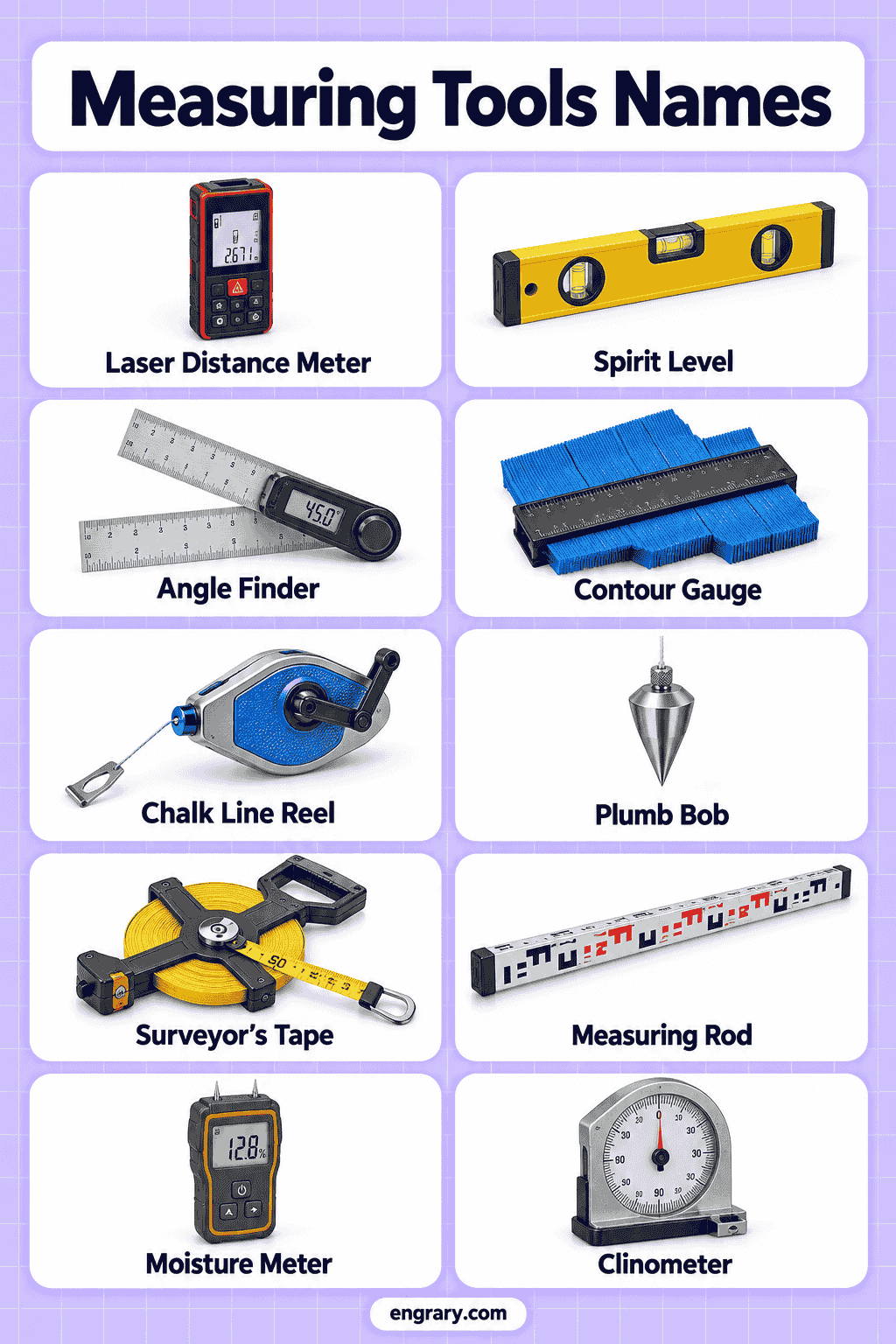
Measuring Tools That Are Easy to Confuse
Many measuring tools appear similar because they measure related quantities. Their scale type, measuring contact, display, and overall design provide the easiest clues for telling them apart.
| Tools | Main Difference |
|---|---|
| Ruler vs Tape Measure | A ruler is rigid and suited to shorter measurements, while a tape measure is flexible and covers longer or curved distances. |
| Steel Rule vs Ruler | A steel rule is a precision-oriented metal measuring rule, while rulers can be made from many materials and are often more general-purpose. |
| Vernier Caliper vs Digital Caliper | A Vernier caliper uses engraved scales, while a digital caliper displays the reading electronically. |
| Caliper vs Micrometer | A caliper measures several types of dimensions, while a micrometer is designed for more focused precision measurement over a smaller range. |
| Outside Micrometer vs Inside Micrometer | An outside micrometer measures external dimensions, while an inside micrometer measures internal spaces. |
| Depth Gauge vs Depth Micrometer | Both measure depth, but a depth micrometer uses a micrometer mechanism for finer measurement. |
| Try Square vs Combination Square | A try square has a fixed right-angle blade, while a combination square has an adjustable head and performs several checking functions. |
| Protractor vs Angle Finder | A protractor uses a graduated degree scale, while an angle finder usually has movable arms or an electronic sensor. |
| Spirit Level vs Digital Level | A spirit level relies on bubble vials, while a digital level provides an electronic angle or level reading. |
| Dial Indicator vs Dial Test Indicator | A dial indicator commonly uses a plunger-style contact, while a dial test indicator usually uses a small pivoting contact point. |
| Multimeter vs Clamp Meter | A multimeter measures several electrical quantities through test leads, while a clamp meter is recognized by jaws designed mainly for current measurement. |
Alternate Names for Measuring Tools
Measuring-tool terminology varies between regions, trades, and manufacturers. Learning alternate terms makes it easier to recognize the same instrument in different contexts.
| Main Name | Alternate Name |
|---|---|
| Tape Measure | Measuring Tape |
| Steel Rule | Steel Ruler |
| Vernier Caliper | Vernier Calliper |
| Spirit Level | Bubble Level |
| Dial Indicator | Dial Gauge |
| Angle Finder | Angle Gauge |
| Laser Distance Meter | Laser Measure |
| Measuring Wheel | Distance Measuring Wheel |
| Pressure Gauge | Pressure Indicator in some contexts |
| Sound Level Meter | Decibel Meter |
Alternate names should not be counted as separate tools when they refer to the same or closely related instrument.
Frequently Asked Questions
Common measuring tools include rulers, tape measures, calipers, micrometers, protractors, squares, spirit levels, weighing scales, thermometers, and pressure gauges.
A caliper can measure outside, inside, and depth dimensions over a relatively broad range. A micrometer usually measures one type of dimension over a smaller range with greater precision.
Protractors, bevel protractors, angle finders, try squares, combination squares, speed squares, and sliding bevels are common tools for angles and squareness.
A spirit level uses bubble vials to show level or plumb alignment, while a digital level uses electronic sensors and displays an angle or level value.
Common precision measuring tools include Vernier calipers, digital calipers, micrometers, height gauges, depth gauges, bore gauges, feeler gauges, dial indicators, and dial test indicators.
You May Also Like



Leave a Comment